
Summary: Deciding when a business needs a website versus staying on social media or marketplaces depends on your growth stage, monthly commission load, and the type of buyers you serve [1, 2, 5]. E-Commerce Survey data from Statistics Indonesia (BPS) cited by the Indonesian Ministry of Trade shows 94.76% of online businesses in Indonesia sell via instant messaging apps like WhatsApp, 29.66% via social media, 17.23% via marketplaces, and only 1.36% own a website, with 84.21% of the Rp1,288.93 trillion transaction total occurring outside marketplaces [2, 3]. That means early-stage micro businesses do not need to build a website right away, but once marketplace repeat-order commissions, admin time spent answering repeated catalog chats, or Business-to-Business (B2B) client verification demands exceed annual web upkeep costs, an owned catalog website pays for itself rapidly [4, 5, 6].
Many Micro, Small, and Medium Enterprise (SME) owners hesitate when pitched website builds costing millions of rupiah while their daily sales on WhatsApp, Instagram, or Shopee are already moving [1, 2]. After learning the framework separating new-buyer acquisition channels from repeat-customer channels in SME Marketing Strategy 2027: Protecting Margins in the AI Search Era, the most basic question to answer honestly is: does your business need social media, a marketplace, or a website, and when does a business need its own website so cash is never wasted?
Table of Contents
- Website, social media, or marketplace: how do they differ for your cash flow and business control?
- Does my business actually need a website? (When you do not need one yet)
- When should my business get a website, and what does it mean for your margins?
- Once it is time for a website, which type of site and domain is most economical for SMEs?
- Frequently asked questions
- Technical notes
- References
Website, social media, or marketplace: how do they differ for your cash flow and business control?
Social media attracts prospective buyers with visual content, marketplaces provide a ready-to-transact storefront with built-in payments and shipping, while a website is your official showroom and catalog that you control 100% as a rule of thumb with zero per-order platform commission [3, 4, 5]. In the short run, social media and marketplaces bring first-time buyers fastest, yet all customer data, algorithmic reach, and fee rules remain under third-party platform control [3, 5].
To view these three channels objectively, look at official Electronic System Trading (PMSE) data in Indonesia. BPS's Statistik E-Commerce 2024 (Publication No. 06300.25015, released 28 November 2025), analyzed in the Ministry of Trade RI's 2025 Indonesian PMSE Performance Report, records that 42.02% of businesses conduct online sales, of which 97.38% are micro enterprises [2, 3].
Among all businesses selling online, the most common channel is neither a marketplace storefront nor a complex website, but instant messaging apps like WhatsApp at 94.76% [2, 3]. Next in line, 29.66% of businesses use social media (Facebook, Instagram, TikTok, and X), 17.23% use marketplaces (such as Shopee and Tokopedia), 2.78% use email, and only 1.36% run an owned website [2, 3].
An even more telling detail for business owners appears in how revenue splits across channels. Out of Indonesia's Rp1,288.93 trillion national e-commerce transaction value in 2024 (up 17.08% over 2023), 84.21% came from non-marketplace media such as instant messaging and social media, whereas transactions inside marketplace platforms accounted for 15.79% or roughly Rp203.58 trillion [2, 3]. Figure 1 summarizes channel adoption rates alongside transaction share and simulated fee deductions [2, 3, 5, 6, 12].
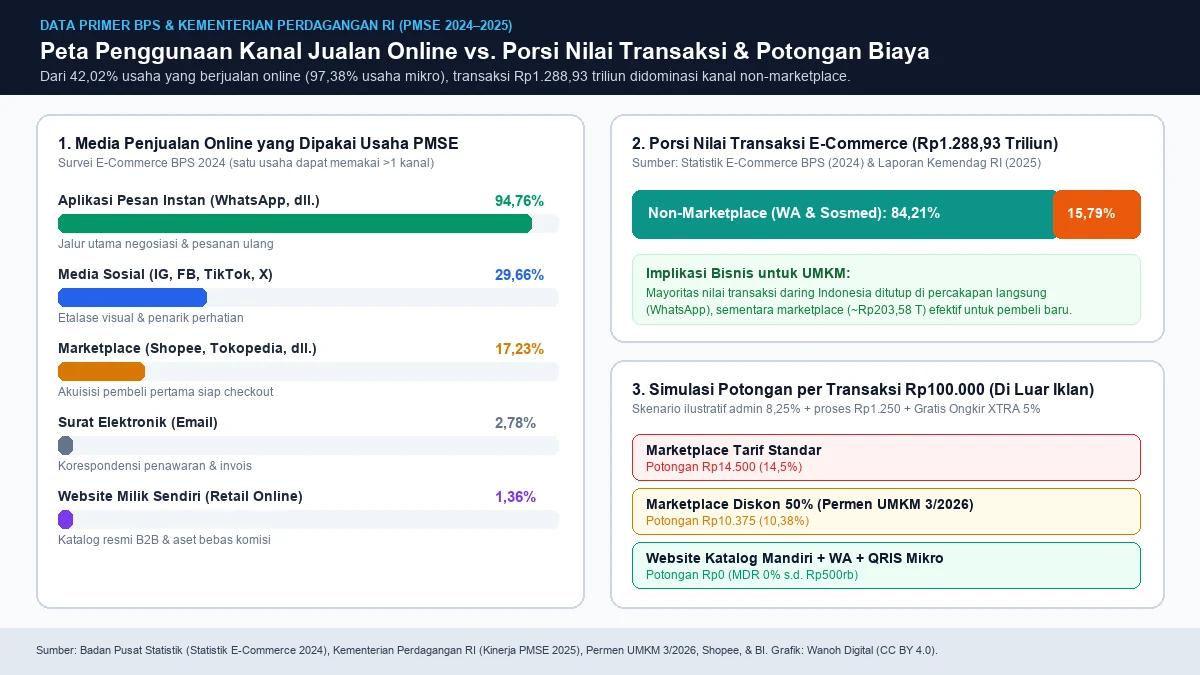
Source: Wanoh Digital (compiled from BPS Statistik E-Commerce 2024, 2025 PMSE Performance Report Ministry of Trade RI, Permen UMKM 3/2026, Shopee Indonesia, and Bank Indonesia). License: CC BY 4.0.
Why does separating the roles of social media, marketplaces, and websites matter even more heading into 2027? Every business owner needs to factor in three legal boundaries and business risks:
- Legal Limits on Social Media Transactions: Minister of Trade Regulation (Permendag) Number 31 of 2023, Article 1 point 17 and Article 21 paragraph (3), states explicitly that Electronic System Trading Operators (PPMSE) with a Social-Commerce business model may only facilitate product offers or promotions and are prohibited from facilitating direct payment transactions inside their electronic systems [4]. In other words, social media is strictly an attention funnel, while payment closing must still go to WhatsApp, a marketplace, or your store's official website (Retail Online under Article 1 point 12 of Permendag 31/2023) [4].
- Market Concentration and Platform Shift Risk on Marketplaces: The Ministry of Trade report notes that over 80% of Indonesia's marketplace Gross Merchandise Value (GMV) is controlled by two major groups: Shopee (46% GMV with 133.1 million monthly visits) plus the Tokopedia (23% GMV with 71.68 million monthly visits) and TikTok Shop (11% GMV) group [3]. Meanwhile, Bukalapak officially stopped physical product marketplace trading starting 7 January 2025 to pivot toward virtual products [3]. The Ministry of Trade warns that large platform dominance, high promo costs, rapid algorithm shifts, and single-platform dependence place SMEs in a weak bargaining position [3].
- The Shift Toward Artificial Intelligence (AI) Search: The e-Conomy South East Asia (SEA) 2026 report by Bain & Company, Google, and Temasek surveying 9,006 AI users across six Southeast Asian countries in July 2026 found that 69% of consumers use AI to compare product choices and 93% trust AI recommendations, then follow up by verifying details via search engines, store reviews, and social media [7]. Without structured catalog details and an official profile, search engines and AI assistants struggle to cite your business [7, 13, 14].
The table below places the operational traits of all three digital channels side by side so you can allocate team effort wisely [2, 3, 4, 5, 6, 12]:
| Business Comparison Aspect | Social Media (Instagram, TikTok, Facebook) | Marketplaces (Shopee, Tokopedia, Lazada, Blibli) | Owned Catalog Website (Linked to WhatsApp & QRIS) |
|---|---|---|---|
| Legal Status under Permendag 31/2023 | Social Media / Social-Commerce (Art. 1 pts 17-18; barred from direct payment processing per Art. 21(3)) [4] | Marketplace (Art. 1 pt 13; facilitates part or all of the transaction flow in-app) [4] | Online Retail (Art. 1 pt 12; commercial website built, managed, and owned directly by the merchant) [4] |
| PMSE Business Adoption Rate (BPS) | Used by 29.66% of PMSE businesses (paired with WhatsApp instant messaging at 94.76%) [2, 3] | Used by 17.23% of PMSE businesses (contributing 15.79% of national transaction value or Rp203.58 trillion) [2, 3] | Used by 1.36% of PMSE businesses (serves as a credibility differentiator for growing firms and B2B) [2, 3] |
| Primary Role for SMEs | Building brand awareness through short video and sparking initial purchase interest [3, 15] | Bringing in new retail buyers looking for escrow protection and shipping subsidies [3, 5] | Centralized official catalog, B2B client verification profile, and commission-free repeat ordering [4, 14] |
| Fee Deduction on a Rp100,000 Sale | Rp0 from social platform (though requires content production time or ad spend) [4] | Roughly Rp14,500 (14.5%) in an illustrative scenario before ads, or Rp10,375 (10.38%) after the 50% SAPA UMKM admin fee discount [5, 6] | Rp0 platform commission; 0% Merchant Discount Rate (MDR) on QRIS for Micro Enterprises up to Rp500,000 [12] |
| Customer Data Ownership | Followers can be lost if an account is restricted or organic reach drops [3] | Buyer phone numbers are masked by the platform; your products appear directly next to competitors [3] | 100% owned by your business as a rule of thumb; order history stays directly in your store's WhatsApp Business |
Does my business actually need a website? (When you do not need one yet)
The short, honest answer is no: not every business needs its own website right now. As a rule of thumb from mentoring SMEs and nonprofits at Wanoh Digital since 2016, if your business is just starting out with fewer than 20 product variants, mostly serves local retail buyers around your shop, and has not yet organized its WhatsApp response flow and Google Maps pin, you do not need a paid website yet [1, 13].
Administrative data from the Ministry of SMEs Single Data Information System (SIDT) as of 31 December 2025 shows that out of 30,209,069 verified non-agricultural SMEs in Indonesia, 30,119,928 units or 99.70% are micro enterprises [1]. For a micro business still testing product-market fit, spending Rp1,500,000 to Rp5,000,000 in an illustrative scenario on a website in month one eats into working capital better spent improving product quality and packaging.
As a rule of thumb, you should hold off on building a website when your business is still in any of these three conditions (matching the Local Foundation Phase, Score 4 to 6 points on our pillar article diagnostic matrix):
- Your entire product or service lineup is under 20 simple variants: If you sell 5 to 15 daily meals, homemade cakes, or fixed-price local services, the free Catalog feature inside WhatsApp Business handles photos, prices, and descriptions smoothly without annual server rental.
- Your Google Business Profile pin and customer reviews are not yet optimized: Official Google documentation confirms local search ranking depends on three core factors: relevance, distance, and prominence [13]. Before thinking about a website, verify your local map listing using Register Google Business Profile in 10 Minutes: Pass Maps Verification and collect genuine customer reviews safely under How to Ask for Google Reviews Without Breaking the Rules: SME Guide [13].
- Nobody is assigned 15 to 30 minutes a month to maintain the website: A website is not a printed flyer you can leave untouched once finished. Websites left for months without system updates risk automated spam page injections that damage your store name on Google, as examined in Website Looks Normal but Hacked? How to Check & Secure It.

Source: rawpixel.com via Unsplash / Wikimedia Commons. License: CC0 1.0.
When should my business get a website, and what does it mean for your margins?
Your business needs its own website once monthly commission fees, wasted admin hours, or missed contract opportunities from lacking a site cost more than building and maintaining one annually. As a rule of thumb, a website shifts from an expense to an investment that pays for itself when your business shows at least two of the following five measurable signs:
1. Marketplace repeat-order commissions exceed the annual cost of a website
On Shopee Indonesia as of May 2026, Non-Star and Star sellers pay category Administration Fees of 2.5% to 10%, plus a Rp1,250 Order Processing Fee per completed order, plus optional Free Shipping XTRA fees of 1% to 9.5% [5]. In an illustrative scenario for a Rp100,000 product (8.25% category admin fee, Rp1,250 processing fee, and 5% Free Shipping XTRA), direct platform deductions total Rp14,500 or 14.5% before advertising spend [5].
Under Minister of SMEs Regulation Number 3 of 2026 Article 15 paragraphs (1) and (2) (whose application window opened via the SAPA UMKM app on 25 October 2026), Micro and Small Enterprises selling solely Domestic Products qualify for at least a 50% discount on base Service Fees [6]. However, as detailed in SME Marketplace Admin Fee Rules: 50% Discount & How to Claim, that 50% discount only cuts the base admin fee (from 8.25% down to 4.125% in the illustrative scenario), so combined with the Rp1,250 processing fee and 5% Free Shipping XTRA, total deductions still sit around Rp10,375 or 10.38% per order [5, 6].
Let us run an illustrative calculation: if your store brings in Rp8,000,000 per month from returning customers (repeat orders) who already know your brand, letting them keep ordering via marketplaces deducts roughly Rp830,400 to Rp1,160,000 every month (or Rp9,964,800 to Rp13,920,000 per year) [5, 6].
If you shift just half of those repeat orders in this illustrative simulation to an owned catalog website paid via WhatsApp Business and QRIS (0% MDR for Micro Enterprises up to Rp500,000 and Small/Medium Enterprises up to Rp100,000 effective 1 October 2026 [12]), you immediately save Rp415,200 to Rp580,000 per month. That covers an illustrative Rp1,500,000 to Rp2,000,000 annual website cost within 3 to 4 months.
2. Admins spend over 1 to 3 hours a day answering repeated catalog and spec questions
Once your business carries more than 20 to 75 product variants, or sells custom services such as uniform tailoring, event catering, specialty auto repair, clinics, wedding planning, or technical repairs, social media feeds and WhatsApp chats quickly turn messy. As a rule of thumb, when admins get bogged down sending the same price-list Portable Document Format (PDF) files, size charts, or warranty terms every day, one clean catalog website cuts that Q&A time in half and pairs well with the daily efficiency workflow in AI for SMEs: 5 Store Tasks Done in 15 Minutes.
3. You start targeting corporate clients, government offices, schools (B2B), or institutional donors
Unlike individual retail buyers accustomed to shopping via live streaming (where the e-Conomy SEA 2025 report noted Indonesia's video commerce grew 90% year-on-year to 2.6 billion transactions by 800 thousand sellers [15]), procurement teams at companies, schools, and government agencies must run vendor administrative verification. They inspect your official website address, business registration numbers, project portfolio, and matching official email identity. The same holds true for foundation, mosque, or nonprofit leaders applying How to Create an Organization Cash Report Donors Trust: having an official-domain web page measurably raises institutional donor confidence.
4. Buyers search for your products or services by specific problem on Google and AI assistants
The Pew Research Center study of 68,879 Google searches from 900 US adult respondents in March 2025 (and preprint paper arXiv:2608.04831) showed that AI Overviews cut clicks to websites from 15% to 8% [8, 9]. However, that click drop mostly hits generic blog posts filled with basic definitions [8, 9]. By contrast, when the 69% of Southeast Asian AI users ask an AI assistant to compare specific providers ("office jacket tailoring min 24 pcs in Bandung" or "warranty-backed commercial espresso machine repair"), AI systems and search engines look for official web pages holding spec tables, price ranges, physical addresses, and verified reviews [7, 13, 14].
5. You want a customer list asset insulated from algorithm shifts and platform rule changes
Owning a custom-domain website ensures you hold one permanent reference address printed on product packaging, Instagram profiles, and TikTok bios. Even when short-video algorithms dip or marketplace service fees rise again, customers always know where to check your latest catalog and contact your store's official WhatsApp number.
Use the interactive calculator below to test your own repeat-order revenue, commission fees, and admin hours:
Website Break-Even Calculator & Business Readiness Diagnostics
Enter your store's operational numbers to test whether WhatsApp, social media, and marketplaces are enough right now, or if an owned catalog website already pays for itself.
As a quick discussion guide with your business partners or store team, check where your business stands this week using the diagnostic checklist below:
Template 1: 8-Point Diagnostic Checklist for Owned Website Readiness
Check off items you have verified below, or click Copy Checklist to share it with your team or web vendor.
Once it is time for a website, which type of site and domain is most economical for SMEs?
SMEs building their first website do not need to jump straight into a massive online store with an automated shopping cart, real-time courier rate calculation, and layered payment gateways whose build and maintenance costs run into tens of millions of rupiah. As a rule of thumb, the most economical and highest-converting option for 95% of SMEs is a lightweight business profile and catalog website where every order button opens a pre-filled WhatsApp Business chat and settles via QRIS [2, 12].
Why does a WhatsApp-linked catalog website outperform a full checkout store at the early stage? Recall the BPS E-Commerce Survey finding that 94.76% of Indonesian online businesses transact via instant messaging apps and 84.21% of national transaction value occurs outside marketplaces [2, 3]. Indonesian buyers like seeing price lists, detailed photos, and official specs on a tidy web page, then tapping a single WhatsApp button to confirm stock or negotiate delivery [2, 3].
Beyond keeping website build fees far lower, you also avoid payment gateway deductions per transaction because payments settle through your store's official QRIS at the 0% MDR rate for Micro Enterprises up to Rp500,000 as covered in Indonesia's Digital Payment Transformation: From QRIS to SME AI [12].
The next key step is picking a credible official domain name. According to the two-decade press release from the Indonesian Internet Domain Name Registry (PANDI) on 1 September 2026, registered .id domains as of 31 July 2026 surpassed 1,523,504 (driven by .my.id, .id, and .web.id) [10]. Official PANDI documentation offers 13 Second Level Domain (SLD) choices matched to Indonesian entity types, so your business does not have to wait for a Limited Liability Company (PT) or Limited Partnership (CV) deed to own an official domain [11]:
.biz.id(Dedicated to SMEs): Provided officially by PANDI specifically for Indonesian SMEs and startups with practical registration rules requiring no PT or CV legal deed, plus very economical annual fees [11]..co.id(Dedicated to Incorporated Companies): Reserved for legal entities holding official incorporation papers (such as PT, CV, or Cooperative) and carries the highest trust during corporate or government procurement [11]..or.idand.id(Organizations and General Brands): The.or.idextension is tailored for organizations, foundations, or formal associations, while the primary.idextension works flexibly for business and professional brands in Indonesia [10, 11].
To understand how Google views small business digital presence and when a local listing suffices versus building search-optimized (SEO) web pages, watch this official guide from Google Search Central [16]:
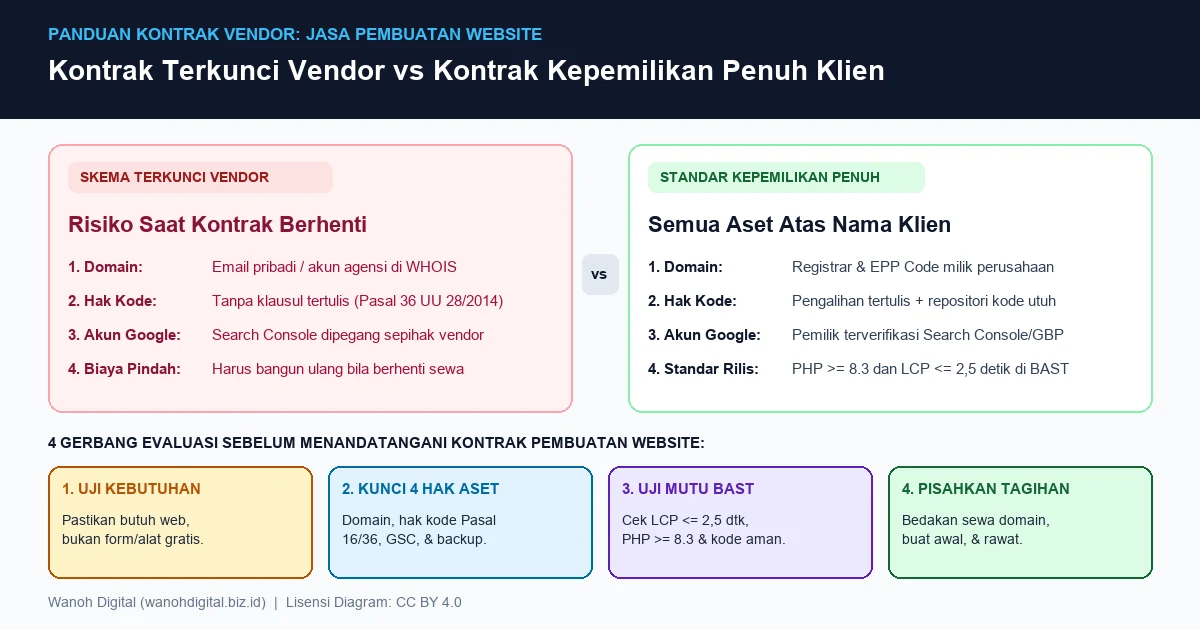
Before signing a contract or paying a deposit to any website builder (freelancer or agency), ask the six asset-protection questions in the checklist below so your business is never locked out later:
Template 2: 6 Mandatory Questions Before Paying a Website Vendor
If you are still unsure whether this month is the right time to launch a website or if tidying up Google Maps and WhatsApp chat workflows yields a better return first, talk it through openly with no obligation via Free Wanoh Digital Consultation. We will examine your operational figures objectively; if your business does not need a website yet, we will tell you honestly and help your team organize workflows through Wanoh Digital Educational Guides. Conversely, if your business is ready for an official-domain catalog website (.biz.id, .co.id, or .or.id) that stays fast, secure, and linked straight to WhatsApp, Wanoh Digital website development supports you from domain registration through admin training. You can also browse examples of business websites and apps we have built or inspect an existing site through our 24-Hour Free Website Check.
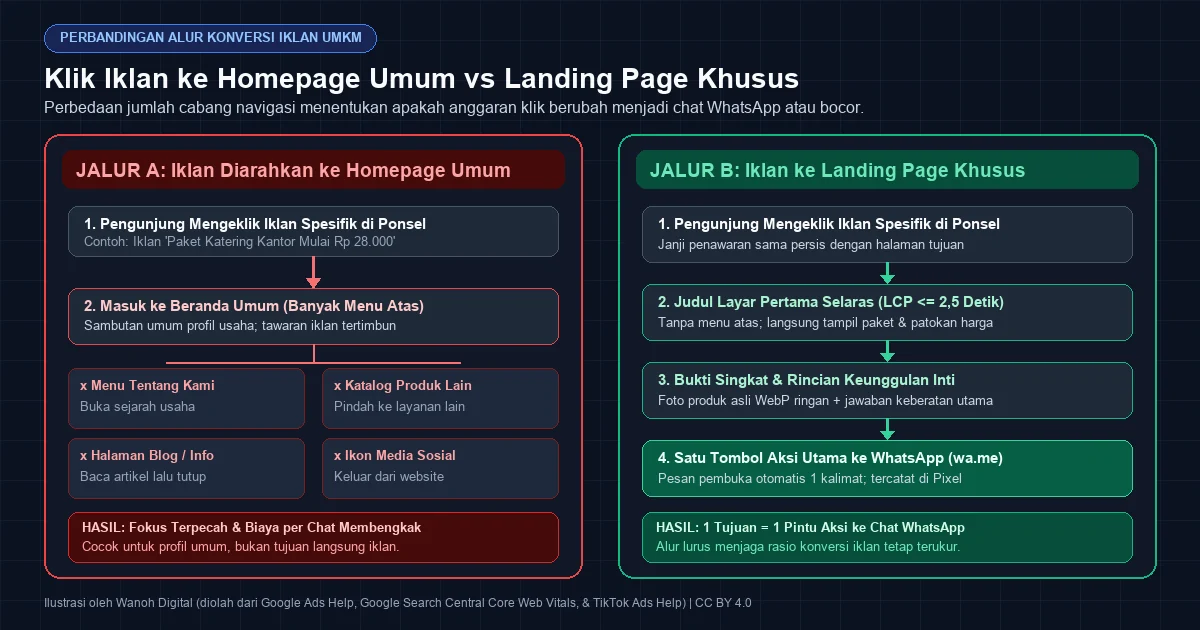
If you plan to send paid ad traffic to a web page, first read landing page vs website differences for SME ads and our first-3-second audit so ad clicks convert into WhatsApp chats.
Frequently asked questions
Does a small business already selling well on Instagram and Shopee still need its own website?
If your product lineup is still under 20 items and commission fees are not weighing on cash flow as a rule of thumb, staying on Instagram and Shopee is enough [1, 5]. However, once repeat orders grow, letting existing customers keep ordering via marketplaces deducts roughly 10.38% to 14.5% per transaction in an illustrative scenario, while Social-Commerce platforms are barred from processing direct payments under Article 21 paragraph (3) of Permendag Number 31 of 2023 [4, 5, 6].
Why does 84.21% of e-commerce transaction value in Indonesia happen outside marketplaces?
The 2024 BPS E-Commerce Survey cited by the Ministry of Trade shows that out of Rp1,288.93 trillion in total transactions, 84.21% came from non-marketplace channels because 94.76% of businesses interact directly via instant messaging apps like WhatsApp [2, 3]. Indonesian consumers like confirming stock, customization, or wholesale prices through live chat, making a catalog website linked to WhatsApp a natural fit for local buying habits [2, 3].
Does building a business website in Indonesia require having a PT or CV legal entity first?
You do not need a PT or CV legal entity [11]. Based on PANDI's classification of 13 official Second Level Domain extensions, corporate legal documents are only required for .co.id [11]. Individual SME owners or early-stage businesses without a PT/CV entity can immediately register the official .biz.id extension (specifically designated by PANDI for SMEs) or .id using the owner's personal identification [10, 11].
Which is better for an SME's first website: an automated checkout store or a WhatsApp catalog website?
As a rule of thumb for an SME's first website with fewer than 75 product variants or custom services, a catalog website linked directly to WhatsApp Business and QRIS payment is much more efficient than an automated shopping-cart checkout system. Aside from lower build and maintenance costs, admins avoid complex dual-inventory syncing and the store benefits from the 0% QRIS MDR rate for Micro Enterprises up to Rp500,000 per transaction [2, 12].
Technical notes
This section is intended for Information Technology (IT) staff or web developers building an SME's first catalog website so the site, social accounts, and marketplace storefronts do not appear disconnected to search engines or Generative Engine Optimization (GEO) systems. Note that embedding the structured data below is a technical discoverability prerequisite helping search engines link your official channels, not an automatic guarantee of top-page rankings [13, 14].
Per official Google Search Central documentation on Local Business (LocalBusiness) structured data, when a business operates an official website alongside Instagram, TikTok, Shopee/Tokopedia stores, and a Google Maps pin, all official channel Uniform Resource Locators (URLs) should be unified using the "sameAs" array property inside JavaScript Object Notation for Linked Data (JSON-LD) markup on the website homepage [14]. With this structure, Google crawlers and AI assistants can verify that your .biz.id or .co.id website, social media accounts, and marketplace stores belong to the same legitimate business entity [7, 14]:
{
  "@context": "https://schema.org",
  "@type": "LocalBusiness",
  "name": "Wanoh Digital (Sample Local Business Entity)",
  "url": "https://wanohdigital.biz.id/en",
  "telephone": "+62-851-8323-1708",
  "address": {
    "@type": "PostalAddress",
    "addressLocality": "Bandung",
    "addressRegion": "West Java",
    "addressCountry": "ID"
  },
  "sameAs": [
    "https://www.google.com/maps?cid=0000000000000000000",
    "https://www.instagram.com/wanohdigital",
    "https://www.linkedin.com/company/wanohdigital/",
    "https://wanohdigital.biz.id/en/blog"
  ]
}
Testing note: The JSON-LD LocalBusiness snippet above was validated against the Google Search Central Structured Data technical specification as of 5 November 2026 [14].
Update and correction policy: All BPS e-commerce statistics, Ministry of Trade RI PMSE performance reports, Permendag Number 31 of 2023 regulations, Permen UMKM Number 3 of 2026 rules, PANDI domain statistics, and Bank Indonesia QRIS MDR terms in this article were verified as of 5 November 2026 [1, 2, 3, 4, 6, 10, 12]. If platform policies or digital trade regulations change in the future, this article will be updated with a dated revision note.
References
Verified Sources & References (16 Sources)Show References
- Indonesian Chamber of Commerce and Industry (Kadin Indonesia, citing Ministry of SMEs SIDT data). "Data dan Statistik UMKM Indonesia." Kadin Indonesia, 15 January 2026. https://kadin.id/data-dan-statistik/umkm-indonesia/ (accessed 5 November 2026) (in Indonesian).
- Statistics Indonesia (BPS RI). "Statistik E-Commerce 2024 (Publication No. 06300.25015)." Badan Pusat Statistik, 28 November 2025. https://www.bps.go.id/id/publication/2025/11/28/647323224ecc656c2933571b/statistik-e-commerce-2024.html (accessed 5 November 2026) (in Indonesian).
- Domestic Trade Policy Center, Trade Policy Agency, Ministry of Trade of the Republic of Indonesia. "Kinerja Perdagangan Melalui Sistem Elektronik (PMSE) Indonesia Tahun 2025." Ministry of Trade RI, 20 December 2025. https://bkperdag.kemendag.go.id/unduhan-file/a11ba920-123c-4a4f-856b-cdbb1f0f64c4 (accessed 5 November 2026) (in Indonesian).
- Ministry of Trade of the Republic of Indonesia. "Peraturan Menteri Perdagangan Nomor 31 Tahun 2023 tentang Perizinan Berusaha, Periklanan, Pembinaan, dan Pengawasan Pelaku Usaha dalam Perdagangan Melalui Sistem Elektronik." JDIH Audit Board (BPK) RI, 26 September 2023. https://peraturan.bpk.go.id/Details/265202/permendag-no-31-tahun-2023 (accessed 5 November 2026) (in Indonesian).
- Shopee Indonesia. "Biaya Administrasi Penjual Non-Star, Biaya Proses Pesanan, dan Program Gratis Ongkir XTRA." Shopee Seller Education Hub, 1 May 2026. https://seller.shopee.co.id/edu/article/7187 (accessed 5 November 2026) (in Indonesian).
- Ministry of Micro, Small, and Medium Enterprises of the Republic of Indonesia. "Peraturan Menteri Usaha Mikro, Kecil, dan Menengah Nomor 3 Tahun 2026 tentang Pelindungan dan Peningkatan Daya Saing Usaha Mikro dan Usaha Kecil dalam Perdagangan Melalui Sistem Elektronik." JDIH Ministry of SMEs RI, 17 June 2026. https://jdih.umkm.go.id/ (accessed 5 November 2026) (in Indonesian).
- Hoppe, Florian, Willy Chang, Aadarsh Baijal, Fock Wai Hoong, and Nitin Gajria. "e-Conomy SEA 2026: Building the intelligent economy." Bain & Company, Google, and Temasek, 21 October 2026. https://www.bain.com/insights/e-conomy-sea-2026/ (accessed 5 November 2026).
- Chapekis, Athena, and Anna Lieb. "Google users are less likely to click on links when an AI summary appears in the results." Pew Research Center, 22 July 2025. https://www.pewresearch.org/short-reads/2025/07/22/google-users-are-less-likely-to-click-on-links-when-an-ai-summary-appears-in-the-results/ (accessed 5 November 2026).
- Chapekis, Athena, et al. "Investigating Click Behaviors On Google Search Result Pages That Produce an AI Overview." arXiv preprint arXiv:2608.04831, 8 August 2026. https://arxiv.org/abs/2608.04831 (accessed 5 November 2026).
- Indonesian Internet Domain Name Registry (PANDI). "Dua Dekade PANDI: Dari 1,52 Juta Domain .id Menuju Panggung Global ICANN87 Bali." Official PANDI Press Release, 1 September 2026. https://pandi.id/en/siaran-pers/dua-dekade-pandi-dari-152-juta-domain-id-menuju-panggung-global-icann87-bali (accessed 5 November 2026) (in Indonesian).
- Indonesian Internet Domain Name Registry (PANDI). "Apa itu domain .id dan 13 Pilihan Second Level Domain (SLD) Indonesia (.biz.id, .co.id, .or.id)." Official PANDI .id Domain Portal, 15 January 2026. https://domain.id/id (accessed 5 November 2026) (in Indonesian).
- Antara News (quoting Bank Indonesia Acting Governor Destry Damayanti and Payment System Policy Department Head Ryan Rizaldy). "BI perluas kebijakan MDR QRIS 0 persen untuk pelaku UMKM." ANTARA News Agency, 16 September 2026. https://jogja.antaranews.com/berita/848451/bi-perluas-kebijakan-mdr-qris-0-persen-untuk-pelaku-umkm (accessed 5 November 2026) (in Indonesian).
- Google. "Tips to improve your local ranking on Google." Google Business Profile Help, 10 January 2026. https://support.google.com/business/answer/7091?hl=id (accessed 5 November 2026) (in Indonesian).
- Google. "Local Business (LocalBusiness) structured data." Google Search Central Documentation, 12 May 2026. https://developers.google.com/search/docs/appearance/structured-data/local-business?hl=id (accessed 5 November 2026) (in Indonesian).
- Google Indonesia, Temasek, and Bain & Company. "e-Conomy SEA 2025: Ekonomi digital Indonesia mendekati GMV $100 miliar tahun ini." Google Indonesia Blog, 6 November 2025. https://blog.google/intl/id-id/company-news/outreach-initiatives/e-conomy-sea-2025-ekonomi-digital-indonesia-mendekati-gmv-us100-miliar/ (accessed 5 November 2026) (in Indonesian).
- Google Search Central. "SEO for small businesses." Official Google Search Central YouTube Channel, 18 April 2024. https://www.youtube.com/watch?v=BKDymFYpvL8 (accessed 5 November 2026).