Summary Monthly website maintenance costs for Micro, Small, and Medium Enterprises (MSMEs) in Indonesia as a rule of thumb typically fall between Rp 200.000 and Rp 1.500.000 per month, while managed plans like those at Wanoh Digital start at Rp 400.000 per month for profile websites or Rp 1.000.000 per month for custom applications [12]. Sorting out access and running an initial audit is urgent ahead of the end of security support for Hypertext Preprocessor (PHP) version 8.2 on 31 December 2026 and the spread of instant web apps built with Artificial Intelligence (AI) [1, 4]. Domain ownership handover and data security standards follow the Internet Corporation for Assigned Names and Numbers (ICANN) Transfer Policy, Supabase Row-Level Security (RLS) documentation, official WordPress backup guidance, and Law No. 27 of 2022 on Personal Data Protection (PDP) [6, 8]. This guide is for business owners looking to move a site away from an unresponsive vendor or audit a vibe coding app before customers use it. The core boundary stays clear: monthly subscription fees only cover routine care on a healthy system, whereas unlocking access, patching legacy holes, and domain or server rentals are billed separately [12].
Many business owners think paying once to build a website is enough and skip setting aside a regular care budget, assuming a page that still loads on a phone is problem-free. Yet Patchstack's annual State of WordPress Security report logged 7,966 new vulnerabilities in the WordPress ecosystem across 2024 data, with 96% coming from third-party plugins and 33% having no official patch when publicly disclosed [2]. Worse still, Patchstack penetration tests against popular web hosting providers in its 2026 report showed default network and server-level hosting protections blocked only 26% of web application exploitation attacks [3].
A second misconception appears among business owners who assemble a booking site or internal dashboard using AI coding tools (vibe coding) and assume it needs no technical upkeep afterward. The Veracode Fall 2026 security study across 18 Large Language Model (LLM) systems found an average security pass rate of just 62%, meaning around 38% of AI coding tasks still produce detectable security flaws [4]. October 2026 research by UpGuard also uncovered 16,326 Supabase databases on standalone websites exposed openly to the public because tables created programmatically by AI agents did not enable row-level access protection by default [5].
Table of Contents
- What is the monthly website maintenance range in Indonesia for normal sites vs takeover sites?
- Why does taking over a website from an old vendor often require initial remediation fees?
- Why do AI-built websites and apps still require maintenance and security audits?
- What are the stages and timeline for a 7 to 14 business-day website takeover with zero downtime?
- How do you estimate first-year maintenance costs and check your site's readiness?
- When is a legacy site or AI app worth maintaining, and when is rebuilding cheaper?
- Short technical notes for your website manager
- Frequently asked questions (FAQ)
- References
What is the monthly website maintenance range in Indonesia for normal sites vs takeover sites?
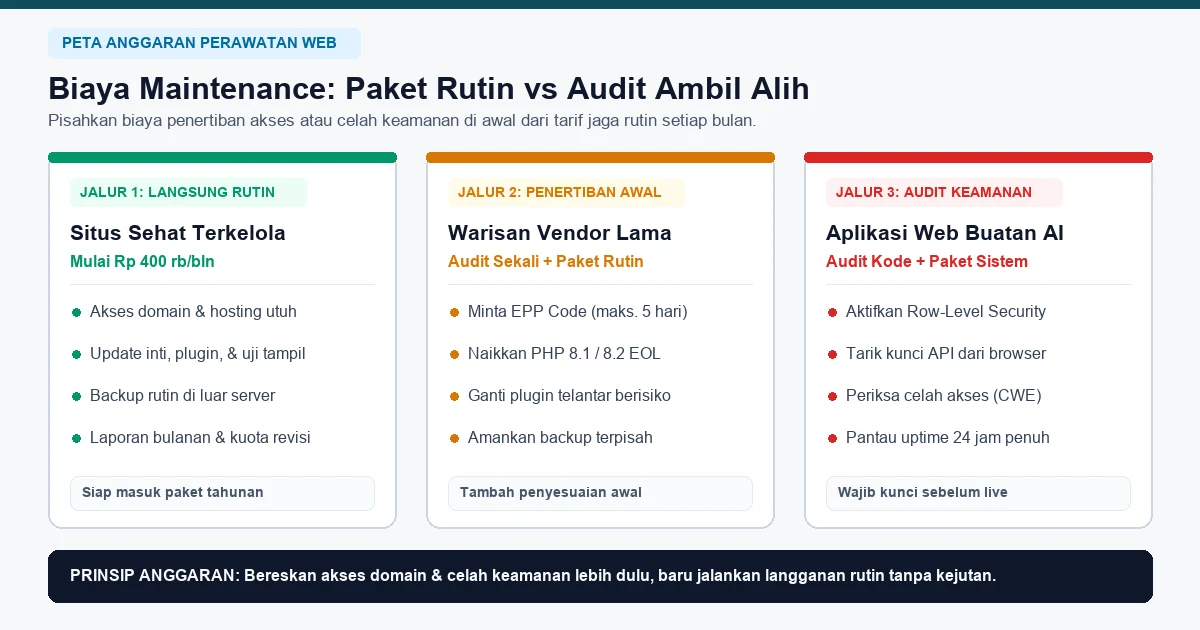
Business website care rates in Indonesia as a rule of thumb break down into Rp 200.000 to Rp 500.000 per month for basic standard Content Management System (CMS) upkeep, Rp 500.000 to Rp 1.500.000 per month for business plans with routine edit quotas, and Rp 500.000 to over Rp 3.000.000 per month for custom systems or dedicated servers [12]. At Wanoh Digital as a transparent benchmark, Temani Website is priced at Rp 400.000 per month or Rp 4.000.000 per year, while Temani Sistem for custom web apps starts at Rp 1.000.000 per month [12].
The main difference appears when an incoming site is not fresh and clean, but a takeover from an old vendor or a prototype AI app. On a healthy site, the provider only handles routine updates, backups, and uptime checks [11, 12]. On a takeover site, the new provider has to clear accumulated technical debt first so the monthly fee does not turn into weekly emergency firefighting [1, 5].
To map which items are included in a monthly subscription and which must be budgeted separately during a takeover, inspect the scope breakdown below:
| Work Component | Cost Range / Condition | Technical & Policy Basis | Monthly Plan Status |
|---|---|---|---|
| Routine CMS core, plugin updates, and display checks | Included in monthly rate (from Rp 400.000/month on Temani Website) [12] | Closes the 96% third-party plugin vulnerability vector before exploitation [2, 3] | Included on healthy sites |
| Off-server file and database backups | Included in monthly rate with scheduled retention [12] | WordPress guidance requires files and databases stored off the production server [11] | Included within reasonable storage quotas |
| Content edit and minor layout adjustment quota | 1 hour/month on Temani Website or 3 hours/month on Temani Sistem [12] | Minor edits beyond quota are billed hourly (Rp 175.000/hour at Wanoh Digital) [12] | Included up to monthly hour quota |
Initial old-vendor takeover audit (EPP Code, outdated PHP) | Billed one-time upfront (hourly or quoted) [12] | AuthInfo delivery within 5 calendar days and migration off PHP 8.1 or 8.2 [1, 8] | Outside monthly plan (initial cleanup fee) |
| AI app security audit (RLS lock and API keys) | Billed one-time upfront before maintenance contract starts [12] | Enables RLS on all exposed tables and supports Article 35 PDP Law compliance [6, 10] | Outside monthly plan (initial hardening audit) |
| Active gambling-spam or backdoor hack cleanup | Separate written quote after free initial check [12] | Requires server isolation, backdoor removal, and Google index recovery | Outside monthly plan (incident recovery) |
To make the cash-flow impact clearer, imagine an illustrative scenario over 12 months for a regional B2B service firm with a WordPress profile site generating 40 leads per month from Google Search. In this illustrative scenario, a 20% closing rate yields 8 transactions per month with a remaining contribution margin before fixed operating costs and tax of Rp 750.000 per deal, averaging Rp 6.000.000 per month (Rp 200.000 per calendar day).
- Path A (Upfront cleanup and predictable annual care): The owner pays for an initial old-vendor cleanup of
4hours atRp 175.000per hour (Rp 700.000) and subscribes to annual Temani Website atRp 4.000.000[12]. Total security and stability spend for the year in this illustrative scenario isRp 4.700.000with zero lost active days. - Path B (Left unmaintained until breaking in month 8): The site crashes when outdated plugins clash with a server update for
10calendar days (equivalent in this illustrative scenario to10days timesRp 200.000orRp 2.000.000in deferred contribution margin), plus a suddenRp 2.500.000emergency repair, followed by monthly care for the remaining4months (Rp 1.600.000) [12]. Total annual cost in this illustrative scenario swells toRp 6.100.000, orRp 1.400.000higher than maintaining it from the start.
If you do not yet have a full picture comparing initial build prices against ongoing annual obligations, also check infrastructure rental items in our website creation cost guide from year one to hidden expenses.
Why does taking over a website from an old vendor often require initial remediation fees?
Taking over website management from a previous developer almost always entails a one-time remediation cost because three sources of technical debt build up quietly behind the visible pages: domain access locked in the vendor's account, server PHP versions that have lost or will soon lose security updates, and abandoned plugins that no longer receive patches [1, 2]. The longer a site sits without clean handover documentation, the more tracing time a new engineer needs to map the file structure before safely pressing any update button.

Source: Photo by Thomas Kvistholt via Wikimedia Commons / Unsplash, https://commons.wikimedia.org/wiki/File:Beautiful_technology_%28Unsplash%29.jpg. License: CC0 1.0.
Here are the three most common bottlenecks uncovered during a takeover audit from a previous manager:
- Domain Ownership &
AuthInfo/EPPAuthorization Codes Still Held Back: Under SectionI.A.5.2of the ICANN Transfer Policy, a registrar must provide the secretAuthInfocode and clear theClientTransferProhibitedlock within5calendar days after a legitimate request by the Registered Name Holder if no self-service panel is available [8]. SectionI.A.5.4of the same policy prohibits a registrar from withholding lock removal orAuthInfodelivery solely due to payment disputes between the owner and an intermediary [8]. For Indonesian domains such as.co.idor.id, Pengelola Nama Domain Internet Indonesia (PANDI) states that the Extensible Provisioning Protocol (EPP) Code is a confidential security key that only the rightful owner may request to move a domain without risk of unilateral hijacking [9]. Trouble arises when the old vendor originally registered the domain under their personal email, forcing ownership verification through business documents first. - Expired PHP Versions or Engines Reaching End of Security Support: According to The PHP Group's official release lifecycle table, each PHP branch receives
2years of active bug fixes plus2additional years of critical security patches [1]. Official security support for PHP8.1permanently ended on31 December 2025(End of Life (EOL) status), while PHP8.2security support closes on31 December 2026[1]. Bumping an old site directly to PHP8.3or8.4often triggers fatal errors in legacy theme code, so an engineer must test the upgrade in a staging environment first. - Abandoned Plugins and Fake Backups on the Same Server: Patchstack data shows
43%of WordPress vulnerabilities require no login (authentication) to exploit, and one-third of disclosed flaws originate in plugins no longer maintained by their original authors [2]. Official WordPress hardening guides therefore stress using plugins only from trusted repositories and updating all server software regularly [15]. In addition, many old vendors rely on default backups stored on the exact same hosting disk, whereas official WordPress admin guidelines require complete file and database copies to be stored outside the production server and tested for recovery [11].
If an initial check reveals the inherited site already contains foreign links or illegal promotional pages, perform emergency recovery following our steps to isolate and clean a website hit by gambling spam hacks or early detection checks in how to inspect an SME website that looks normal despite being hacked.
Why do AI-built websites and apps still require maintenance and security audits?
Websites or web apps built with AI coding agents dramatically speed up initial UI prototyping, yet still require a budget for security audits and ongoing maintenance because AI language models optimize for making an app run quickly rather than sealing server access boundaries tightly [4, 5]. Once an AI prototype goes straight into production for customer signups, order tracking, or form storage, small default flaws in generated code can turn initial savings into business data-leak liabilities.
Three technical risks appear most often when auditing AI-built web apps prior to routine care:
- Database Tables Exposed Publicly Without
RLSRules: UpGuard security research published in October 2026 found16,326Supabase databases on standalone websites exposing tables publicly, including personal identity records, phone numbers, and user messages [5]. The root cause is specific: tables created manually in the Supabase dashboard turn on Row-Level Security (RLS) automatically, whereas tables created programmatically via the Application Programming Interface (API) by AI coding tools, as documented in Common Vulnerabilities and Exposures (CVE)CVE-2025-48757, leave RLS disabled by default [5, 13]. Notably, the official National Vulnerability Database (NVD) entry forCVE-2025-48757records that the AI developer platform disclaimed responsibility because each app owner accepts responsibility for securing their own data, aligning with Supabase's03 November 2026documentation requiring RLS on every exposed table [6, 13]. - Code Vulnerabilities and Exposed Secret Keys in the Browser: In the 2025 edition of the Open Worldwide Application Security Project (OWASP) Top 10, Broken Access Control still ranks #1 among web app risks leading to unauthorized exposure of sensitive information [14]. Matching this, Veracode's GenAI Code Security Fall 2026 report tested
18LLM models across JavaScript, Python, Java, and C# on four Common Weakness Enumeration (CWE) classes including SQL Injection (CWE-89) and Cross-Site Scripting (CWE-80) [4]. Although the top-scoring model reached a73%security pass rate, the overall average was only62%, with progress stalling on basic vulnerability patterns [4]. In AI app audits, beginners also frequently embed payment secrets orservice_rolekeys directly in frontend code visible in any visitor's browser. - Legal Obligations for Customer Data Security in Indonesia: Law No. 27 of 2022 on Personal Data Protection (PDP) is now fully enforceable after the
2-year transition period set out inArticle 74[10].Article 35requires data controllers to implement technical and operational safeguards protecting personal data being processed [10]. If a breach occurs due to misconfigured databases,Article 46(1)mandates written notification within3 x 24hours to affected data subjects and the supervisory authority, backed by administrative sanctions inArticle 57[10].
To see how server-side data locking works, watch this brief official guide from the Supabase team:
What are the stages and timeline for a 7 to 14 business-day website takeover with zero downtime?
Taking over a website from an old vendor or auditing an AI-built app ideally takes 7 to 14 business days without interrupting the live site, by moving a copy of the system to a staging server first before cutting old connections [8, 11]. Measured scheduling keeps your business out of scenarios where the site suddenly goes dark mid-workday because registrar access is locked or legacy code clashes with a newer server version.
Use the following sequence as a practical workflow benchmark in your handover agreement with the new technical team:
- Business Days 1 to 2 (Passive Audit & Ownership Mapping): Run external checks covering Secure Sockets Layer (SSL) expiry, active PHP version, plugin or package dependency scans, and public WHOIS registrant contact details without touching Domain Name System (DNS) settings so traffic and office email stay uninterrupted.
- Business Days 3 to 7 (
EPP CodeRelease & Full Staging Copy): Request removal ofClientTransferProhibitedand theAuthInfoauthorization code if the domain must leave the old vendor's account, backed by the rightful owner's5-calendar-day timeline under ICANN transfer policy (plus up to5calendar days for inter-registrar processing when transferring out, provided the domain is past the60-day post-registration or transfer window) [8]. At the same time, pull a complete copy of files and databases to a separate test server [11]. - Business Days 8 to 11 (Server Engine Upgrade or AI App Hardening): For WordPress or custom vendor sites, update core software and swap abandoned plugins [2], then test compatibility on an actively supported PHP branch (
8.3or8.4) [1]. For AI-built web apps, enable RLS on every public-schema table, move paid service calls to the backend, and rotate every API key ever exposed in browser code [6]. - Business Days 12 to 14 (Customer Flow Testing & Routine Care Activation): Test WhatsApp chat buttons, signup forms, and checkout pages directly on mobile, turn on automated off-server backups [11], and log all domain, hosting, and code repository credentials in your company's name as governance best practice before monthly billing starts.
How do you estimate first-year maintenance costs and check your site's readiness?
You can estimate your year-one maintenance budget honestly by adding three separate items: initial remediation hours (if inheriting old-vendor debt or AI code flaws), 12 months of routine care (factoring in annual contract discounts if available), and domain plus hosting renewals if paid directly to providers [12]. Separating all three upfront prevents misunderstandings between business owners and engineers in month two.
Save and use the checklist below before signing any takeover agreement or routine maintenance plan:
8-Point Readiness Checklist for Old-Vendor Takeover & AI App Audit
Check off each verified item below, or click Copy Checklist to send it to your team or website provider.
To calculate your own business budget numbers right away and check off completed handover items, use the open calculator below:
Year-One Website Maintenance Budget & Takeover Readiness Calculator
Calculate combined initial remediation costs (old-vendor takeover or AI app code audit), 12 months of routine maintenance, and domain plus hosting renewals.
Initial remediation: 4 hours x Rp 175.000 = Rp 700.000
Routine 12-month care (annual 10x plan): Rp 4.000.000
Annual domain and hosting renewal: Rp 750.000
Total year-one budget: Rp 5.450.000 (average Rp 454.167 per month)
Handover audit readiness checked: 0 of 8 items
When is a legacy site or AI app worth maintaining, and when is rebuilding cheaper?
A legacy vendor website or AI-built application is generally worth maintaining when domain ownership can be claimed by the rightful owner [8], the underlying software sits on an actively maintained ecosystem [1], and estimated upfront cleanup costs stay below roughly 40% to 50% of building an equivalent new system. Conversely, rebuilding is far cheaper if source code was obfuscated by a vanished vendor, AI core logic is so tangled that every fix breaks another feature, or legacy architecture repeatedly gets breached due to lacking modern PHP support [1].
In our public client support work, this principle of preserving working systems without pushing unnecessary rebuilds from scratch has guided security maintenance and updates for PT Kaneka Foods Indonesia's bilingual corporate site throughout 2025 and continuing into 2026, domain and hosting stewardship for CV Bina Coating maintained since 2016, and an honest security review of Shandy Rent Car's third-party site in 2025 [12]. Longevity comes from clear responsibility boundaries and keeping full access in the business owner's hands from day one.
If you are deciding whether your company's website simply needs light tidying or ongoing managed care, review scope and rates on Wanoh Digital's Website Maintenance Service page (Temani Website Rp 400.000/month or Rp 4.000.000/year, Temani Sistem from Rp 1.000.000/month, and out-of-plan adjustments at Rp 175.000/hour) and browse examples of our website and system maintenance work [12].
As a first step without sharing hosting passwords upfront, request a free passive scan through Free Website Check within 24 Hours (limited to 10 sites per week) or describe your site's situation during a free Listen via WhatsApp consultation at +62 851 8323 1708 [12].
Short technical notes for your website manager
If you have already assigned internal IT staff or a freelance developer to run the takeover audit, share these two core checks so server and web app health can be verified in one session:
- Verify Row-Level Security Status on AI App Databases: Run the following Structured Query Language (SQL) commands in the PostgreSQL or Supabase console to identify tables in the
publicschema with RLS disabled and lock down unauthorized reads immediately [6]:
-- 1. List public schema tables where RLS is still off
SELECT schemaname, tablename, rowsecurity
FROM pg_tables
WHERE schemaname = 'public' AND rowsecurity = false;

-- 2. Enable RLS and restrict rows to the authenticated account owner
ALTER TABLE public.pesanan ENABLE ROW LEVEL SECURITY;

CREATE POLICY "Only account owners can view their orders"
ON public.pesanan
FOR SELECT
TO authenticated
USING ((SELECT auth.uid()) = user_id);- Quick Check of Server Runtime and Dependencies: On legacy PHP or Node.js servers, confirm the language branch is on an actively supported security version [1] and run built-in package vulnerability audits before deploying code to production:
# Check active PHP version on production server (avoid 8.1 and plan upgrade off 8.2 before 31 Dec 2026)
php -v

# Audit library vulnerabilities on PHP (Laravel / Composer CMS) or Node.js projects
composer audit
npm audit --omit=dev
Frequently asked questions (FAQ)
Does monthly website maintenance include annual domain and hosting renewals?
Most providers in Indonesia separate monthly technical maintenance fees from domain and hosting infrastructure rentals so business owners retain accounts in their own name and stay free to switch vendors anytime [12]. Always verify in the written contract whether annual domain and hosting renewals are billed separately or bundled into an annual package.
Can you move website maintenance if the old developer or vendor is unreachable?
Yes, provided your company email was listed as the domain owner contact at registration or you still have access to the hosting panel where the site files live [8, 9]. If the domain sits with an unresponsive registrar, the rightful domain owner has the right to request the AuthInfo or EPP code and transfer lock removal within 5 calendar days under ICANN rules [8, 9].
Why can AI-built web applications still leak data even on modern cloud services?
Modern cloud platforms offer safeguards like PostgreSQL Row-Level Security, yet those access restrictions are often disabled by default when tables are created programmatically via API calls from AI coding agents [5, 6]. As a result, anyone copying the app's public key from the browser can pull table contents without signing in unless per-row access policies are written explicitly [6].
Do you have to lock into an annual maintenance contract right after taking over an old website?
References
Verified Sources & References (15 Sources)Show References
- PHP Development Team. "PHP: Supported Versions." The PHP Group, 15 November 2026. https://www.php.net/supported-versions.php (accessed 15 November 2026).
- Patchstack. "State of WordPress Security in 2025." Patchstack Security Whitepaper, 14 March 2025. https://patchstack.com/whitepaper/state-of-wordpress-security-in-2025/ (accessed 15 November 2026).
- Patchstack. "State of WordPress Security in 2026." Patchstack Security Whitepaper, 25 February 2026. https://patchstack.com/whitepaper/state-of-wordpress-security-in-2026/ (accessed 15 November 2026).
- Natalie Tischler. "GenAI Code Security Fall 2026: The Ceiling Moves, But on the Low-Hanging Fruit." Veracode Blog, 29 October 2026. https://www.veracode.com/blog/fall-2026-genai-code-security/ (accessed 15 November 2026).
- UpGuard Research. "Everything Everywhere: Systemic Data Exposure in Supabase Apps." UpGuard Blog, 14 October 2026. https://www.upguard.com/labs/research/everything-everywhere-systemic-data-exposure-in-supabase-apps (accessed 15 November 2026).
- Supabase Official Documentation. "Row Level Security." Supabase Docs, 03 November 2026. https://supabase.com/docs/guides/database/postgres/row-level-security (accessed 15 November 2026).
- Supabase (Official YouTube Channel). "Implement Authorization using Row Level Security (RLS) with Supabase (Step By Step Guide)." YouTube, 03 September 2021. https://www.youtube.com/watch?v=Ow_Uzedfohk (accessed 15 November 2026).
- Internet Corporation for Assigned Names and Numbers (ICANN). "Transfer Policy." ICANN Consensus Policy, 21 February 2024. https://www.icann.org/en/contracted-parties/accredited-registrars/resources/domain-name-transfers/policy (accessed 15 November 2026).
- Pengelola Nama Domain Internet Indonesia (PANDI). "Mengenal Istilah EPP Code." PANDI Blog, 24 July 2020. https://pandi.id/blog/mengenal-istilah-epp-code (accessed 15 November 2026) (in Indonesian).
- Republic of Indonesia. "Undang-Undang Nomor 27 Tahun 2022 tentang Pelindungan Data Pribadi." Legal Documentation and Information Network of the Audit Board (JDIH BPK), 17 October 2022. https://peraturan.bpk.go.id/Details/229798/uu-no-27-tahun-2022 (accessed 15 November 2026) (in Indonesian).
- WordPress Developer Documentation. "Backups - Advanced Administration Handbook." WordPress.org, 28 October 2026. https://developer.wordpress.org/advanced-administration/security/backup/ (accessed 15 November 2026).
- Wanoh Digital. "WordPress & Laravel Website Maintenance Service." Wanoh Digital, 13 November 2026. https://wanohdigital.biz.id/en/jasa-maintenance-website (accessed 15 November 2026).
- National Institute of Standards and Technology (NIST). "CVE-2025-48757 Detail." National Vulnerability Database (NVD), 17 June 2026. https://nvd.nist.gov/vuln/detail/cve-2025-48757 (accessed 15 November 2026).
- Open Worldwide Application Security Project (OWASP). "A01:2025 Broken Access Control." OWASP Top 10:2025, 24 September 2026. https://top10.owasp.org/2025/A01_2025-Broken_Access_Control/ (accessed 15 November 2026).
- WordPress Developer Documentation. "Hardening WordPress - Advanced Administration Handbook." WordPress.org, 14 October 2026. https://developer.wordpress.org/advanced-administration/security/hardening/ (accessed 15 November 2026).