Summary Choosing a safe website development service requires checking four asset rights before paying a deposit: official domain registration in your company's name, a written clause transferring economic rights to the source code, primary control of Google accounts, and technical testing before handover [1, 2]. This scrutiny is increasingly critical ahead of the end of security support for PHP
8.2on31 December 2026and the rise of vendors assembling projects with AI coding tools that average a38%security test failure rate according to the Veracode Fall 2026 report [9, 11]. Every ownership standard and quality benchmark in this guide refers directly toArticle 36andArticle 16(2)(e)of Law No.28of2014on Copyright, transfer policies from the Internet Corporation for Assigned Names and Numbers (ICANN), documents from Pengelola Nama Domain Internet Indonesia (PANDI), and Core Web Vitals standards [1, 2]. This guide is for business owners and organization managers, from startups to established firms, who want to commission a profile site, catalog, or web system without getting trapped in vendor lock-in. The key boundary is clear: cheap starter rental plans usually bundle annual usage so code is not handed over upfront, while full ownership packages always separate development fees from domain and hosting bills paid directly to official providers [12].
Many business owners assume that once they pay a website invoice in full, they automatically own every file on the site. In reality, Article 36 of Law No. 28 of 2014 on Copyright stipulates that unless agreed otherwise, the creator and copyright holder of a commissioned work remains the party who built it [1]. Furthermore, Article 16(2)(e) and its elucidation require the transfer of economic rights over computer programs and databases to be stated clearly in writing, not merely implied by a project payment receipt [1].
A second misconception comes from assuming that any modern vendor who can put a page online in a few days delivers the same technical quality and lifespan. According to the official release lifecycle table from The PHP Group, security support for PHP 8.1 ended on 31 December 2025 and PHP 8.2 follows on 31 December 2026, meaning new sites built on outdated engines immediately inherit urgent upgrade debt [9]. Meanwhile, Veracode Fall 2026 security research across 18 Large Language Model (LLM) systems found that AI-generated code passed security checks only 62% of the time on average (leaving vulnerabilities in 38% of tasks), meaning fast AI-built projects without code audits carry real data-leak risks after launch [11].
Table of Contents
- When does your business actually need to pay for website development, and when are free tools enough?
- Why does a paid invoice not automatically make the domain and source code yours?
- What are the cost and business risk differences between locked rental, one-off, and full-ownership websites?
- How do you test a vendor's technical quality before signing the handover report?
- What is the 8-point vendor contract checklist and 24-month cost simulation before signing?
- How do contract transparency and full ownership work in practice?
- Short technical notes for your website manager
- Frequently asked questions (FAQ)
- References
When does your business actually need to pay for website development, and when are free tools enough?
You only get real value from paying for a website development service when your business needs pages that earn buyer trust in Google search results, structured order integration, or full control over ad messaging, whereas daily cash logs and simple forms run by one or two admins can usually rely on free tools [4, 12].
Official Google Search Central documentation reminds site owners to evaluate genuine business needs and watch out for irresponsible providers who damage domain reputation over the long term [4]. Before contacting any vendor, watch Google's official summary on what to consider first before hiring a web developer:
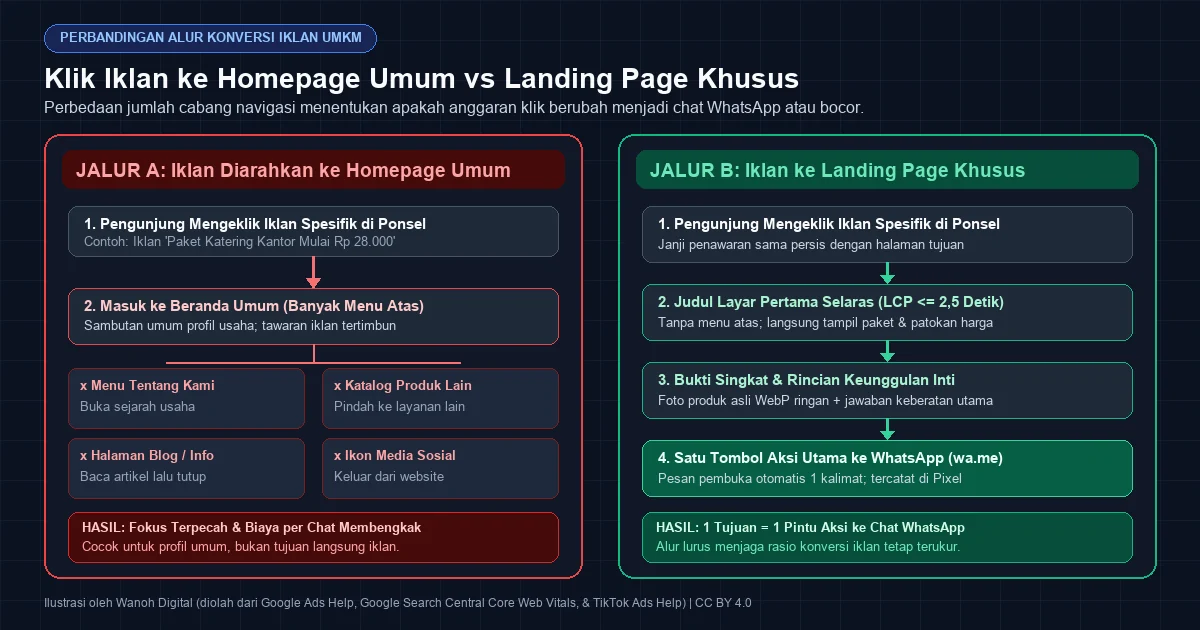
To show that not every operational problem requires building a site from scratch, Wanoh Digital once advised a training center in Bandung that initially wanted to commission a monthly student tuition tracking system [12]. After reviewing the workflow during our free advice session, their admin could handle the entire process with Google Forms and Google Sheets at zero programming cost [12]. If your business is still weighing whether social media, forms, or free bookkeeping and membership apps are sufficient, first read our analysis on when a business truly needs its own website vs social media as well as the goal differences between an ad landing page and a full company website.
Why does a paid invoice not automatically make the domain and source code yours?
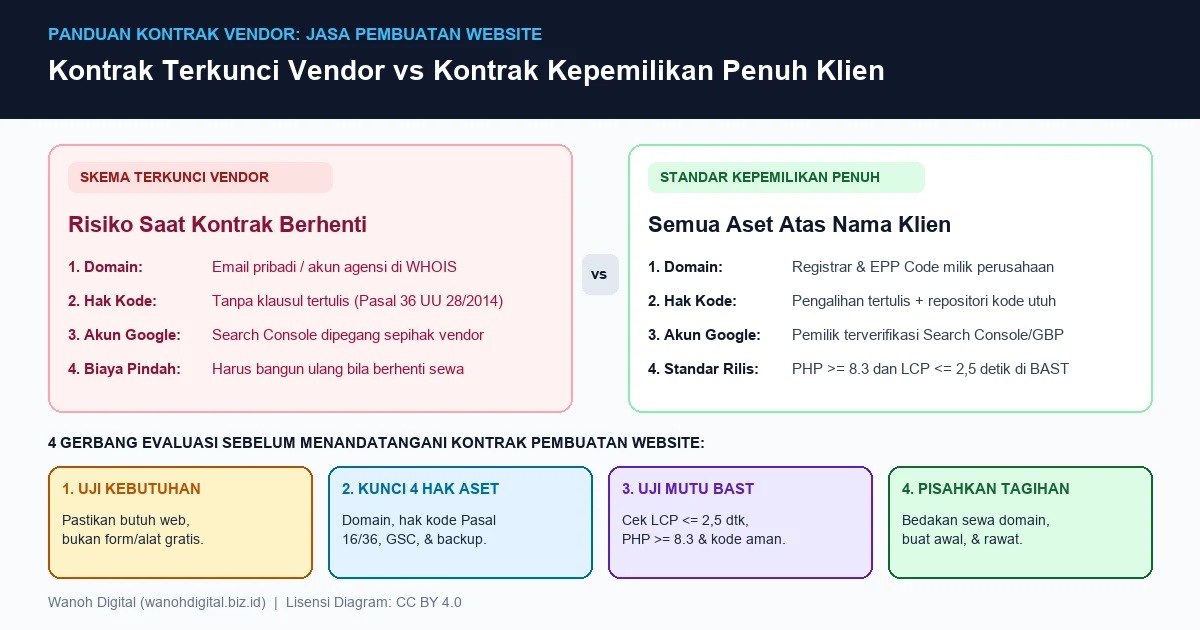
A paid invoice is only proof that you settled the labor fee. It is not a legal transfer document for the source code, domain registrar account, Google Search Console (GSC) ownership, or database backups unless those rights are written into the contract and handed over with the formal Handover Report (BAST) [1, 2].

Source: Photo by JESHOOTS (jeshoots.com) via Wikimedia Commons / Unsplash, https://commons.wikimedia.org/wiki/File:Businessman_working_and_writing_notes_in_office_%28Unsplash%29.jpg. License: CC0 1.0.
To avoid being held hostage when your first-year contract expires or when you decide to switch technical managers, make sure all four asset rights below are explicitly written before work starts:
- Written Transfer of Source Code Economic Rights (
Article 16&Article 36ofLaw 28/2014):Article 40(1)items (n) and (s) of Law No.28of2014list databases and computer programs as protected works [1]. UnderArticle 36, copyright for commissioned work without a separate agreement stays with the creator, andArticle 16(2)requires economic rights transfers to be stated explicitly in writing so your company has the legal right to maintain, modify, and move the site code to any developer [1]. - Official Domain Registrant Contact and Transfer Code (
ICANN&PANDI): Under SectionI.A.5.2of the ICANN Transfer Policy, a registrar must deliver the secretAuthInfocode and remove theClientTransferProhibitedlock within5calendar days when requested by the Registered Name Holder, and SectionI.A.5.4forbids withholding transfer codes simply over payment disputes with an intermediary [2]. For Indonesian domains such as.idor.co.id, PANDI affirms that the Extensible Provisioning Protocol (EPP) code is a confidential password that only the rightful domain owner can request [3]. Your company email must therefore be listed as the domain owner from initial registration, especially as inter-registrar moves also carry a60-day lock after initial registration or transfer under SectionI.A.3.7[2]. - Verified Owner Status on Google Assets (
GSC& Business Profile): In Google Search Console, a Verified owner account (viaDomain Name System(DNS) record or HTML file) holds full authority to add or revoke other users [6]. Similarly, on Google Business Profile, third-party policy requires client businesses to retain primary or co-ownership, and agency representatives must unlink their access within7business days after the contract ends [7]. Google Search documentation also reminds owners that advertising on Google has no effect on organic rankings, so primary control of search properties must stay in the business owner's account [4]. - File and Database Backups Stored Off the Vendor Server: Official WordPress administration guides stress that a site backup is only valid if it includes both all files and the database and is stored in a separate location outside the production server [10]. Requiring full backup copies and code repository access at handover gives your business a clean restore point if you change providers or face hosting trouble.
What are the cost and business risk differences between locked rental, one-off, and full-ownership websites?
In Indonesia's website development market, low upfront prices often stem from asset restrictions in the contract: locked rentals charge recurring fees forever without handing over source code, one-off builds leave post-launch security gaps, and full-ownership contracts separate one-time development fees from domain hosting and optional maintenance [1, 12].
Compare the three most common contract models offered by vendors below before committing your company budget:
| Contract Evaluation Criteria | Model A: Locked Platform Rental | Model B: Unmaintained One-Off Project | Model C: Documented Full Ownership |
|---|---|---|---|
| Domain & Google Account Status | Often registered under agency/builder account without full registrar access | Domain sometimes handed over, but Search Console control is often missed [6] | Domain in company name at official registrar + Verified Owner in GSC [2, 6] |
Copyright & Code Copy (Law 28/2014) | Limited usage rights while subscribed; pages vanish if payments stop | No written transfer clause (Article 36 stays with the builder) [1] | Written economic rights transfer (Article 16) + code repo & database [1, 10] |
| Maintenance & Revision Support | Tied to vendor monthly plan for minor edits and updates [12] | Stops completely after final payment; vulnerable to outdated PHP or hacks [9, 10] | Initial support + freedom to self-manage or choose a maintenance plan [12] |
| Cost to Switch Vendors | Must rebuild the entire site because code cannot be exported | Medium-to-high if code lacks documentation or relies on abandoned plugins | Minimal: simply revoke old permissions and continue with any developer [6, 7] |
To make the 24-month cash flow impact easier to see, look at an illustrative scenario over 24 months for a service company profile website paying Rp 750.000 per year directly for a .co.id or .com domain and basic hosting (Rp 1.500.000 over 2 years), excluding operating contribution margins:
- Path Model A (
24-Month Locked Builder Rental): Initial setup fee ofRp 1.200.000plus a closed subscription ofRp 400.000per month multiplied by24months (Rp 9.600.000), bringing total24-month cash outflow in this illustrative scenario toRp 10.800.000, while source code ownership still never transfers to the company. - Path Model B (Cheap One-Off Build + Year-2 Emergency Fix): Low initial build fee of
Rp 2.500.000with no security support plus2years of domain and hosting (Rp 1.500.000); in year two the site breaks due to expired server versions or a hack, triggering an emergency repair or rebuild ofRp 4.200.000, pushing total24-month cost in this illustrative scenario toRp 8.200.000. - Path Model C (Full Ownership from Day One): Initial Website Usaha build at
Rp 3.000.000(which includes1month of initial care and full handover of domain, hosting, and source code) plus2years of domain and hosting paid directly to the provider atRp 1.500.000puts self-managed total cost atRp 4.500.000(Rp 6.300.000cheaper than Model A), orRp 8.500.000(Rp 2.300.000cheaper than Model A) if the owner opts to continue with full Temani Website care in year two atRp 4.000.000per year [12].
(Note on figures: the calculation above is an illustrative 24-month cash flow comparison assuming fixed project values and does not include lost sales if the site goes down or is held back by a previous vendor).
To explore year-two domain and hosting costs and post-launch maintenance scope in detail, also review our guide on website creation cost breakdowns for year one and beyond and benchmarks for monthly website maintenance fees and takeover requirements.
How do you test a vendor's technical quality before signing the handover report?
Quality testing before settling the final payment and signing the Handover Report (BAST) must verify four objective checks in staging or production: mobile speed meeting Core Web Vitals, PHP branch support of at least 8.3 or 8.4, vulnerability checks on human and AI-written code, and complete documentation plus admin training [8, 9].
Never approve final payment based only on a clean homepage screenshot on a designer's laptop. Ask the provider to prove all four technical verification benchmarks with you:
- Passes Core Web Vitals Thresholds on Mobile: Under official web.dev standards, a healthy site at the 75th percentile of user experience must achieve Largest Contentful Paint (LCP) within
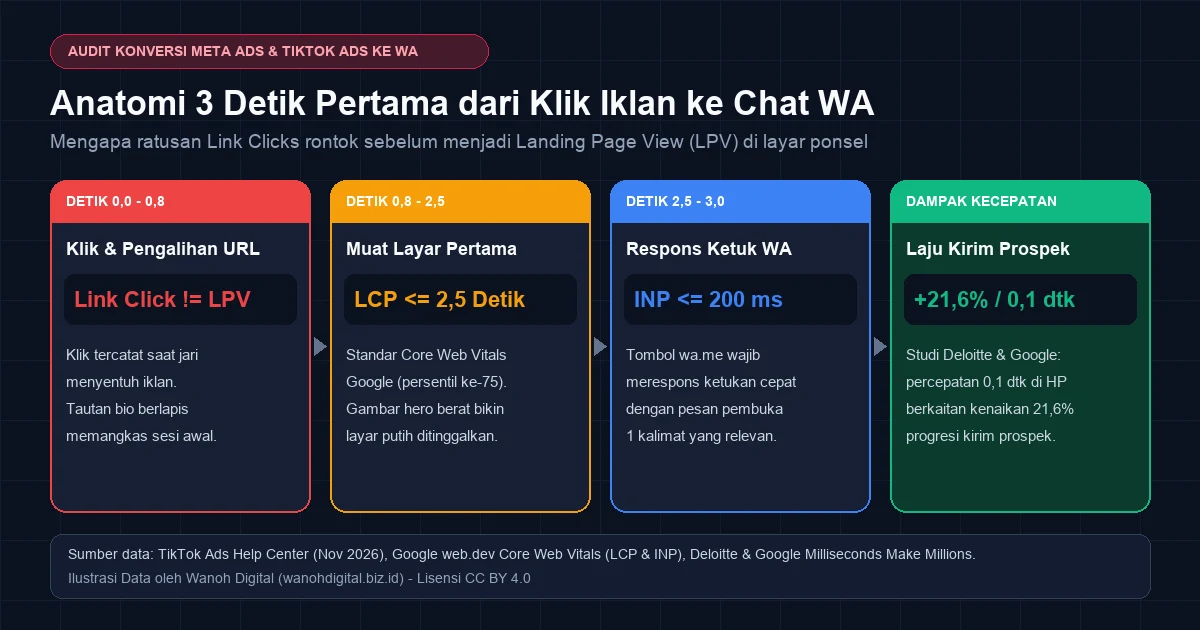
2.5seconds, Interaction to Next Paint (INP) within200milliseconds, and Cumulative Layout Shift (CLS) of at most0.1[8]. Also confirm that all WhatsApp buttons, quote forms, and location maps work without errors on standard mobile data [5]. - Runs on an Actively Supported Server Engine: According to The PHP Group release calendar, security support for PHP
8.2closes on31 December 2026, while PHP8.3continues until31 December 2027and PHP8.4until31 December 2028[9]. Specify in the BAST that any new WordPress, Laravel, or custom PHP site runs at least PHP8.3with a valid, auto-renewing Hypertext Transfer Protocol Secure (HTTPS) certificate [5, 9]. - Security Review of AI-Generated Code and Temporary Accounts: With AI coding agents now common in commercial web projects, Veracode Fall 2026 findings across
18LLM models show nearly two in five raw outputs (38%) fail security checks [11]. Request confirmation that secret Application Programming Interface (API) keys are never exposed in browser-side code, database access rules are locked down, and all temporary developer test accounts have been removed. - Staging Review, Admin Guide, and Post-Launch Warranty: Ensure the vendor shares periodic staging links before launch, delivers a written guide for your internal admin to edit pages or upload photos, and specifies the initial maintenance window plus off-server backups [10, 12].
What is the 8-point vendor contract checklist and 24-month cost simulation before signing?
Before accepting a proposal from any website development service, confirm all 8 requirements covering domain ownership, source code economic rights transfer, Google access, and technical handover standards while calculating the 24-month cost gap using the actual quotes you received [1, 8].
Use this contract checklist as a mandatory attachment during proposal discussions with prospective vendors:
8-Point Website Development Contract & Handover Checklist
Check off each verified item below, or click Copy Checklist to send it to your team or website vendor.
Enter the vendor quote numbers you are comparing into the calculator below to see the 24-month cost difference and copy ready-to-use legal and technical BAST clauses:
24-Month Website Contract Total Cost Calculator & BAST Clause Drafts
Compare two-year costs across locked rental, unmaintained one-off builds, and full source code ownership, then check contract terms and copy handover clauses.
[24-Month Total Cost Comparison]
Model A (Locked Builder Rental): Rp 10.800.000 (assets remain tied to vendor subscription)
Model B (One-Off Build + Year-2 Emergency Fix): Rp 8.200.000 (2-yr domain/hosting Rp 1.500.000)
Model C (Full Ownership, Self-Managed in Year 2): Rp 4.500.000 (saves Rp 6.300.000 vs Model A)
Model C (Full Ownership + Managed Maintenance in Year 2): Rp 8.500.000 (saves Rp 2.300.000 vs Model A)
Checked contract readiness: 0 of 8 items

[Draft Addendum: Website Handover & Copyright Clauses (Articles 16 & 36 Law 28/2014)]
1. Transfer of Economic Rights & Source Code: Upon full payment, the Contractor delivers a complete copy of the source code, database, and exclusive economic rights for the Client to use and modify the commissioned work under Article 16(2)(e) and Article 36 of Law No. 28 of 2014, excluding open-source third-party libraries.
2. Domain & Official Account Ownership: The domain is registered using the Client's official email as the Registered Name Holder, and the Client holds Verified Owner status on Google Search Console and Google Business Profile. The Contractor must unlink agency access within 7 business days if the engagement ends.
3. Technical BAST Acceptance Criteria: The website launches on an active PHP branch of at least version 8.3 with valid HTTPS, passes testing for WhatsApp buttons, forms, and Core Web Vitals thresholds (LCP <= 2.5s, INP <= 200 ms, CLS <= 0.1), and includes an initial off-server backup.
4. Separation of Infrastructure & Maintenance Billing: Annual domain and hosting renewal fees are paid directly by the Client to official providers. Post-launch routine maintenance is optional with monthly fees and out-of-scope hourly rates agreed in writing before work begins.
How do contract transparency and full ownership work in practice?
Vendor transparency shows up in practice when a provider maps out the leanest option first during initial consultation, separates entry-level rental tiers from full-ownership systems, and maintains clean access boundaries across multi-year client relationships [12].
In Wanoh Digital's public client track record, long-term ownership and technical support span different business sizes: the corporate profile site for CV Bina Coating was built and has had its domain and hosting maintained since 2016, the bilingual corporate website for PT Kaneka Foods Indonesia has run recurring maintenance and security update contracts across 2025 and 2026, and the deposit and agent-commission system PaketLebaranKu processed more than 500 deposits in its first month since 2025 [12]. Conversely, when an initial need can be solved with existing free tools, the engagement stops honestly at the Advise stage without pushing an expensive custom build [12].
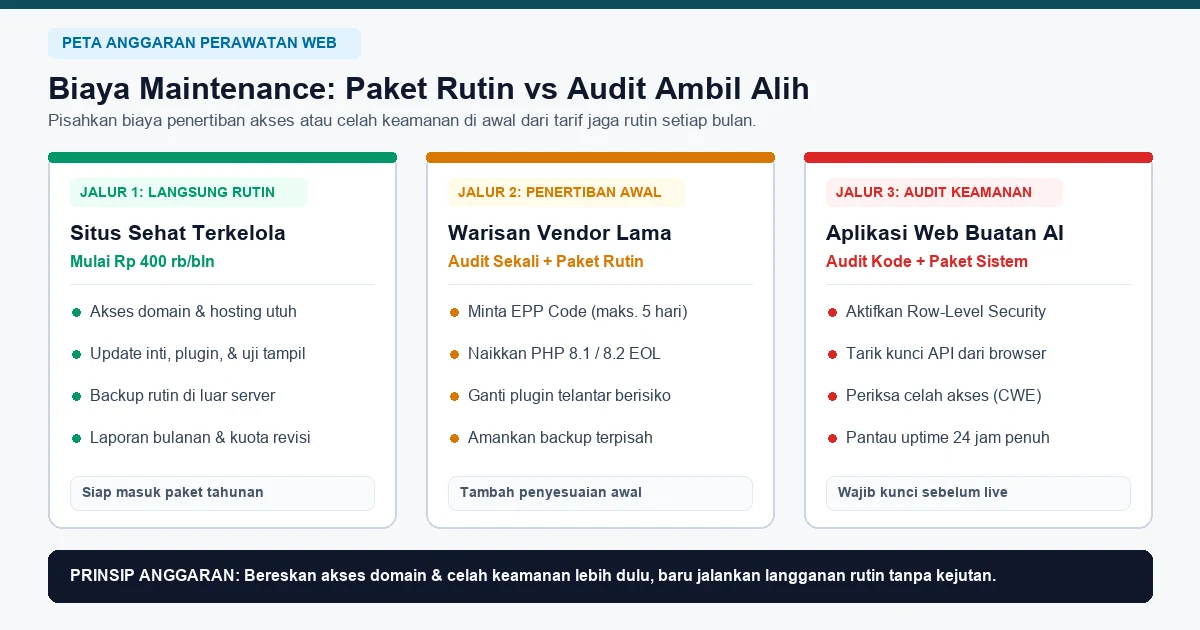
Under our published pricing as of November 2026, early-stage businesses can start with Website Siap Jalan (Rp 69.000/month, 12-month minimum contract or Rp 828.000/year including a single-page template, domain, hosting, and SSL certificate) and upgrade anytime to Website Usaha (from Rp 3.000.000 one-time with domain, hosting, and source code fully in your company's name plus 1 month of Temani Website), or choose Sistem Kerja with a written quote after free Listen and Advise stages [12]. Ongoing care is optional with transparent rates under Temani Website at Rp 400.000/month (Rp 4.000.000/year) and out-of-quota minor edits at Rp 175.000/hour [12].
If you are comparing proposals from multiple vendors or want to talk through your business workflow before deciding whether you need a new website, review our scope and "Everything is yours" standard on Wanoh Digital's How It Works & Pricing page and verified public cases on Our Work. If you already have an older site and want a passive external health check without sharing passwords first, request a free scan via 24-Hour Free Website Check (quota of 10 sites per week) or book a free Listen consultation via WhatsApp +62 851 8323 1708.
Short technical notes for your website manager
If your internal IT staff or technical consultant is verifying the asset handover from a website vendor on the day you sign the BAST, run these two non-destructive checks to confirm control and server standards have actually been transferred:
- Verify Domain Registration, Transfer Lock Status, and Clean Server Headers: Confirm that
Domain Status, expiry dates, security certificates, and initial server responses match contract specifications before final payment [2, 9]:
# 1. Check registrar details, expiration date, and domain transfer lock status
whois example.com | grep -iE "Registrar:|Registry Expiry|Domain Status|Registrant"

# 2. Check HTTP/HTTPS response codes, server headers, and SSL certificate validity
curl -sI https://example.com/ | head -n 15
echo | openssl s_client -servername example.com -connect example.com:443 2>/dev/null | openssl x509 -noout -dates- Verify Active PHP Engine Version and Completeness of Repository + Database Backups: Confirm the server runs an actively supported PHP branch (
>= 8.3) and that both the source code repository and Structured Query Language (SQL) database backup can be restored independently on a test server without closed dependencies [9, 10]:
# Confirm production server PHP version is at least 8.3 (not 8.1 or 8.2 which ends 31 December 2026)
php -v

# Verify local git history and check latest SQL backup file size is not empty (0 bytes)
git status && ls -lh backup-database-*.sql.gz
Frequently asked questions (FAQ)
Does website source code automatically belong to the client after paying the website development fee in full?
Not automatically [1]. Under Article 36 of Law No. 28 of 2014 on Copyright, copyright over a computer program or commissioned work stays with its creator unless agreed otherwise, and Article 16(2) requires any transfer of economic rights to be stated clearly in writing within the project contract [1].
How can you prevent a domain from being held hostage if your partnership with a website vendor ends?
Ensure from day one that the domain is registered using your company email as the official registrant contact in the registrar panel, rather than a personal or intermediary email [2, 3]. With legal owner status on record, ICANN policy requires the registrar to deliver the AuthInfo transfer code within 5 calendar days and forbids withholding it over disputes with a third party [2].
What is a realistic budget for building a business website where you own the code?
Outside monthly lightweight template rentals like Website Siap Jalan (Rp 69.000/month, 12-month minimum), building a professional profile or catalog website with full handover of domain, hosting, and source code at Wanoh Digital starts at Rp 3.000.000 one-time including 1 month of initial maintenance, while annual domain and hosting renewals are paid directly to the provider based on capacity needs [12].
What are the risks if a website vendor builds a site with AI coding tools without an audit and handover contract?
Veracode Fall 2026 security research found that raw code generated by AI coding agents still fails basic security checks 38% of the time [11]. If a vendor relies on AI code without access-control review, full repository handover, or clear post-launch maintenance responsibility, your company risks customer data leaks and full rebuild costs later on [11, 12].
References
Verified Sources & References (12 Sources)Show References
- Republic of Indonesia. "Undang-Undang Nomor 28 Tahun 2014 tentang Hak Cipta (Lembaran Negara Republik Indonesia Tahun 2014 Nomor 266)." World Intellectual Property Organization (WIPO Lex) Official Archive, 16 October 2014. https://www.wipo.int/wipolex/en/legislation/details/15600 (accessed 17 November 2026) (in Indonesian).
- Internet Corporation for Assigned Names and Numbers (ICANN). "Transfer Policy." ICANN Consensus Policy, 21 February 2024. https://www.icann.org/en/contracted-parties/accredited-registrars/resources/domain-name-transfers/policy (accessed 17 November 2026).
- Pengelola Nama Domain Internet Indonesia (PANDI). "Mengenal Istilah EPP Code." PANDI Blog, 24 July 2020. https://pandi.id/blog/mengenal-istilah-epp-code (accessed 17 November 2026) (in Indonesian).
- Google Search Central. "Do You Need an SEO? Tips for Hiring an SEO." Google for Developers, 10 October 2026. https://developers.google.com/search/docs/fundamentals/do-i-need-seo?hl=id (accessed 17 November 2026).
- Google Search Central (Official YouTube Channel). "Tips for Hiring a Web Developer (If You Need One) - Search for Beginners Ep 3." YouTube, 21 November 2019. https://www.youtube.com/watch?v=aKD3s_7Dkl0 (accessed 17 November 2026).
- Search Console Help. "Manage Owners, Users, and Permissions." Google Help Center, 12 August 2026. https://support.google.com/webmasters/answer/7687615?hl=id (accessed 17 November 2026).
- Google Business Profile Help. "Third-Party Policies for Business Profile." Google Help Center, 05 September 2026. https://support.google.com/business/answer/7353941?hl=id (accessed 17 November 2026).
- Walton, Philip, et al. "Web Vitals." Google web.dev, 14 May 2026. https://web.dev/articles/vitals (accessed 17 November 2026).
- PHP Official Developers. "PHP: Supported Versions." The PHP Group, 17 November 2026. https://www.php.net/supported-versions.php (accessed 17 November 2026).
- WordPress Developer Documentation. "Backups - Advanced Administration Handbook." WordPress.org, 28 October 2026. https://developer.wordpress.org/advanced-administration/security/backup/ (accessed 17 November 2026).
- Tischler, Natalie. "GenAI Code Security Fall 2026: The Ceiling Moves, But on the Low-Hanging Fruit." Veracode Blog, 29 October 2026. https://www.veracode.com/blog/fall-2026-genai-code-security/ (accessed 17 November 2026).
- Wanoh Digital. "Website Creation Cost, Full Ownership Standard, and How It Works." Wanoh Digital, 17 November 2026. https://wanohdigital.biz.id/en/cara-kerja (accessed 17 November 2026).