
Summary: Using AI for SMEs in Indonesia still leaves a wide market gap in daily store operations [1, 2]. In her opening remarks at Indonesia Digital MeetUp (IDM) 2026 at the Smesco Indonesia Building on October 15, 2026, Deputy Minister of Micro, Small, and Medium Enterprises (SMEs) Helvi Yuni Moraza noted that out of 92% of workers familiar with artificial intelligence, only around 15% use it actively for business, while more than 90% of SMEs have not applied it to daily work [1, 2, 3]. Instead of getting stuck in complex theory, store owners can close this gap with a practical 15-minute daily routine covering five time-consuming tasks: replying to customer complaint chats, writing catalog captions, calculating net selling prices after marketplace deductions, recapping daily cash, and building a Frequently Asked Questions (FAQ) list in WhatsApp Business [11, 12, 13].
Every night after closing time, millions of warung owners, grocery shops, culinary sellers, and local fashion merchants face the same pile of admin work. You have to reply to dozens of WhatsApp messages asking about stock, write captions for tomorrow morning's catalog posts, recalculate profit margins after platform fee deductions, and add up sales slips alongside bank transfer screenshots.
For micro and small businesses run solo or with one or two staff members, that repetitive admin work drains energy meant for product quality and customer service. This is where generative AI tools such as Google Gemini or ChatGPT act as a free admin drafting assistant, not a replacement for the owner's judgment [5, 8].
This guide takes an honest look at where AI adoption stands among small businesses in Indonesia right now, then gives you five copy-ready prompt templates and a simulation calculator so you can finish five daily store tasks in 15 minutes.
Table of Contents
- Why have over 90% of SMEs not used AI for daily store tasks?
- Which daily store tasks are best suited for AI?
- How can you finish 5 store tasks in 15 minutes with AI?
- Which store data must never be entered into free AI tools, and what are the security rules?
- When is free AI enough for SMEs, and when do you need your own website system?
- Frequently Asked Questions (FAQ)
- References
Why have over 90% of SMEs not used AI for daily store tasks?
During the opening remarks of IDM 2026 at Smesco Convention Hall in Jakarta on Thursday, October 15, 2026, Deputy Minister of SMEs Helvi Yuni Moraza stated that although 92% of workers in Indonesia already know about AI, only around 15% use it actively for business processes, and more than 90% of SMEs have yet to use AI in daily operations [1, 2, 3]. That stage remark describes a digital paradox: high daily smartphone usage that has not turned into store productivity or sales conversions [1, 2].
Business owners and readers should view those 15% and over-90% figures in context as a spoken remark by an official on stage rather than a standalone national census [1, 2]. When we triangulate three recent datasets and sector surveys in Indonesia, it becomes clear why AI adoption looks high in corporate offices yet remains low in retail shops and warungs:
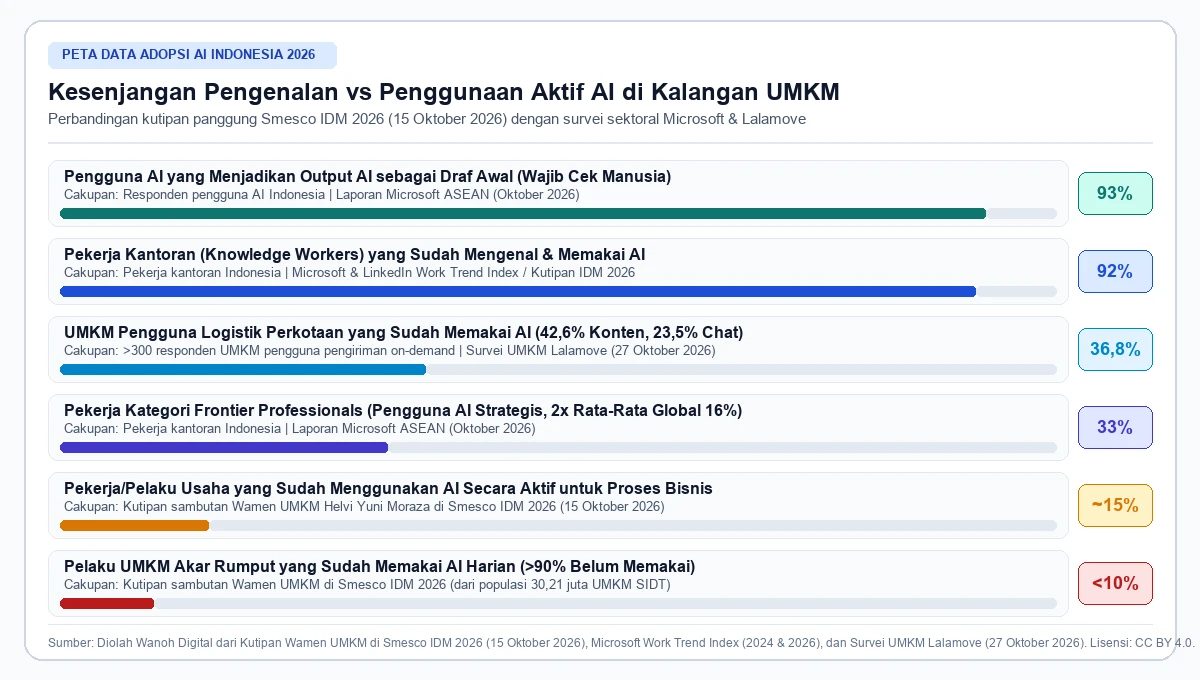
Source: Wanoh Digital (compiled from Deputy Minister of SMEs remarks at IDM 2026, Microsoft Work Trend Index, and Lalamove 2026 SME Survey). License: CC BY 4.0.
As shown in the comparison chart above, the sharp differences across Indonesian AI adoption numbers come from the different sample populations measured by each organization [1, 7, 9, 10]:
- Office Worker Population (Knowledge Workers): The Work Trend Index report from Microsoft and LinkedIn recorded that 92% of knowledge workers in Indonesia have used generative AI (above the 75% global average and 83% Asia-Pacific average), with 33% classified as Frontier Professionals in 2026 [7, 8]. However, that survey targets employees who spend their workday on computers, and notes that 93% of AI users in Indonesia still treat AI outputs solely as a first draft requiring human verification [8].
- Digital Logistics SME Segment: The 2026 SME Survey released by on-demand logistics platform Lalamove on October 27, 2026 across more than 300 SME respondents using its service found that 36.8% already use AI and 29.6% are considering it [9]. Within this app-connected delivery group, AI usage concentrates on marketing and content at 42.6% and customer service and communication at 23.5% [9].
- National Grassroots SME Population: Based on the Ministry of SMEs Single Data Information System (SIDT) as of December 31, 2025 summarized by the Indonesian Chamber of Commerce and Industry (Kadin), Indonesia has 30.21 million non-agricultural SME units, of which 99.70% (30.12 million units) are Micro Enterprises under Government Regulation (PP) Number 7 of 2021, concentrated in retail trade (14.44 million units) and culinary businesses (6.41 million units) [10, 19]. It is in this grassroots micro-enterprise base that the Deputy Minister's statement about over 90% not yet using AI reflects reality [1, 2, 10].
The table below compares the methodology and coverage of all three data sources so you can read the market opportunity accurately [1, 2, 7, 8, 9, 10]:
| Source / Research | Date & Population Scope | Headline Figures Reported | Practical Meaning for SME Store Owners |
|---|---|---|---|
| Deputy Minister of SMEs Helvi Yuni Moraza at IDM 2026 | October 15, 2026; opening speaker remarks at the Smesco Building in Jakarta [1, 2, 3]. | 92% of workers know AI, around 15% use it actively; over 90% of SMEs have not used AI in daily business [1, 2]. | Most competing offline and online shops around you are not yet using AI for daily operational efficiency [1, 2]. |
| Microsoft & LinkedIn Work Trend Index (2024 & 2026) | June 2024 & October 2026; survey of computer-based office workers in Indonesia [7, 8]. | 92% of office workers use AI; 33% Frontier Professionals; 93% treat AI outputs only as first drafts [7, 8]. | Never take AI text or calculations at face value; use AI to speed up the first draft, then check it yourself [8]. |
| Lalamove Indonesia 2026 SME Survey | October 27, 2026; more than 300 SME respondents using app-based delivery logistics [9]. | 36.8% already use AI, 29.6% are considering it; focused on content (42.6%) and customer communication (23.5%) [9]. | The two fastest areas to show results for a store are product content creation and customer chat replies [9]. |
| Ministry of SMEs SIDT Database & Kadin | As of December 31, 2025 & October 2026; national administrative population [1, 2, 10]. | 30.21 million non-agricultural SME units (99.70% Micro Enterprises); 12.7 million registered on government service apps [1, 2, 10]. | AI tools for micro stores must be free, runnable from a phone in minutes, and require zero coding skills [5, 6]. |
At the two-day IDM 2026 forum on October 15-16, 2026 alongside Smesco Indonesia President Director Doddy Akhmadsyah Matondang, AI researcher Adhiguna Kuncoro, and entrepreneur Atta Halilintar, the core message was consistent [1, 4]. The Deputy Minister reminded business owners not to chase viral posts or vanity follower counts, and instead to use technology to improve customer communication, sales conversions, and business record-keeping [2].
At the same event, Atta Halilintar stressed that once anyone can generate content with AI, the deciding factor that makes buyers pick a store is trust and service relevance [4]. Earlier, on September 29, 2026, Smesco Indonesia and Google also launched the Smesco Incubation and Acceleration Program (SIAP) 2026 titled "UMKM Naik Kelas Bareng Gemini AI" to help small business owners practice using AI assistants straight from their own devices [5, 6].
Which daily store tasks are best suited for AI?
The five daily store tasks best suited for generative AI in a 15-minute routine are drafting tricky customer chat replies, writing product catalog captions, simulating net selling prices after marketplace commissions, recapping daily sales notes, and drafting FAQ answers for WhatsApp Business Quick Replies [9, 11, 12, 13]. All five tasks repeat daily, follow clear text or basic arithmetic patterns, and directly affect response speed and store cash flow [9, 11].
Why only these five tasks, and how do you split them so they finish in 15 minutes without cutting into busy customer hours? As a rule of thumb from our operational mentoring at Wanoh Digital, store owners only need 15 minutes in the morning before opening or at night after closing by dividing the time into 3 minutes per task (2 minutes having AI draft + 1 minute verifying facts and numbers yourself).

Source: Alejandro Escamilla via Wikimedia Commons. License: CC0 1.0.
As shown in the photo above, this workflow keeps you in charge of every final decision, matching Microsoft's research finding that 93% of AI users in Indonesia treat AI output as a starting point that humans must verify [8]. The table below lays out the 15-minute schedule and daily time savings for micro and small stores as a practical benchmark:
| Order & Time Block | Daily Store Task | Old Manual Method (No AI) | AI Workflow (2 Min Draft + 1 Min Check) | Ready-to-Use Output |
|---|---|---|---|---|
| Minutes 01 - 03 (3 mins) | 1. Reply to Customer Chats (complaints, returns, or wholesale haggling) | Typing from scratch while stressed; easy to sound blunt (10 - 15 mins per case). | Paste the complaint and store policy into AI; pick 1 of 2 polite, solution-focused replies. | An empathetic WhatsApp reply that protects margins and is ready to send. |
| Minutes 04 - 06 (3 mins) | 2. Catalog Captions & Posts (WhatsApp Status, Instagram, TikTok) | Stuck searching for an opening line and skipping uploads altogether (15 - 20 mins). | Enter product specs, materials, sizing, and price; request 3 tone variations. | Three complete caption drafts with clear purchase calls to action. |
| Minutes 07 - 09 (3 mins) | 3. Calculate Selling Price & Margin (accounting for marketplace admin fees) | Guessing prices by marking up cost alone; profit disappears into commissions [12, 13]. | Enter Cost of Goods Sold (HPP), target margin, category admin fee, and order processing fee [12, 13]. | A side-by-side price table comparing direct store sales vs marketplace sales. |
| Minutes 10 - 12 (3 mins) | 4. Daily Sales Recap (from cashier chats and mixed receipts) | Adding up messy chat logs line by line every night (20 - 30 mins). | Copy daily cashier text without customer personal data; have AI group by payment method. | A summary table of units sold, gross revenue, expenses, and net cash. |
| Minutes 13 - 15 (3 mins) | 5. Build Store FAQ Answers (for WhatsApp Business / shortcuts) | Retyping shipping rates, opening hours, and order steps every day [11]. | Ask AI to tighten 10 standard answers to store in your 50-slot / shortcuts [11]. | A quick-reply library that pops up in 2 seconds when you type / [11]. |
How can you finish 5 store tasks in 15 minutes with AI?
The key to finishing five store tasks in 15 minutes is not paying for expensive software, but using a prompt structure with five parts: AI Role, Store Context, Raw Data, Format Rules, and Verification Step. You can copy all five templates below into free apps like Google Gemini, ChatGPT, or Claude on your phone or laptop.
To see how Indonesian small business owners put this into practice for daily product descriptions and promo ideas using Google Gemini, watch this official training video from the Jakarta Provincial Office of Industry, Trade, Cooperatives, and SMEs (Dinas PPKUKM DKI Jakarta) [17]:
::videoJakarta SMEs Level Up: Run Business Faster with Google Gemini AI (Dinas PPKUKM DKI Jakarta)
Summary: This official training video from Dinas PPKUKM DKI Jakarta and Google Indonesia shows culinary and craft SME owners writing contextual prompts in Google Gemini to draft product descriptions, vary daily promo lines, and speed up store admin straight from a smartphone [17].
Now let us apply that approach to five 3-minute blocks for your store.
Minutes 01 to 03: Replying to Customer Complaints or Price Haggling
The first task that drains store owners the fastest is answering chats from customers upset about courier delays, damaged parcels, or asking for wholesale prices on single-unit orders. When you reply in a rush during peak hours, messages can come across as harsh or overly accommodating to the point of losing money.
Copy the prompt template below and replace the bracketed placeholders with your store's details:
Role: You are a senior customer service admin for [Your Store Name], a business selling [product type, e.g., baked tempeh chips / local modest wear].
Situation context: A customer sent this message: "[Paste the complaint or negotiation text without full names, phone numbers, or home addresses]".
Our store policy:
1. [E.g., 100% free replacement with an unboxing video; return/replacement shipping covered by the store].
2. [E.g., Single-unit price of Rp65,000 is fixed; a 10% wholesale discount applies starting at 12 pcs].
Task: Write 2 short WhatsApp reply options (max 3 short paragraphs each) in polite, warm, natural language that does not blame the buyer while holding our store policy firm.
Option A: Primary solution following store policy.
Option B: A middle-ground option so the buyer feels comfortable ordering again.
In under 30 seconds, AI will give you two calm, well-structured reply drafts. Spend one minute reviewing to confirm the prices and guarantee terms are accurate before hitting send on WhatsApp.
Minutes 04 to 06: Writing Catalog Captions and Daily Product Posts
Lalamove's 2026 SME Survey found that 42.6% of SMEs already using AI apply it to marketing and content creation [9]. Still, the most common mistake when generating captions with AI is typing vague one-liners like "Write a caption to sell chili paste", which produces stiff clichés missing the details shoppers actually want.
Use this specific template so AI writes captions that answer buyer questions right away:
Role: You are a catalog copywriter for [Store Name], a local SME brand selling [product name].
Product specifications:
- Main ingredients / material: [E.g., Fresh bird's eye chili with no artificial preservatives, aluminum-sealed 180g glass jar]
- Specific advantages: [E.g., Keeps 14 days at room temperature unopened, Halal and PIRT certified]
- Price and bundle: [E.g., Rp38,000 per jar, value pack of 3 jars for Rp105,000]
- How to order: [E.g., Tap the WhatsApp link in bio or order directly through our website catalog]
Task: Write 3 caption variations in natural, clear language with no hype and no long dashes:
1. Short format (max 50 words) for WhatsApp Status photo captions and WhatsApp Business catalog.
2. Problem-solution story format (80 - 110 words) for an Instagram or Facebook post.
3. A 20-second voice-over script in short sentences for TikTok or Reels showing the product texture.
By feeding net weight, shelf life, bundle pricing, and ordering steps directly into the prompt, the AI draft carries concrete facts that drive conversions, matching the guidance shared at IDM 2026 [2, 4].
Minutes 07 to 09: Calculating Selling Price, COGS, and Marketplace Commission Cuts
Many micro business owners assume they made a profit selling an item for Rp100,000 on Rp65,000 of material costs, only to find their marketplace payout shrunk sharply after stacked platform fees [12, 13]. As detailed in our guide on the 50% marketplace admin fee discount rule for SMEs via SAPA UMKM, Minister of SMEs Regulation Number 3 of 2026 mandates at least a 50% discount on base Service Fees for Micro and Small Enterprises selling verified local products through SAPA UMKM [12, 18].
However, Article 8 paragraph (1)(c) of Minister of SMEs Regulation Number 3 of 2026 and Shopee Seller Education Center rules show that optional promo programs (such as Free Shipping Xtra or Promo Xtra at around 4% to 8%) and Shopee's fixed Rp1,250 order processing fee per completed transaction are not reduced by that subsidy [12, 13]. On top of Shopee's Non-Mall category admin fees ranging from 2.5% to 10%, you must calculate selling prices using the commission divisor formula so your target margin stays intact [12, 13].
Use this prompt template to have AI build a selling price comparison table in three minutes:
Role: You are a retail financial analyst for SME stores in Indonesia.
Cost data per 1 unit of [Product Name]:
- Cost of Goods Sold (HPP) including materials, labor, and box packaging: Rp[60,000]
- Target net profit per unit the store must keep: Rp[25,000]
- Base marketplace category admin fee rate: [8]% (Scenario A without SAPA UMKM discount; Scenario B with 50% base service fee discount to [4]%)
- Optional promo program fee rate (Free Shipping Xtra / Promo Xtra): [6]%
- Fixed order processing fee per transaction: Rp[1,250]
Task:
1. Calculate the minimum selling price to list on the marketplace under Scenario A (no SAPA UMKM discount), Scenario B (with 50% SAPA UMKM base admin discount), and Scenario C (direct sales via WhatsApp / Website using QRIS).
2. Use the correct commission divisor formula: Selling Price = (HPP + Target Net Profit + Fixed Fee) / (1 - Total Marketplace Fee Percentage), rounded up to the nearest Rp500.
3. Show the breakdown in a table so I can verify every number on a calculator.
To avoid manual math or AI rounding mistakes, use the 15-Minute Admin Time Saver & AI Prompt Generator below, which combines net selling price simulations under Minister of SMEs Regulation Number 3 of 2026 with automatic prompts tailored to your store's numbers [12, 18]:
Admin Time Calculator & 5 Store Task Prompt Generator
Enter your product cost and current daily admin time to calculate safe selling prices across channels, monthly hours saved, and a copy-ready AI prompt adjusted to your numbers.
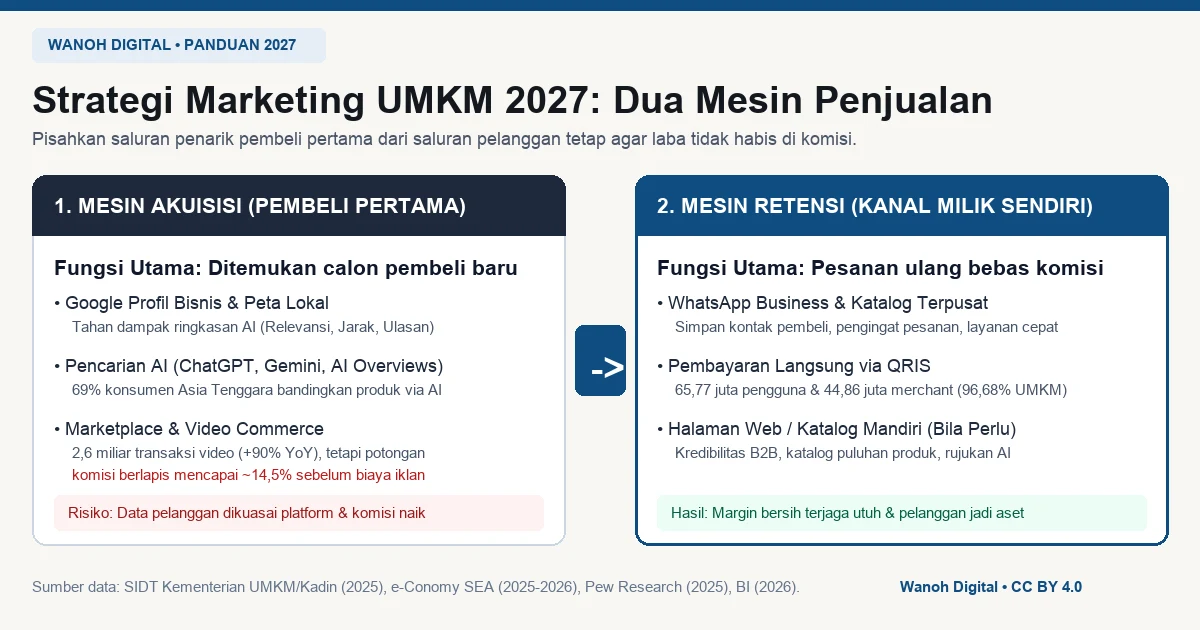
Once you get your price comparison from the calculator above, pair it with our 2027 SME marketing strategy to protect margins in the AI search era so repeat buyers shift toward ordering through your store's direct channels.
Minutes 10 to 12: Recapping Daily Sales and Cash Flow from Messy Notes
In many food stalls and retail shops, daily transactions are still scattered across an internal WhatsApp group between the owner and cashier using Quick Response Code Indonesian Standard (QRIS) and cash notes like "Sold 4 grilled chicken sets QRIS 100k, 2 iced orange cash 16k, bought gas 22k". Tallying dozens of these lines every night makes arithmetic mistakes easy.
You can organize that daily cash log in three minutes with this template (make sure no customer names, phone numbers, or addresses are inside):
Role: You are a detail-oriented retail store bookkeeper.
Raw cashier transaction notes for today ([Date]):
[Paste copied cashier/notebook transaction lines, for example:
- 09:15: Sold 3 Palm Sugar Iced Coffee @Rp18,000 (QRIS)
- 10:40: Sold 2 Chocolate Toast @Rp15,000 + 1 Black Coffee @Rp12,000 (Cash)
- 13:00: Bought ice cubes and plastic cups Rp45,000 (Paid from cash drawer)
- 16:20: App courier order 5 Palm Sugar Iced Coffee @Rp18,000 (Transfer/App)]
Task:
1. Build a sales recap table by item (Product Name, Units Sold, Unit Price, Subtotal Revenue).
2. Build a daily cash flow summary separating: Total Cash Inflow, Total Non-Cash Inflow (QRIS/Transfer), Total Daily Operating Expenses, and Net Cash Balance Today.
3. Show the step-by-step addition below the table so I can match it against the physical cash in the drawer.
As soon as AI outputs the recap table, spend one minute checking the cash balance against the physical money in your drawer, then save it to your monthly sheet. If your business or community group needs a cleaner standard for monthly reporting, check out our guide on how to prepare clean and transparent cash reports with cross-check templates.
Minutes 13 to 15: Building FAQ Replies for WhatsApp Business / Quick Replies
The last task in this 15-minute routine builds a long-term time-saving asset. According to official WhatsApp Business Help Center documentation, Quick Replies let store accounts save up to 50 ready-to-use reply shortcuts that appear the moment you type a forward slash (/) in the chat box, including support for product photos or videos on mobile [11]. WhatsApp Business also offers an automatic Greeting Message sent when a customer messages for the first time or after 14 days of no chat activity [11].
Many store owners leave those 50 slots empty because writing the replies one by one feels tedious [11]. Use your final three minutes to have AI draft your standard store reply pack:
Role: You are a customer communication specialist for SME store [Store Name] located in [Your City/District].
Basic store details:
- Opening hours: [Monday - Saturday 08:00 - 20:00 WIB, closed Sunday]
- Same-day shipping cutoff: [Payments before 15:00 WIB ship today; after 15:00 WIB ship tomorrow morning]
- Official payment methods: [Official QRIS under Store X and Bank Y Transfer under PT/CV/Owner X]
- Size exchange / return policy: [Size exchange allowed within 3 days of delivery if tags remain attached and an unboxing video is included]
Task: Write 5 WhatsApp Business Quick Reply texts with short slash keywords:
1. /hello (Warm opening greeting asking what the buyer needs)
2. /hours (Opening hours and daily shipping cutoff times)
3. /pay (Official payment instructions plus a safety reminder to transfer only to the store's official account)
4. /size (Size exchange rules and unboxing video requirement)
5. /location (Physical store address and Google Maps pin directions)
Keep each reply to a maximum of 4 short sentences so it reads comfortably on a phone screen.
Once those five texts are saved under Business Tools > Quick Replies in WhatsApp Business, you or your admin staff just type /hours or /pay to answer recurring questions in two seconds [11]. To make your /location reply easier for nearby buyers searching via Google or AI assistants, make sure your store pin is verified using our guide on registering a Google Business Profile on Google Maps.
Which store data must never be entered into free AI tools, and what are the security rules?
When using free AI tools, SME owners are strictly prohibited from entering customer personal data (such as full names linked to phone numbers, full home addresses, National Identification Numbers (NIK), or identifiable transfer receipts) as well as core trade secrets into the prompt box [14, 15, 16]. Protecting customer data confidentiality is legally binding under Law Number 27 of 2022 on Personal Data Protection (UU PDP) and Ministry of Communication and Informatics Circular Letter Number 9 of 2023 on Artificial Intelligence Ethics [14, 15].
Why does this restriction matter so much for small businesses? During her IDM 2026 opening remarks on October 15, 2026, Deputy Minister of SMEs Helvi Yuni Moraza specifically reminded businesses that SME AI adoption must go hand in hand with personal data protection and cybersecurity awareness [2]. According to Google's official Gemini Apps Privacy Hub documentation, when the Keep Activity setting is turned on for a consumer account, some conversations may be reviewed by trained human reviewers to improve AI models and stored for up to 3 years [16].
Google explicitly warns users not to enter confidential information they would not want a human reviewer to see [16]. By contrast, if you turn off Keep Activity or use Temporary Chat, new chats are not used to train generative AI models and are retained for at most 72 hours to keep the service running reliably [16].
Beyond privacy risks on AI platforms, customer data theft and locked store bookkeeping files also often happen when cashier computers get infected by malware, as covered in our guide on how to prevent ransomware and data leaks on business devices. Use the interactive checklist below as your standard security routine whenever you or your admin staff use AI for store work [8, 14, 15, 16]:
Daily AI Data Security & Quality Control Checklist for Store Owners
Check off the items you have verified below, or click Copy Checklist to share them with your team or website vendor.
When is free AI enough for SMEs, and when do you need your own website system?
SME owners can rely on free AI apps plus WhatsApp Business as long as daily orders stay below 20 transactions, product variations remain small, and one person can finish admin in 15 minutes a day as a practical benchmark from our mentoring work. However, once customer chats asking about your catalog pass 30 messages a day or marketplace commission cuts drain tens of millions of rupiah per year from net profit, copying text manually from AI into individual chats stops scaling [11, 12, 13].
At that stage, the bottleneck in your business is no longer typing speed, but lacking an independent digital storefront working 24 hours a day. When your store relies solely on messaging apps without a structured catalog, prospective buyers have to ask repeatedly about stock, size options, and shipping costs before they can pay.
Having an official catalog website connected directly to WhatsApp checkout buttons and digital payments gives your store three structural advantages that daily AI prompts alone cannot match:
- An Independent Catalog Storefront Built for Google Search and AI Discovery: When your product specs, official prices, and AI-refined FAQ answers live on your own domain website, Google Search and AI answer engines can surface your products directly when local buyers search in your city [4].
- Permanent Reduction in Repetitive Chats: Buyers can pick variants, check size guides, and see totals right on the catalog page, so messages landing in WhatsApp Business arrive as complete orders ready for payment [11].
- Long-Term Savings on Marketplace Commissions: All repeat orders placed through your own store website avoid the 2.5% to 10% category commissions and 4% to 8% optional promo fees charged by marketplaces [12, 13].
If you want to start applying this 15-minute AI routine while building your own digital catalog and official FAQ pages, Wanoh Digital can help with web application development and workflow automation that is fast, mobile-friendly, and priced for SME budgets, or you can talk through your store operations first in a Free Consultation while checking examples of websites and business systems we have built.
Frequently Asked Questions (FAQ)
Is the claim that over 90% of SMEs have not adopted AI an absolute census figure?
It is not a standalone census figure, but a remark quoted from Deputy Minister of SMEs Helvi Yuni Moraza when opening Indonesia Digital MeetUp (IDM) 2026 at the Smesco Indonesia Building in Jakarta on October 15, 2026 [1, 2, 3]. In those remarks, she noted that out of 92% of Indonesian workers who know AI, only around 15% use it actively for business, while more than 90% of SMEs have not used it in daily operations [1, 2]. For comparison, the Lalamove 2026 SME Survey of over 300 app-based logistics SME respondents recorded a 36.8% AI adoption rate, showing that adoption moves much faster among app-connected SMEs than across the national base of 30.21 million SME units [9, 10].
Which free AI apps are easiest for SME owners to use on a smartphone?
SME owners can immediately use the free versions of Google Gemini (gemini.google.com or the Gemini mobile app), OpenAI's ChatGPT, or Anthropic's Claude with an existing email account [5, 16]. The Ministry of SMEs and Smesco Indonesia also partnered officially with Google Gemini in the SIAP 2026 incubation program ("UMKM Naik Kelas Bareng Gemini AI") because its interface supports everyday Indonesian and runs directly in a mobile browser with no subscription fee [5, 6].
Is it safe to paste sales recaps and customer chats into free AI apps?
It is safe only if you remove all personal customer identifiers before pasting the text into an AI prompt box [14, 16]. Under Law Number 27 of 2022 on Personal Data Protection (UU PDP) and the Gemini Apps Privacy Hub policy, you must not enter full names linked to phone numbers, home addresses, NIK, or customer bank details, because chats on accounts with Keep Activity enabled may be reviewed by human reviewers and retained for up to 3 years [14, 16]. Turn off Keep Activity so chats are not used to train AI models and are retained for at most 72 hours [16].
How do I connect AI-drafted FAQ answers to a store's WhatsApp Business account?
After having AI draft short answers for recurring questions (opening hours, shipping schedules, official payment accounts, and return terms), open WhatsApp Business on your phone, go to Business Tools > Quick Replies, and add each reply with its shortcut keyword [11]. Official WhatsApp Business documentation allows up to 50 quick replies that you can insert anytime during chat by typing a forward slash (/) followed by the shortcut keyword [11].
Why must AI-generated selling price calculations and cash recaps still be checked manually?
Generative AI language models predict sequences of words and numbers from text patterns, so they can still make rounding errors or apply the wrong marketplace commission divisor formula [8, 15]. That is why Microsoft's 2026 research found that 93% of AI users in Indonesia treat AI output only as a first draft, and Ministry of Communication and Informatics Circular Letter Number 9 of 2023 requires human supervision and accountability for every business output used [8, 15].
How do I calculate selling prices with AI if my store registered for the 50% admin fee discount on SAPA UMKM?
You need to separate the base Service Fee percentage from optional promotional fees in your prompt instructions [12, 13]. Under Minister of SMEs Regulation Number 3 of 2026, the minimum 50% discount applied through SAPA UMKM only reduces the base category admin fee (for example, from 8% down to 4%), whereas Free Shipping Xtra, Promo Xtra, and Shopee's fixed Rp1,250 order processing fee per transaction remain 100% in effect [12, 13, 18].
References
Verified Sources & References (19 Sources)Show References
- Taufiq Al Hakim. "Indonesia Digital MeetUp 2026 Dorong UMKM Jadi Pemain Utama Ekonomi Digital." InvestorTrust, 15 October 2026. https://investortrust.id/business/119427/indonesia-digital-meetup-2026-dorong-umkm-jadi-pemain-utama-ekonomi-digital (accessed 03 November 2026).
- Liputan6.com. "Wamen UMKM Ingatkan Pelaku Usaha: Jangan Cuma Kejar Viral." Liputan6.com, 15 October 2026. https://www.liputan6.com/bisnis/read/8313882/wamen-umkm-ingatkan-pelaku-usaha-jangan-cuma-kejar-viral (accessed 03 November 2026).
- Ministry of Micro, Small, and Medium Enterprises of the Republic of Indonesia. "Wakil Menteri UMKM Helvi Moraza Membuka Acara Indonesia Digital Meetup 2026 'Where Business Meets AI'." Official Portal of the Ministry of SMEs RI, 15 October 2026. https://umkm.go.id/news/hvukhs6wr5tp52sk1bpr12ka (accessed 03 November 2026).
- Viqri Maulana Fachreza. "Di Era AI, Semua Bisa Berkarya: Pelajaran Bisnis dari Indonesia Digital MeetUp 2026." Serikat Usaha Muhammadiyah (SUMU), 22 October 2026. https://sumu.or.id/di-era-ai-semua-bisa-berkarya-pelajaran-bisnis-dari-indonesia-digital-meetup-2026/ (accessed 03 November 2026).
- Ministry of Micro, Small, and Medium Enterprises of the Republic of Indonesia. "Siaran Pers Nomor 140/Press/SM.3.1.UMKM/2026: SMESCO dan Google Gemini Inisiasi SIAP 2026 Perkuat UMKM Naik Kelas melalui Pemanfaatan AI." Official Portal of the Ministry of SMEs RI, 30 September 2026. https://umkm.go.id/news/ob2mh3gdtw2lekrub1hsmroi (accessed 03 November 2026).
- Shofi Ayudiana. "Smesco Dorong UMKM Manfaatkan AI untuk Kembangkan Usaha." ANTARA News Agency, 30 September 2026. https://www.antaranews.com/berita/5764960/smesco-dorong-umkm-manfaatkan-ai-untuk-kembangkan-usaha (accessed 03 November 2026).
- Microsoft Indonesia. "Microsoft dan LinkedIn Luncurkan Work Trend Index 2024: Menilik Keadaan AI dalam Dunia Kerja di Indonesia." Microsoft Indonesia News Center, 11 June 2024. https://news.microsoft.com/id-id/2024/06/11/microsoft-dan-linkedin-luncurkan-work-trend-index-2024-menilik-keadaan-ai-dalam-dunia-kerja-di-indonesia/ (accessed 03 November 2026).
- Warta Ekonomi. "Microsoft: Indonesia Jadi Salah Satu Pengguna AI Paling Maju di Dunia Kerja." Warta Ekonomi, 20 October 2026. https://wartaekonomi.co.id/read619901/microsoft-indonesia-jadi-salah-satu-pengguna-ai-paling-maju-di-dunia-kerja (accessed 03 November 2026).
- MetroTVNews.com. "Survei: 50,5% UMKM Optimistis Hadapi 2027, Adopsi AI Meningkat." MetroTVNews.com, 27 October 2026. https://www.metrotvnews.com/read/ba4CvxAB-survei-50-5-umkm-optimistis-hadapi-2027-adopsi-ai-meningkat (accessed 03 November 2026).
- Indonesian Chamber of Commerce and Industry (Kadin). "Data dan Statistik UMKM Indonesia." Kadin Indonesia, 15 February 2026. https://kadin.id/data-dan-statistik/umkm-indonesia/ (accessed 03 November 2026).
- WhatsApp LLC. "Cara Menggunakan Balas Cepat di Aplikasi WhatsApp Business." WhatsApp Help Center, 10 January 2026. https://faq.whatsapp.com/1791149784551042 (accessed 03 November 2026).
- Ministry of Micro, Small, and Medium Enterprises of the Republic of Indonesia. "Peraturan Menteri Usaha Mikro, Kecil, dan Menengah Republik Indonesia Nomor 3 Tahun 2026 tentang Pelindungan dan Peningkatan Daya Saing Usaha Mikro dan Usaha Kecil dalam Perdagangan Melalui Sistem Elektronik." JDIH Ministry of SMEs, 17 June 2026. https://jdih.umkm.go.id/ (accessed 03 November 2026).
- Shopee Indonesia. "Biaya Administrasi dan Biaya Proses Pesanan Penjual Shopee." Shopee Indonesia Seller Education Center, 01 May 2026. https://seller.shopee.co.id/edu/article/7187 (accessed 03 November 2026).
- Government of the Republic of Indonesia. "Undang-Undang (UU) Nomor 27 Tahun 2022 tentang Pelindungan Data Pribadi." JDIH Audit Board (BPK) RI, 17 October 2022. https://peraturan.bpk.go.id/Details/229798/uu-no-27-tahun-2022 (accessed 03 November 2026).
- Ministry of Communication and Informatics of the Republic of Indonesia. "Surat Edaran Menteri Komunikasi dan Informatika Nomor 9 Tahun 2023 tentang Etika Kecerdasan Artifisial." JDIH Ministry of Communication and Digital RI, 19 December 2023. https://jdih.komdigi.go.id/produk_hukum/view/id/883/t/surat+edaran+menteri+komunikasi+dan+informatika+nomor+9+tahun+2023 (accessed 03 November 2026).
- Google LLC. "Gemini Apps Privacy Hub." Google Help Center, 01 October 2026. https://support.google.com/gemini/answer/13594961?hl=id (accessed 03 November 2026).
- Dinas PPKUKM DKI Jakarta. "UMKM JAKARTA MAKIN CANGGIH! Kelola Bisnis Jadi 'Sat-Set' Pakai Google Gemini AI." YouTube, 10 February 2026. https://www.youtube.com/watch?v=JeUYCgQ4i30 (accessed 03 November 2026).
- Ministry of Micro, Small, and Medium Enterprises of the Republic of Indonesia. "SAPA UMKM: Sistem Aplikasi Pelayanan Usaha Mikro, Kecil, dan Menengah." Official Portal of the Ministry of SMEs RI, 25 October 2026. https://sapa.umkm.go.id/ (accessed 03 November 2026).
- Government of the Republic of Indonesia. "Peraturan Pemerintah (PP) Nomor 7 Tahun 2021 tentang Kemudahan, Pelindungan, dan Pemberdayaan Koperasi dan Usaha Mikro, Kecil, dan Menengah." JDIH Audit Board (BPK) RI, 02 February 2021. https://peraturan.bpk.go.id/Details/161837/pp-no-7-tahun-2021 (accessed 03 November 2026).