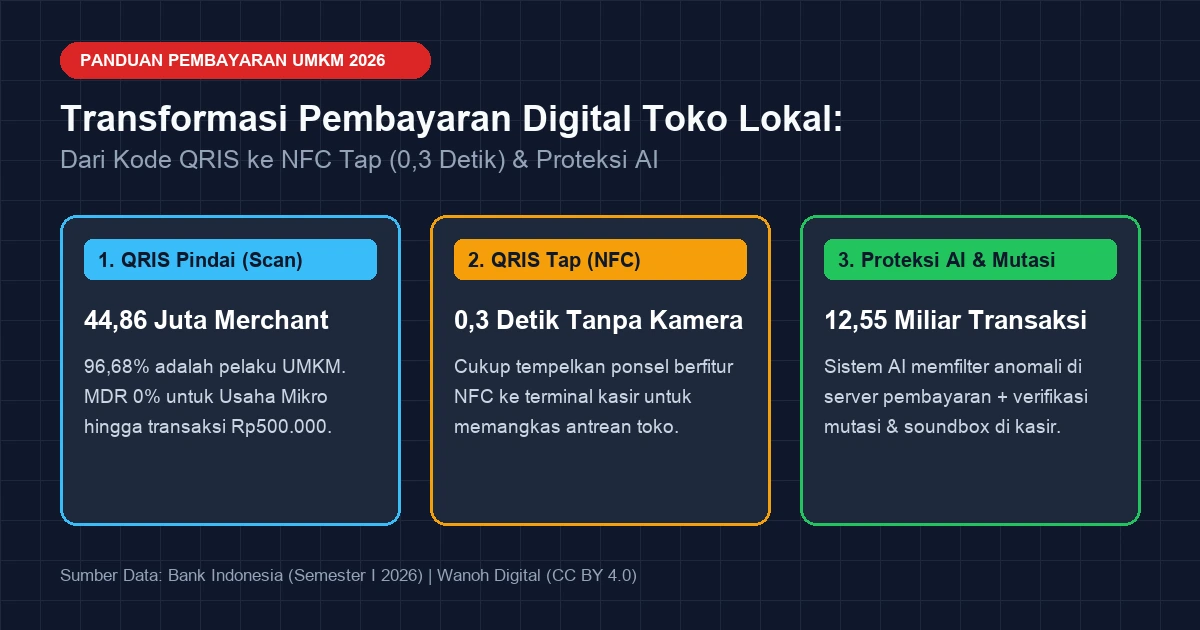
Summary: At its core, Indonesia's digital payment transformation for small stalls and local shops is a shift from merely setting out a payment code to managing queue speed, service-fee efficiency, and cashier reconciliation security. By June 2026, Bank Indonesia recorded that Quick Response Code Indonesian Standard (QRIS) had reached 65.77 million users and 44.86 million merchants, with 96.68% of them being Small and Medium Enterprises (SMEs) [1]. Through the 0% Merchant Discount Rate (MDR) policy for Micro Businesses on transactions up to Rp500.000 and contactless QRIS Tap powered by Near Field Communication (NFC), small shops can speed up checkout while benefiting from Artificial Intelligence (AI) screening for suspicious transactions [3, 4, 9].
A few years ago, signs reading cash-only still dominated checkout counters at food stalls, neighborhood groceries, and barbershops across Indonesia. Entering the second half of 2026, the first question customers ask at the counter has flipped to asking where the QRIS code or contactless tap reader sits [2, 4]. This guide walks through the latest QRIS service-fee rules, how contactless tap and behind-the-scenes AI security work, and practical checks to shield your cashier from fake payment screenshots.
Article Contents
- Why are stalls and local shops moving from cash to QRIS in 2026?
- What are the QRIS MDR fee deductions for micro and small businesses?
- How do QRIS Tap NFC and AI work behind local shop payments?
- What should shop owners check to stay safe from fake QRIS scams?
- Frequently asked questions
- Technical notes
- References
Why are stalls and local shops moving from cash to QRIS in 2026?
Stalls and local shops are moving to QRIS because one standardized payment code accepts transfers from dozens of banking apps and digital wallets without burdening shopkeepers with small change or expensive checkout hardware [2]. Bank Indonesia data shows that across the first half of 2026, national QRIS volume surpassed 12.55 billion transactions, jumping 100.12% compared to the same period in 2025, with total value reaching Rp600.69 trillion [2].
That surge rests directly on Indonesia's real economic structure, which is overwhelmingly micro-merchant driven. At the macro level, 2021 government data recorded 65.4 million SMEs across all sectors including agriculture, contributing 61% of national Gross Domestic Product (GDP) and absorbing 97% of the workforce [7]. Under the verified administrative database of the Ministry of SMEs' Single Data Information System (SIDT) as of 31 December 2025, non-agricultural SMEs totaled 30.21 million units, 99.70% of which are micro scale and concentrated in retail trade (14.44 million units) and food service (6.41 million units) [6].
Before national standardization, small merchants accepting digital payments had to print separate QR stickers from multiple wallet providers and check balances across disconnected apps [2]. Today, QRIS infrastructure connects 96 banks, 60 non-bank institutions, and 4 national switching operators into a single code format linked straight to the owner's bank account [2].
For stall owners, that shift solves three everyday counter headaches:
- Eliminates small-change discrepancies: Cashiers no longer run out of small bills during rush hours or risk accepting worn or counterfeit banknotes.
- Logs cash flow automatically: Every completed payment is recorded with timestamp and amount inside the merchant app, building transaction history that helps when applying for formal business financing later [1, 2].
- Captures cashless walk-in buyers: Customers carrying only a smartphone can complete purchases without walking away to find an ATM first.
What are the QRIS MDR fee deductions for micro and small businesses?
The service fee deduction, or Merchant Discount Rate (MDR), on QRIS for Micro Businesses is 0% (free) for every transaction up to Rp500.000, and 0.3% only when a single transaction exceeds Rp500.000 [3]. Starting 01 October 2026, Bank Indonesia also expanded the 0% MDR exemption for Small, Medium, and Large Businesses on transactions up to Rp100.000, down from the previous 0.7% fee [3].
Every shop owner should note that MDR is a processing fee charged by Payment Service Providers (PJP) to the merchant [3]. Under official Bank Indonesia rules, MDR is strictly borne by the seller and must never be added onto the customer's bill as a surcharge at checkout [3].
To check exact deductions for your store's registered merchant tier as of October 2026, review the official schedule and illustrative scenarios in the table below [3]:
| QRIS Merchant Category | Fee-Free Threshold (0% MDR) | MDR Rate Above Threshold | Illustrative Rp80.000 Transaction | Illustrative Rp600.000 Transaction |
|---|---|---|---|---|
| Micro Business (UMI) | Up to Rp500.000 [3] | 0.3% (transactions above Rp500.000 only) [3] | Rp0 fee (Rp80.000 received intact) [3] | Rp1.800 fee (Rp598.200 received) [3] |
| Small Business (UKE) | Up to Rp100.000 (effective 01 October 2026) [3] | 0.7% (transactions above Rp100.000 only) [3] | Rp0 fee (Rp80.000 received intact) [3] | Rp4.200 fee (Rp595.800 received) [3] |
| Medium (UME) & Large Business (UBE) | Up to Rp100.000 (effective 01 October 2026) [3] | 0.7% (transactions above Rp100.000 only) [3] | Rp0 fee (Rp80.000 received intact) [3] | Rp4.200 fee (Rp595.800 received) [3] |
| Special Education | Up to Rp100.000 [3] | 0.6% (transactions above Rp100.000) [3] | Rp0 fee (Rp80.000 received intact) [3] | Rp3.600 fee (Rp596.400 received) [3] |
| Fuel Stations (SPBU) | Up to Rp100.000 [3] | 0.4% (transactions above Rp100.000) [3] | Rp0 fee (Rp80.000 received intact) [3] | Rp2.400 fee (Rp597.600 received) [3] |
| Public Services, BLU, PSO, Taxes, Social Aid & Nonprofit Donations | All transaction amounts (0% MDR) [3] | 0% [3] | Rp0 fee (Rp80.000 received intact) [3] | Rp0 fee (Rp600.000 received intact) [3] |
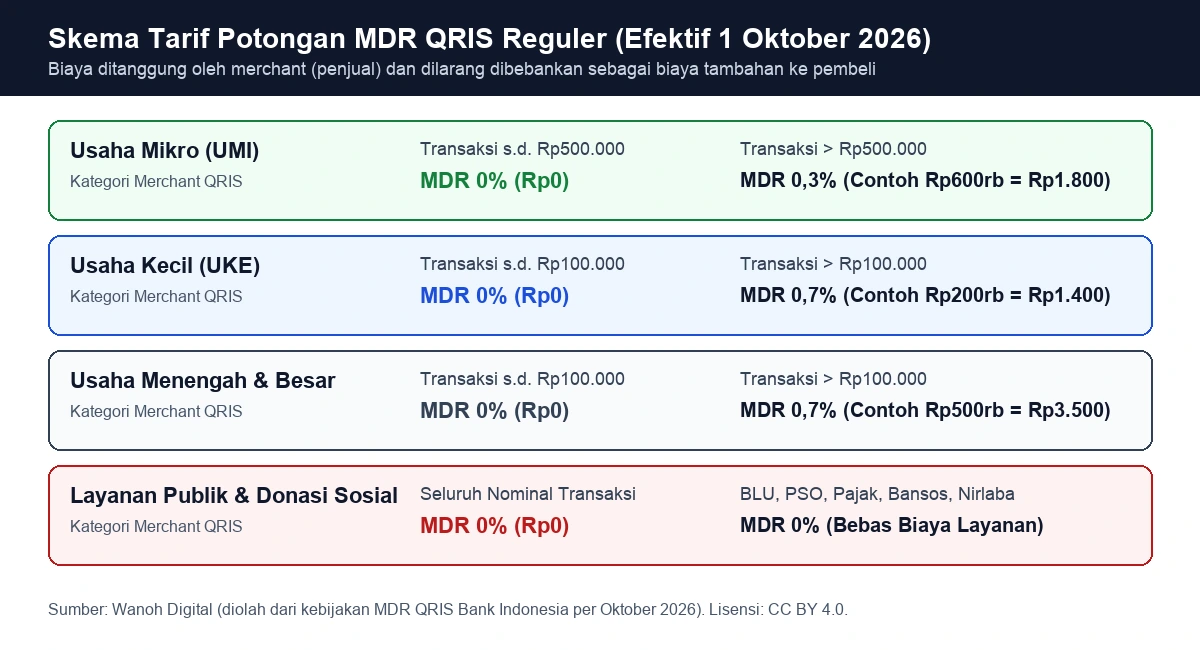
Source: Wanoh Digital (adapted from Bank Indonesia QRIS MDR policy as of October 2026). License: CC BY 4.0.
As Figure 1 shows, for food stalls, street vendors, or convenience shops registered as Micro Businesses (UMI) whose typical customer ticket stays under Rp500.000, QRIS does not trim sales margins at all [3]. Even for Small Business (UKE) retailers such as cafes or local pharmacies, expanding the 0% MDR ceiling up to Rp100.000 since October 2026 keeps everyday retail tickets free from platform deductions [3]. That direct payment savings is also why many businesses pair QRIS with repeat orders on WhatsApp Business, covered further in SME Marketing Strategy 2027: Protect Margins in the AI Search Era.
To calculate exact MDR deductions and estimated net payouts to your shop account based on your merchant category and ticket size, use the interactive calculator below:
QRIS MDR Fee & Net Payout Simulator
Select your shop's registered merchant category and enter a transaction amount to calculate the applicable Merchant Discount Rate (MDR) effective October 2026 along with net funds settled to your bank account.
*Regulatory note: Based on Bank Indonesia QRIS MDR policy effective 1 October 2026. MDR fees are paid by the merchant and may not be charged as an extra fee to buyers.
How do QRIS Tap NFC and AI work behind local shop payments?
Digital payments at local shops are now moving from camera scanning toward QRIS Tap using Near Field Communication (NFC), which settles a transaction in 0.3 seconds while server-side Artificial Intelligence (AI) automatically filters out suspicious activity [4, 9]. Bank Indonesia officially launched QRIS Tap together with the Ministry of Transportation and the Indonesian Payment System Association (ASPI) on 14 March 2025 to cut checkout queues across transit, retail, parking, and SMEs [4, 5].
With conventional scan QRIS, buyers have to unlock their phone, open a payment app, point the camera at a printed sticker, and wait for autofocus, which often stalls under glare or slow mobile data [5]. With QRIS Tap, buyers carrying an NFC-enabled smartphone simply hold the phone close to the cashier reader terminal (generally under 4 centimeters) and payment confirmation completes within 0.3 seconds [4, 5, 11].
Watch this short demonstration from Bank Indonesia's official channel showing how contactless QRIS Tap works in the field:
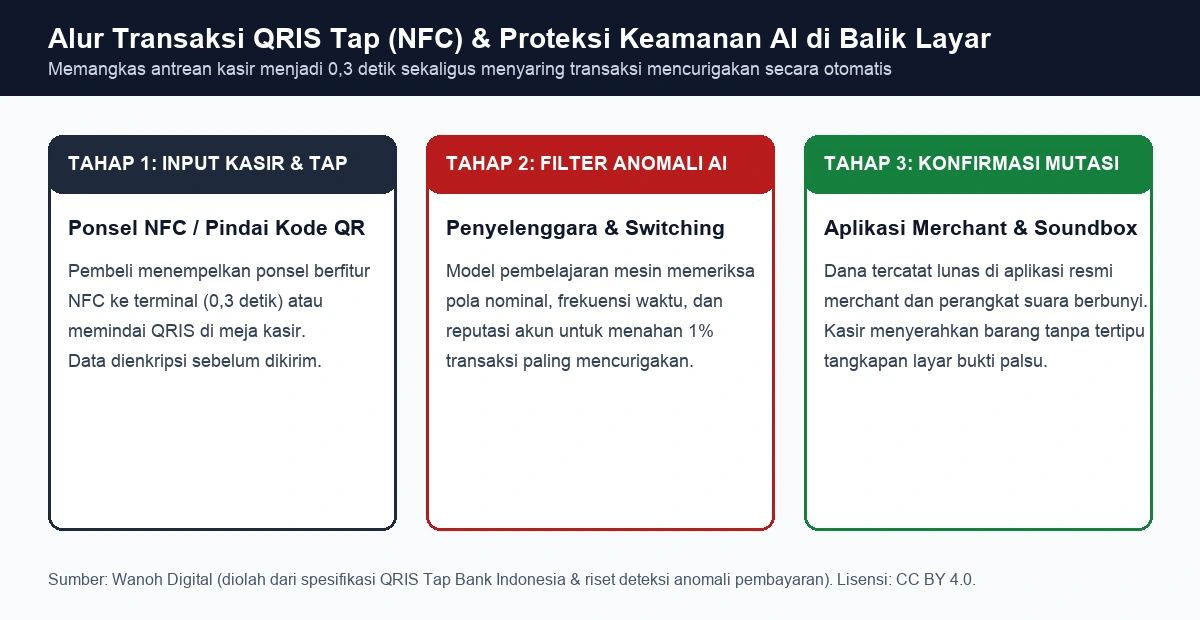
Source: Wanoh Digital (adapted from Bank Indonesia QRIS Tap specifications and payment anomaly detection research). License: CC BY 4.0.
Behind the checkout speed shown in Figure 2, the 2026 e-Conomy Southeast Asia (SEA) report notes that 243 million residents, or 58% of the working-age population across six major Southeast Asian countries, already interact with AI ecosystems, while digital financial service providers rely on behind-the-scenes AI for risk management and fraud prevention [8]. Financial transaction security research by Fariha et al. (2025) and Yu et al. (2024) shows how machine learning models screen millions of payments simultaneously without slowing merchants down [9, 10]:
- Real-time behavioral pattern scanning: AI systems at banks and switching operators evaluate merchant category profiles, historical average ticket sizes, geographic locations, and intervals between transactions within milliseconds [9].
- Outlier detection for anomalous transactions: Using Transformer and autoencoder models, systems automatically flag roughly the top 1% most anomalous transactions, such as an unknown account firing dozens of consecutive payments after a stall's closing hours [9, 10].
- Automated cashier reconciliation summaries: For shop owners, AI inside merchant apps surfaces as daily turnover breakdowns, peak customer hours, and automatic alerts whenever unusual refund spikes occur [8, 9].
What should shop owners check to stay safe from fake QRIS scams?
Even while bank servers run AI anomaly detection, fraud against small stalls and local shops still happens right at the counter when staff skip verifying settled balances or fail to notice fake QRIS stickers pasted over acrylic stands. Scammers typically exploit busy hours by flashing an edited payment screenshot while zero money has actually arrived in the seller's account.
To close those loss points without slowing down customer queues, put this 4-step procedure in place with your shop cashiers:
- Step 1, forbid handing over goods based solely on the buyer's phone screen: Post a clear rule at the register stating a sale is settled only after an incoming payment notification appears inside the shop's official merchant app or plays through a transaction speaker (soundbox).
- Step 2, inspect physical QRIS stickers every morning before opening: Laminate your printed QRIS sheet or seal it behind a closed acrylic frame, and perform a quick morning test scan to verify the store name displayed on screen still matches your business identity.
- Step 3, pick the QRIS setup suited to your daily queue volume: As a practical rule from field operations work, stalls averaging fewer than 30 cashless transactions per day do fine with a Static QRIS sticker monitored on the shop's phone app, whereas shops handling over 30 daily transactions or rotating cashiers should use Dynamic QRIS on a POS screen or add a soundbox so staff do not need access to the owner's primary banking phone.
- Step 4, separate your QRIS settlement bank account from personal accounts: Dedicate one business operating account so daily revenue summaries, MDR fee checks on transactions above the free threshold, and inventory restock budgets stay separate from household expenses [1, 3].
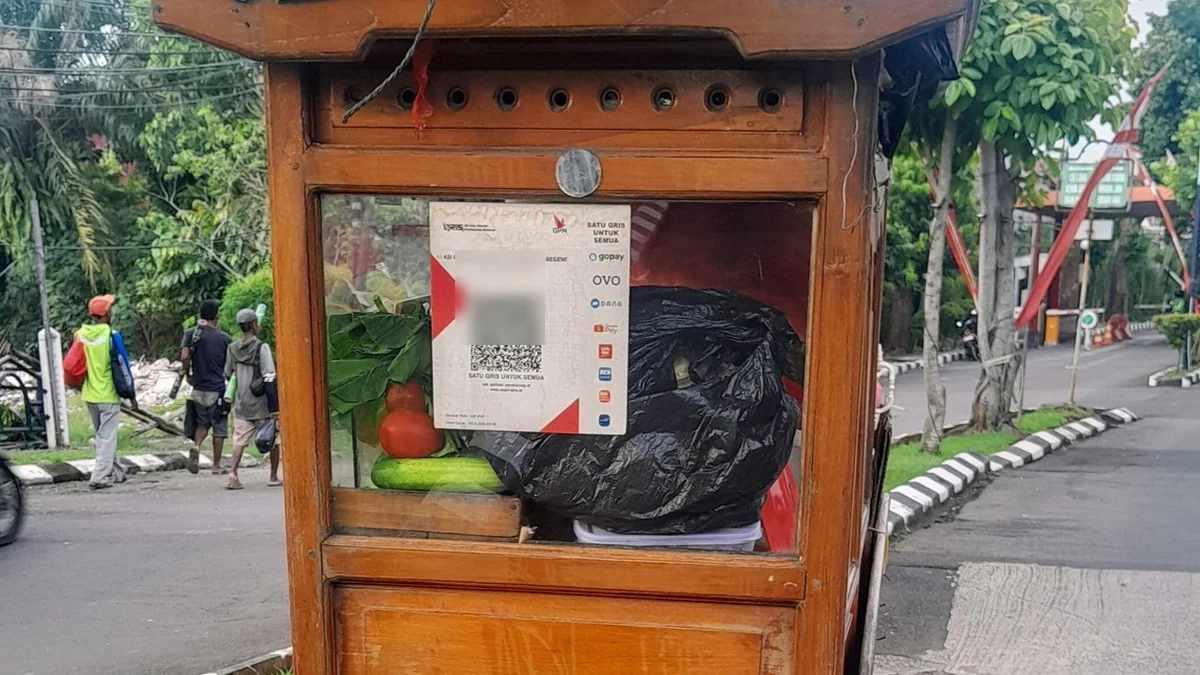
Source: VulcanSphere via Wikimedia Commons (cropped 16:9 & QR code blurred for merchant privacy). License: CC BY 4.0.
As seen on the food cart above, placing the QRIS sheet behind the inside face of a display glass is a simple, effective safeguard for micro vendors to stop outsiders from sticking fake codes over it from the street.
To help you choose the right cashier hardware without renting equipment you do not need yet, use the QRIS Cashier Hardware Selection Matrix below as a practical guide by picking one column on each row and totaling your score:
| Cashier Operating Variable | Score 1 (Solo Stall Scale) | Score 2 (Busy Shop Scale) | Score 3 (Multi-Cashier Retail Scale) |
|---|---|---|---|
| 1. Average cashless transactions per day | Fewer than 30 transactions per day | 30 to 100 transactions per day | More than 100 transactions per day |
| 2. Staff operating the register | Operated directly by the business owner | Operated by 1 to 2 regular employees | Rotating shift cashiers or multiple checkout counters |
| 3. Peak-hour queue conditions | Customers arrive spaced out at a relaxed pace | Queues build up during meal times or evenings | Heavy queues requiring checkout under 5 seconds |
| 4. Inventory & receipt printing needs | Daily settlement summary in phone app is enough | Need instant voice confirmation without unlocking a phone | Must deduct stock automatically and print receipts |
Add up your four store condition scores (between 4 and 12 points) and match them with the hardware recommendations below:
- Total Score 4 to 6 points (Acrylic Static QRIS Sticker Only, Rp0 device cost): As a rule of thumb, you do not need to rent a POS machine or paid terminal yet. Simply set up a laminated Static QRIS printout at the register and turn on voice alerts in the merchant app on the owner's phone.
- Total Score 7 to 9 points (Static QRIS + Audio Soundbox Device): As a practical setup for shops run by staff, place a QRIS soundbox unit on the counter so every settled payment is announced aloud within seconds without handing your main banking phone to cashiers.
- Total Score 10 to 12 points (POS-Integrated Dynamic QRIS & NFC Tap Terminal): Your shop is ready for a POS register that generates a fresh Dynamic QRIS per order and supports QRIS Tap NFC (0.3 seconds) so totals lock automatically and lines move quickly [4, 5].
If you want to reorganize your cashier payment logs or talk through digital operations bottlenecks at your shop without pressure, you can book a Free Wanoh Digital Consultation with zero fee and no contract obligation. You can also browse Wanoh Digital sample websites and transaction-tracking apps, read our related operational guides on how SMEs claim 50% marketplace admin fee discounts and practical 15-minute AI workflows for shop operations, or move forward to Build with Wanoh Digital if your store needs an integrated direct-order catalog page.
Frequently asked questions
Are micro businesses charged a fee every time they receive a QRIS payment?
Not for everyday retail transactions. Under official Bank Indonesia policy effective October 2026, merchants registered in the Micro Business (UMI) category pay a 0% Merchant Discount Rate (MDR), meaning zero deduction, on every transaction up to Rp500.000 [3]. The 0.3% MDR fee for Micro Businesses applies only when a single buyer payment exceeds Rp500.000 [3].
What is the difference between Static QRIS and Dynamic QRIS for a small stall or local shop?
With Static QRIS, a single QR code is printed permanently on a sticker or acrylic stand and buyers type the rupiah amount themselves on their phones. With Dynamic QRIS, a unique QR code is displayed on the cashier screen or payment terminal for one specific order with the exact amount locked by the cashier, eliminating the risk of buyers mistyping payment figures.
Can a seller add a QRIS admin fee onto the buyer's bill?
No. Bank Indonesia payment system regulations state clearly that QRIS MDR service fees are borne entirely by the merchant (seller) and must not be charged as an extra fee (surcharge) to consumers or buyers [3]. If your shop's ticket sizes frequently exceed the 0% MDR limit, factor that operating cost into your standard retail prices rather than adding a separate surcharge at checkout [3].
Technical notes
This section is intended for Information Technology (IT) staff or managers of SME Point of Sale (POS) cashier systems connecting web catalogs or register apps to digital payment gateways. Keep in mind that implementing the protocol standards below is a prerequisite for secure system communication, while preventing counter fraud in physical shops still depends on cashier staff following balance-verification procedures:
- NFC Data Exchange and Web Payment Interface Protocols: On browser-based self-service registers, contactless reader integration follows the Web NFC Application Programming Interface (API) specification from Mozilla Developer Network (MDN) for short-range NFC Data Exchange Format (NDEF) message exchange, alongside the World Wide Web Consortium (W3C) Payment Request standard to streamline payment confirmation flows [11, 12].
- Cryptographic Payment Webhook Verification (HMAC): Whenever a shop POS system receives a paid-status notification (callback / webhook) from a Payment Service Provider (PJP) server, it must verify the digital signature using Keyed-Hashing for Message Authentication (HMAC) per Internet Engineering Task Force (IETF) Request for Comments (RFC) 2104 and National Institute of Standards and Technology (NIST) SP 800-63B authentication guidelines so order statuses cannot be forged via spoofed network requests [13, 14].
# Sample HMAC-SHA256 signature verification (RFC 2104) on an SME POS payment webhook
import hmac
import hashlib

def verify_payment_webhook(raw_payload: bytes, signature_header: str, secret_key: str) -> bool:
    expected_mac = hmac.new(
        secret_key.encode("utf-8"),
        msg=raw_payload,
        digestmod=hashlib.sha256
    ).hexdigest()
    return hmac.compare_digest(expected_mac, signature_header.strip())
Testing note: The verification function snippet above uses Python 3 standard libraries (hmac and hashlib) per IETF RFC 2104 specifications as of 28 October 2026 [13].
Update and correction policy: This article was first published on 23 January 2026 and thoroughly updated on 28 October 2026 with H1 2026 QRIS transaction figures and Bank Indonesia's expanded 0% MDR policy effective October 2026 [1, 2, 3].
References
Verified Sources & References (14 Sources)Show References
- Antara News (citing Bank Indonesia Deputy Governor Filianingsih Hendarta). "BI: QRIS dipakai 65,77 juta pengguna dan diterima 44,86 juta merchant." ANTARA News Agency, 21 August 2026. https://www.antaranews.com/berita/5705449/bi-qris-dipakai-6577-juta-pengguna-dan-diterima-4486-juta-merchant (accessed 28 October 2026) (in Indonesian).
- Antara News (citing Bank Indonesia Deputy Governor Filianingsih Hendarta). "BI: Transaksi QRIS capai 12,55 miliar pada semester I 2026." ANTARA News Agency, 06 August 2026. https://www.antaranews.com/berita/5682285/bi-transaksi-qris-capai-1255-miliar-pada-semester-i-2026 (accessed 28 October 2026) (in Indonesian).
- Antara News (citing Acting Bank Indonesia Governor Destry Damayanti and BI Payment System Policy Department Head Ryan Rizaldy). "BI perluas kebijakan MDR QRIS 0 persen untuk pelaku UMKM." ANTARA News Agency, 16 September 2026. https://jogja.antaranews.com/berita/848451/bi-perluas-kebijakan-mdr-qris-0-persen-untuk-pelaku-umkm (accessed 28 October 2026) (in Indonesian).
- Antara News (citing Bank Indonesia Governor Perry Warjiyo). "BI resmi luncurkan QRIS Tap untuk permudah pembayaran digital." ANTARA News Agency, 14 March 2025. https://www.antaranews.com/berita/4710961/bi-resmi-luncurkan-qris-tap-untuk-permudah-pembayaran-digital (accessed 28 October 2026) (in Indonesian).
- Antara News. "Mengenal QRIS Tap: Sistem pembayaran NFC tanpa scan QR code." ANTARA News Agency, 16 March 2025. https://www.antaranews.com/berita/4721513/mengenal-qris-tap-sistem-pembayaran-nfc-tanpa-scan-qr-code (accessed 28 October 2026) (in Indonesian).
- Indonesian Chamber of Commerce and Industry (Kadin) (citing Ministry of SMEs SIDT data). "Data dan Statistik UMKM Indonesia." Kadin Indonesia, 15 January 2026. https://kadin.id/data-dan-statistik/umkm-indonesia/ (accessed 28 October 2026) (in Indonesian).
- Ministry of State Secretariat of the Republic of Indonesia. "Kontribusi UMKM bagi Perekonomian Besar, Presiden Tekankan Pentingnya Izin bagi UMKM." State Secretariat RI, 13 July 2022. https://www.setneg.go.id/baca/index/kontribusi_umkm_bagi_perekonomian_besar_presiden_tekankan_pentingnya_izin_bagi_umkm (accessed 28 October 2026) (in Indonesian).
- Hoppe, Florian, Willy Chang, Aadarsh Baijal, Fock Wai Hoong, and Nitin Gajria. "e-Conomy SEA 2026: Building the intelligent economy." Bain & Company, Google, and Temasek, 21 October 2026. https://www.bain.com/insights/e-conomy-sea-2026/ (accessed 28 October 2026).
- Fariha, Nudrat, et al. "Advanced fraud detection using machine learning models: enhancing financial transaction security." arXiv Preprint arXiv:2506.10842, 12 June 2025. https://arxiv.org/abs/2506.10842 (accessed 28 October 2026).
- Yu, Chang, et al. "Credit Card Fraud Detection Using Advanced Transformer Model." arXiv Preprint arXiv:2406.03733, 06 June 2024. https://arxiv.org/abs/2406.03733 (accessed 28 October 2026).
- Mozilla Developer Network (MDN). "Web NFC API." MDN Web Docs, 10 April 2026. https://developer.mozilla.org/en-US/docs/Web/API/Web_NFC_API (accessed 28 October 2026).
- World Wide Web Consortium (W3C). "Payment Request API." W3C Recommendation, 08 September 2022. https://www.w3.org/TR/payment-request/ (accessed 28 October 2026).
- Krawczyk, Hugo, Mihir Bellare, and Ran Canetti. "RFC 2104: HMAC: Keyed-Hashing for Message Authentication." Internet Engineering Task Force (IETF), 01 February 1997. https://www.rfc-editor.org/info/rfc2104 (accessed 28 October 2026).
- Grassi, Paul A., et al. "NIST Special Publication 800-63B: Digital Identity Guidelines - Authentication and Lifecycle Management." National Institute of Standards and Technology (NIST), 01 June 2017. https://pages.nist.gov/800-63-3/sp800-63b.html (accessed 28 October 2026).