Summary: Preparing an organization cash report that members and donors trust immediately does not require a treasurer to produce dozens of dense accounting pages. The key lies in four monthly traceability habits: holding funds in an official bank account in the organization's name under Law (UU) Number 17 of 2013, separating restricted trust funds from unrestricted operating cash based on Interpretation of Financial Accounting Standards (ISAK) 335 from the Indonesian Institute of Accountants (IAI), keeping donation collection operating costs under the 10% ceiling set by Government Regulation (PP) Number 29 of 1980, and attaching a receipt code to every expense [3, 5, 7, 9].
Many social foundation boards, mosque committees (DKM), school parent committees, community cooperatives, and neighborhood unit (RT/RW) leaders share the same frustration: committee members volunteer honestly to guard the money, yet the monthly report posted in the WhatsApp group still sparks suspicion. Questions such as "Why is the cash balance still Rp 25 million while the orphan aid program has not started?" or "Did yesterday's disaster relief donations get spent on meeting snacks?" almost always arise when every inflow and outflow is lumped into one single balance column [3, 5].
This article explains why ordinary cash logs trigger misunderstandings, how to translate Indonesia's latest nonprofit accounting standard into a reader-friendly one-page table, and includes an automated calculator to verify cash reconciliation before publishing your report.
Article Contents
- Why are honest organization cash reports still suspected by members or donors?
- What is the difference between an ordinary cash log and ISAK 335 that reassures donors?
- How to structure a 2-layer cash report and attach receipts without breaching privacy?
- How to verify cash reconciliation, the 10% operating limit, and draft monthly reports?
- Frequently asked questions
- Technical notes
- References
Why are honest organization cash reports still suspected by members or donors?
An organization cash report prepared by an honest treasurer still draws suspicion from members or donors when a single-column log mixes special-program trust funds with daily operating cash, hides how much sits in the bank versus physical cash on hand, and lists lump-sum expenses without receipt numbers [2, 3, 5]. Whenever contributors cannot verify whether their earmarked donation remains intact or went toward routine office bills, doubt grows even when not a single rupiah was misused [3, 5].
Empirically, Indonesian society shows remarkably high social trust and generosity. The World Giving Index 2024 report by the Charities Aid Foundation (CAF), surveying over 145,000 respondents across 142 countries in 2023, ranked Indonesia first as the world's most generous country for seven consecutive years with an index score of 74 out of 100 [1]. In that global survey, 90% of Indonesian respondents reported donating money to charities or social causes and 65% volunteered their time [1]. High civic participation means the main challenge for local organizations is not convincing people to give once, but keeping trust intact so members and donors give again.
On the other hand, public caution around organizational cash handling carries real risk whenever basic internal controls are skipped. The global study Occupational Fraud 2024: A Report to the Nations published by the Association of Certified Fraud Examiners (ACFE), analyzing 1,921 occupational fraud cases across 138 countries between January 2022 and September 2023, shows that nonprofit organizations accounted for 10% of all investigated cases [2].
In that ACFE report, the median loss at nonprofit organizations reached USD 76,000 (around Rp 1.2 billion), and hit a median of USD 85,000 in religious, charitable, or social services categories [2]. The top triggers for those cash leaks were a lack of basic internal controls in 32% of cases and missing management review in 18% of cases [2].
In Indonesia, cash governance for associations and social institutions also follows clear legal rules on bank accounts, operating cost caps, and public disclosure [6, 7, 8, 9]. The table below maps the five reporting habits most likely to trigger member suspicion alongside their proper fixes [2, 3, 6, 7, 8, 9]:
| Cash Reporting Habit That Triggers Suspicion | Why Members & Donors Doubt It | Indonesian Accounting Standard & Legal Rule | Practical Fix in Monthly Reports |
|---|---|---|---|
| 1. Holding dues or donations in a chair or treasurer's personal bank account | Organization cash flows mix with the treasurer's household spending and risk inheritance disputes if an officer passes away [2, 9]. | Article 38 paragraph (2) of Law 17 of 2013 on Societal Organizations requires using an account at a national bank in the organization's name [9]. | Open a bank account in the institution's name and keep the organization's Quick Response Code Indonesian Standard (QRIS) separate from personal QRIS codes [9]. |
| 2. Merging all inflows and outflows into a single ending balance | Program-specific donors (e.g., orphan aid or roof repairs) assume their entrusted funds paid for electricity and meeting snacks [3, 5]. | IAI's ISAK 335 standard requires separating Net Assets Without Donor Restrictions (free cash) from Net Assets With Donor Restrictions (restricted funds) [3, 5]. | Split the cash report table into two clear blocks: General Cash (Unrestricted) and Special-Program Trust Funds (Restricted) [3, 5]. |
| 3. Writing lump-sum expense lines like "Miscellaneous Costs Rp 2.500.000" with no receipt code | Using "Miscellaneous" without item quantities, unit prices, or receipt numbers looks like a place to hide cash discrepancies [2]. | The 2024 ACFE report notes expense reimbursements (29%) and billing schemes (36%) thrive when receipts go unverified [2]. | Assign a unique code to every entry (BKM-01 for Cash Receipt, BKK-01 for Cash Disbursement) and remove the "Miscellaneous" category [2]. |
| 4. Deducting excessive committee or staff overhead from donated funds | Donors feel misled when a large share of donations goes toward honorariums, banners, or committee meals [7, 8]. | Article 6 paragraph (1) of PP Number 29 of 1980 jo. Minister of Social Affairs Regulation (Permensos) Number 8 of 2021 caps fundraising operating costs at 10% (and 0% for disasters) [7, 8]. | Display the operating expense ratio openly beneath the cash table (ensuring it stays below the 10% limit) [7, 8]. |
| 5. Publishing cash reports months late with only one signature | Reporting delays and missing second-person review make members suspect cash balances are being borrowed privately [2, 6]. | Article 51 of Law Number 28 of 2004 on Foundations establishes joint liability for boards and supervisors if annual reports are untrue or misleading [6]. | Set a fixed month-end closing date, perform a physical cash count (cash opname), and add cross-check initials from at least two officers [2, 6]. |
What is the difference between an ordinary cash log and ISAK 335 that reassures donors?
The core difference between an ordinary single-column cash book and an ISAK 335 compliant financial report is the separation of fund stewardship: an ordinary cash log merely subtracts total cash out from total cash in, whereas ISAK 335 separates Unrestricted Funds (routine dues or general donations permitted for office operations) from Restricted Funds (donor contributions locked for specific programs such as scholarships, aid distribution, or construction) [3, 5]. That split lets donors see right away that their program money remains 100% intact and untouched by electricity, internet, or board meeting expenses [3, 5].
Foundation boards, religious institutions, and accounting staff should note the updated Indonesian accounting standard numbering so they stop citing withdrawn guidelines. Previously, nonprofit reporting followed Statement of Financial Accounting Standards (PSAK) 45, which was revoked and replaced by ISAK 35 effective 1 January 2020 [3, 4]. Next, under a Financial Accounting Standards Board (DSAK) IAI decision effective 1 January 2024, Indonesian Financial Accounting Standards (SAK) renumbered local interpretations into the 3xx series, renaming ISAK 35 to ISAK 335: Presentation of Financial Statements of Not-for-Profit Oriented Entities without altering its substance [3].
Furthermore, after five years of implementation, DSAK IAI issued a Post-Implementation Review (PIR) ISAK 335 paper on 17 March 2025 to gather stakeholder feedback [4]. Following up, on 3 June 2026 (publicly announced 22 June 2026), DSAK IAI approved Amendments to ISAK 335 updating references and illustrative examples to align with PSAK 118, adding operating, investing, and financing sub-classifications in financial performance statements and harmonizing the Statement of Cash Flows format for not-for-profit entities [5].
Look at the illustrative scenario in Figure 1 below to see why the exact same ending cash balance of Rp 25.500.000 triggers opposite reactions from members and donors when presented as a mixed cash log versus an ISAK 335 two-layer format [3, 5, 7, 9]:
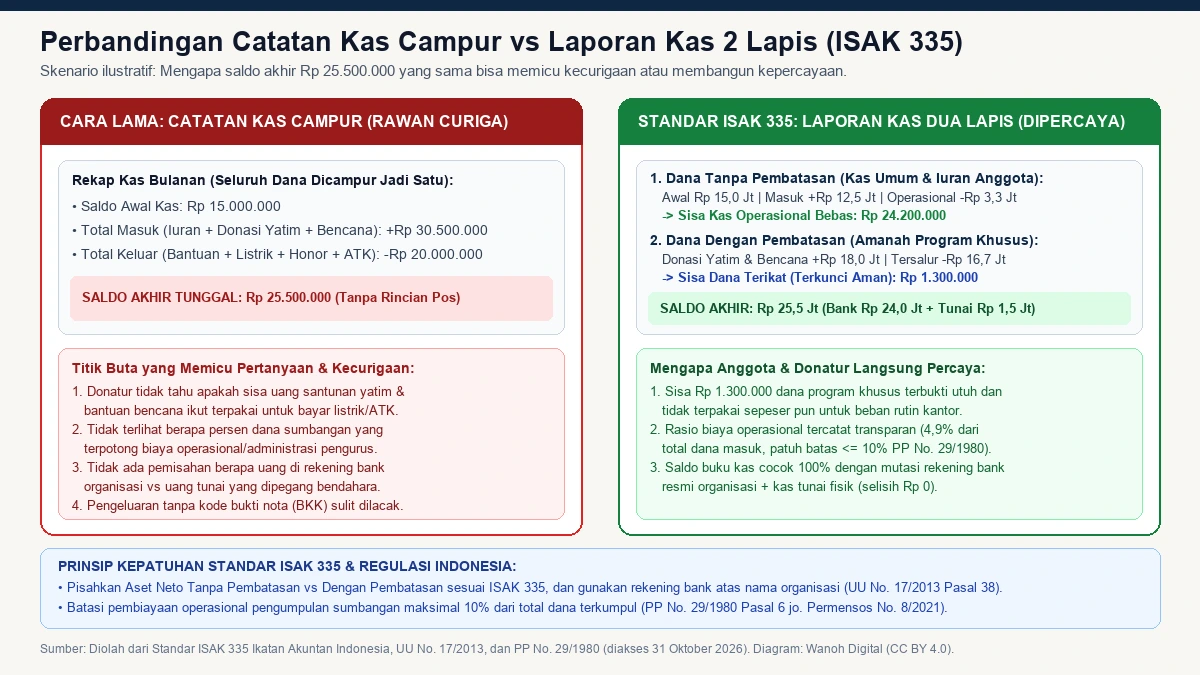
Source: Wanoh Digital (adapted from IAI ISAK 335 Standard, Law 17 of 2013, and PP Number 29 of 1980). License: CC BY 4.0.
To hear directly how Indonesia's official standard-setter frames updates to nonprofit reporting, watch the public hearing recording from the official Indonesian Institute of Accountants (IAI) YouTube channel below [5]:
For treasurers of foundations, schools, houses of worship, or community clubs looking for a concise overview of nonprofit financial statement components, watch this 8-minute 42-second walkthrough from a Licensed Accounting Services Office (KJA) [3, 5]:
How to structure a 2-layer cash report and attach receipts without breaching privacy?
As our practical rule of thumb from supporting SMEs and nonprofits since 2016, the surest way to build a cash report members grasp in under a minute while standing up to donor scrutiny is a Two-Layer Cash Report Format:
- Layer 1 (One-Page Public Summary): Shared regularly at the start of each month (by the 5th at the latest) in the member WhatsApp group, secretariat noticeboard, or organization website. This first layer shows three compact blocks: Unrestricted Funds (Free Cash) activity, Restricted Funds (Special-Program Trusts) activity, and Physical & Bank Cash Reconciliation (exact rupiah in the official bank account plus physical cash in the treasurer's safe) [3, 5, 9].
- Layer 2 (Receipt-Numbered Daily Cash Book & Digital Receipt Folder): Holds the chronological transaction register listing receipt codes (
BKM-01for Cash Receipt andBKK-01for Cash Disbursement) matched to photo filenames of store receipts or bank transfer slips stored inside a view-only cloud folder.

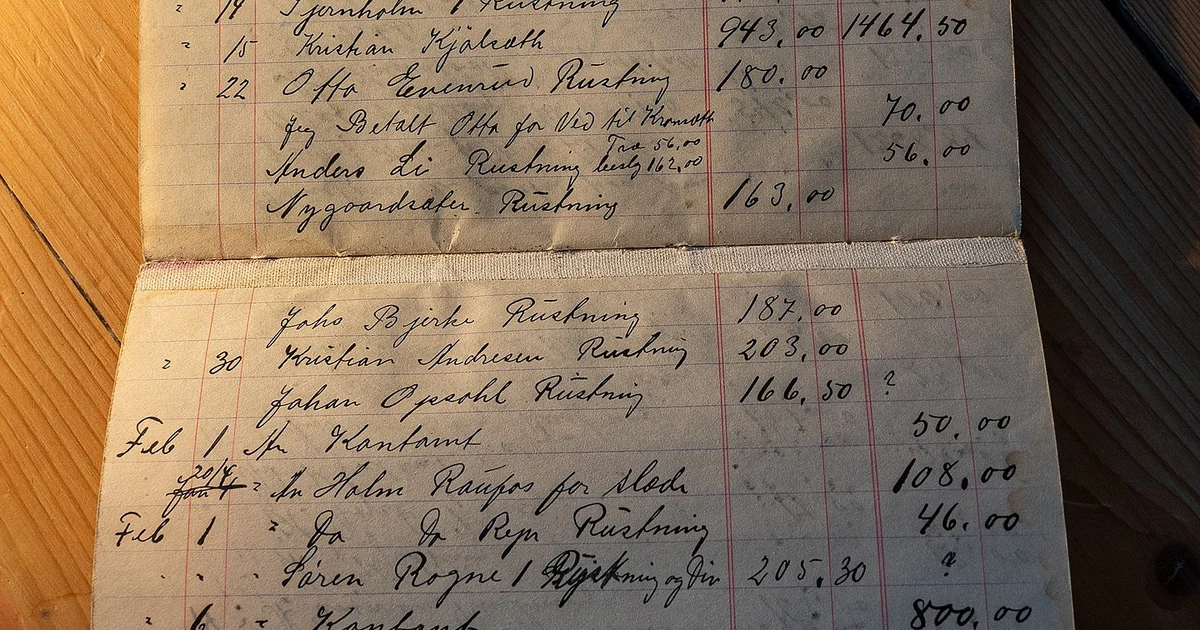
Source: Unsplash via Wikimedia Commons. License: CC0 1.0.
As illustrated at the reconciliation desk above, steady daily logging lets a treasurer assemble the monthly summary table without late-night rushes at month-end. Below is a complete illustrative example of a Monthly Public Cash Summary Table (Layer 1) ready to copy for foundations, mosque committees, school parent groups, or community associations [3, 5, 7]:
| Line Code | Cash Flow Category & Description (October 2026) | Cash In (Rp) | Cash Out (Rp) | Ending Balance by Line (Rp) |
|---|---|---|---|---|
| A | Part 1: Unrestricted Funds (General Cash & Member Dues) | |||
| A.0 | Beginning Unrestricted Cash Balance (as of 01 October 2026) | 15.000.000 | ||
| A.1 | Member Dues & General Donation Box / Unrestricted Gifts (BKM-01 to BKM-18) | 12.500.000 | ||
| A.2 | Routine Community Activities & Grounds Maintenance (BKK-01 to BKK-05) | 1.800.000 | ||
| A.3 | Secretariat Operating Costs: Electricity, Internet, Stationery, & Admin (BKK-06 to BKK-09) | 1.500.000 | ||
| Subtotal A | Ending Balance of Unrestricted Funds (Available for Operations) | 12.500.000 | 3.300.000 | 24.200.000 |
| B | Part 2: Restricted Funds (Special-Program Donor Trusts) | |||
| B.0 | Beginning Restricted Program Funds (as of 01 October 2026) | 0 | ||
| B.1 | Dedicated Donations for 50 Orphans Aid Program (BKM-19 to BKM-27) | 8.000.000 | ||
| B.2 | Dedicated Donations for Natural Disaster Relief Logistics (BKM-28 to BKM-35) | 10.000.000 | ||
| B.3 | Food Packages & Cash Aid Disbursed to 50 Orphans (BKK-10 to BKK-12) | 7.500.000 | ||
| B.4 | Phase 1 Disaster Logistics Disbursed with zero operating deductions (BKK-13 to BKK-16) | 9.200.000 | ||
| Subtotal B | Ending Balance of Restricted Funds (Locked for Phase 2: Orphans Rp 500.000 + Disaster Rp 800.000) | 18.000.000 | 16.700.000 | 1.300.000 |
| C | Part 3: Total Cash Reconciliation & Physical / Bank Balances (31 October 2026) | |||
| C.1 | Total Ending Cash Book Balance (Subtotal A + Subtotal B) | 30.500.000 | 20.000.000 | 25.500.000 |
| C.2 | Official Organization Bank Account Balance (Per Bank Statement 31 October 2026) | 24.000.000 | ||
| C.3 | Physical Cash in Treasurer's Safe (Cash Opname 31 October 2026) | 1.500.000 | ||
| C.4 | Reconciliation Variance: Cash Book vs Bank + Physical Cash (C.1 - (C.2 + C.3)) | 0 (100% Match) |
Notice how Subtotal B and Row C.4 in the table above answer every likely question from members and donors at a glance: orphan-aid donors see the remaining Rp 500.000 and disaster-relief donors see Rp 800.000 still locked intact in the ending balance, while the secretariat operating cost ratio (Rp 1.500.000 divided by total funds received Rp 30.500.000 = 4.9%) sits well below the 10% cap under Article 6 paragraph (1) of PP Number 29 of 1980 jo. Permensos Number 8 of 2021 [3, 7, 8].
To ensure sharing receipt photos in digital folders respects contributor privacy and beneficiary dignity, apply these two monthly operational checklists and broadcast templates [2, 6, 7]:
Template 1: Monthly Cash Closing Checklist & Two-Officer Cross-Check (Before the 5th)
Check off the items you have verified below, or click Copy Checklist to share it with your committee or site administrator.
Template 2: Monthly Cash Report Broadcast Message for Member & Donor WhatsApp Groups
[Organization Name], thank you for your trust, dues, and donations throughout [Month Year]. Below is our Cash Transparency & Fund Distribution Report as of [Month-End Date], cross-verified by the Board and Supervisors."Rp [...] | Inflows +Rp [...] | Activities & Operating Costs ([...]%) -Rp [...] -> Ending Unrestricted Cash: Rp [...]. 2) Restricted Special-Program Funds: Beginning Balance Rp [...] | Earmarked Donations +Rp [...] | Disbursed to Beneficiaries -Rp [...] -> Ending Restricted Funds (Locked Safe): Rp [...]."[Month-End Date] is Rp [...], held in Official Bank Account [Bank Name - Organization Name] (Rp [...]) and Safe Physical Cash (Rp [...]) (Reconciliation Variance: Rp 0 / 100% Match)."BKM/BKK) can be reviewed anytime via our official archive link (view-only access): [Google Drive Folder / Transparency Page Link]. For questions or donation recording corrections, please contact the Treasurer ([Name & WhatsApp Number])."To keep cashless dues and donations flowing straight into the institution's official bank account without mixing with the treasurer's personal funds, you can also review digital cashier governance in our guide on Indonesia's Digital Payment Transformation: From QRIS to SME AI.
How to verify cash reconciliation, the 10% operating limit, and draft monthly reports?
Before sharing a monthly cash report in the member WhatsApp group or pinning it to a noticeboard, run a two-minute self-check on three core compliance indicators: confirm the reconciliation variance between the cash book ending balance and actual bank plus physical cash is Rp 0, confirm the ending restricted program fund balance is not negative and is fully backed by actual cash on hand per ISAK 335, and verify the operating expense ratio for donation collection does not exceed the 10% ceiling under Article 6 paragraph (1) of PP Number 29 of 1980 jo. Permensos Number 8 of 2021 [3, 5, 7, 8].
Use the interactive calculator below by entering your organization's cash movements this month to test all three indicators and generate a ready-to-copy WhatsApp report draft:
Cash Reconciliation, Operating Ratio & WhatsApp Report Generator (ISAK 335)
Enter your organization's monthly cash figures to verify cash book reconciliation against bank + physical cash, test the operating cost ceiling (max 10% under PP No. 29/1980), and generate a ready-to-send report draft for members and donors.
Monthly Cash Report Summary Draft (Ready to Paste into WhatsApp Group / Notice):
*Methodology note: This tool separates Net Assets Without Restrictions and With Restrictions based on IAI ISAK 335 and checks operating costs against the 10% ceiling in PP No. 29 of 1980 jo. Permensos No. 8 of 2021.
In addition to the monthly checks above, managers of legally incorporated Foundations (Yayasan) must meet the annual compliance rules set out in Law Number 28 of 2004 Amending Law 16 of 2001 on Foundations [6]:
- Mandatory Written Annual Report and Office Noticeboard Posting (All Foundations): Under Article 49 paragraph (1) and Article 52 paragraph (1) of Law Number 28 of 2004, foundation boards must prepare a written annual report within 5 months after the fiscal year closes, and a summary of that annual report must be posted on the foundation office noticeboard for stakeholders to read [6].
- Mandatory Public Accountant Audit and Newspaper Publication Thresholds: Under Article 52 paragraphs (2) and (3) of Law Number 28 of 2004, if a foundation receives state aid, foreign aid, and/or public donations of Rp 500.000.000 (five hundred million rupiah) or more in 1 fiscal year, or holds assets outside waqf property of Rp 20.000.000.000 (twenty billion rupiah) or more, its financial statements must be audited by a Public Accountant and the summary must be published in an Indonesian-language daily newspaper [6].
- Safe Digital Publication and Easy Public Verification: So out-of-town donors can verify your institution's legitimacy easily, make sure your secretariat address is verified on local maps using our guide Register Google Business Profile in 10 Minutes: Pass Maps Verification. If your foundation or community publishes cash reports and official donation bank accounts on its website, protect the site against third-party tampering that could swap donation account numbers on visitors' screens by applying the checks in Website Looks Normal but Was Hacked? How to Check & Secure It, and handle routine member and donor communications efficiently as covered in SME Marketing Strategy 2027: Protect Margins in the AI Search Era.
If your foundation, mosque, cooperative, or community board wants to move cash bookkeeping from manual notes into structured spreadsheets or a digital transparency dashboard, you can talk it over free of charge through a Free Wanoh Digital Consultation. We also run training sessions for treasurers and officers through Wanoh Digital Educational Guides, as well as building custom organization financial publication pages through Wanoh Digital web application and workflow services (browse real ledger applications we have built on Wanoh Digital portfolio).
If your foundation, school committee, or community wants to try transparent cash and member dues tracking right away without building a system from scratch, you can use our free web app BukuQas, which is already used in live operations by the Parent Committee of TK Persis 21 Al Hikmah Soreang.
Frequently asked questions
Do small organizations like neighborhood associations, hobby clubs, or mosque committees have to prepare all five ISAK 335 financial statements?
For monthly public reporting to neighborhood residents, club members, or mosque congregants who are not accountants, you do not need to circulate five complex accounting documents; simply apply the core principle of ISAK 335 via the Two-Layer Cash Summary Table separating Unrestricted General Cash from Restricted Special-Program Trust Funds alongside bank and physical cash reconciliation [3, 5]. Preparing the full five-statement package under ISAK 335 (Statement of Financial Position, Statement of Comprehensive Income, Statement of Changes in Net Assets, Statement of Cash Flows, and Notes to Financial Statements) is only required formally at fiscal year-end for legal foundation entities or when undergoing a Public Accountant audit [3, 5, 6].
Can donor names be listed as "Anonymous" or masked in public cash reports to protect privacy?
Yes, and doing so is strongly recommended to protect contributor privacy in public channels, as long as the treasurer records a unique transaction reference code or the last four digits of the transfer reference number in the Daily Cash Book [2]. As an illustrative example, writing BKM-19 | Donor #019 (Anonymous - Transfer 12/10) | Orphan Aid | Rp 500.000 lets that donor confirm their gift entered the organization's cash intact without exposing their full name or personal phone number to the public.
What is the legal cap on operating expenses and committee fees taken from public donations?
Under Article 6 paragraph (1) of Government Regulation Number 29 of 1980 on Donation Collection Implementation in conjunction with Minister of Social Affairs Regulation Number 8 of 2021 on Money or Goods Collection (PUB), operating expenses for collecting donations are capped at no more than 10% (ten percent) of total donations collected, while donations collected for natural disaster relief must be distributed 100% to beneficiaries with zero operating deductions [7, 8]. If your organization requires routine admin funding above that figure, it must come from board or founding member dues or operational grants specifically given for office costs (Unrestricted Funds) [3, 7].
Technical notes
This section is intended for finance admin staff, supporting accountants, or managers of organization spreadsheets and websites structuring bookkeeping data in line with ISAK 335 (formerly ISAK 35) and Amendments to ISAK 335 (2026) [3, 5]:
- 4-Digit Chart of Accounts Structure for Net Asset Separation: Use account numbering that separates cash accounts (
11xx), liabilities (21xx), unrestricted net assets (31xx), and restricted net assets (32xx) from day one so monthly totals can be computed automatically withSUMIFSformulas instead of sorting entries manually at year-end [3, 5]. - Cash Flow Statement Classification Aligned with Amendments to ISAK 335 (Approved 3 June 2026): When preparing annual reports for nonprofits following SAK Indonesia, ensure sub-classifications for Operating, Investing, and Financing activities match the Amendments to ISAK 335 aligned with PSAK 118, where operating surplus or deficit serves as the starting line if the organization presents Cash Flows using the indirect method [5].
- Security of Digital Receipt Archives (Read-Only & Redacted): Save scanned receipt images (
BKM/BKK) in compressed image formats (.webpor flattened static.pdf) inside a folder set to Viewer (readeronly, restricting public downloads if wet signatures appear) so outsiders cannot alter receipt letterheads or officer signatures.
# Sample Chart of Accounts & Spreadsheet Reconciliation Formulas (ISAK 335)

[1100] CURRENT ASSETS - CASH & CASH EQUIVALENTS
  1101 - Physical Cash in Treasurer's Safe (Cash on Hand)
  1102 - Official Organization Bank Account - General Operations (Unrestricted)
  1103 - Official Organization Bank Account - Program Trust Funds (Restricted)

[3000] NET ASSETS (PER ISAK 335)
  3101 - Net Assets Without Restrictions (Member Dues, General Gifts, Self-Funded Income)
  3201 - Net Assets With Restrictions - Aid & Scholarship Programs
  3202 - Net Assets With Restrictions - Construction / Disaster Relief Programs

# Automated Validation Formulas in Spreadsheets (Google Sheets / Excel):
Ending_Unrestricted_Balance = Begin_3101 + SUMIFS(CashIn, FundCode, "3101") - SUMIFS(CashOut, FundCode, "3101")
Ending_Restricted_Balance   = Begin_32xx + SUMIFS(CashIn, FundCode, "32*") - SUMIFS(CashOut, FundCode, "32*")
Cash_Bank_Reconciliation_Diff = (Bal_1101 + Bal_1102 + Bal_1103) - (Ending_Unrestricted_Balance + Ending_Restricted_Balance)
PUB_Operating_Expense_Ratio   = Total_Board_Operating_Expenses / (Total_Inflow_3101 + Total_Inflow_32xx)
References
Verified Sources & References (9 Sources)Show References
- Charities Aid Foundation (CAF). "World Giving Index 2024: Global Trends in Generosity." Charities Aid Foundation, 23 July 2024. https://www.cafonline.org/insights/research/world-giving-index (accessed 31 October 2026).
- Association of Certified Fraud Examiners (ACFE). "Occupational Fraud 2024: A Report to the Nations." Association of Certified Fraud Examiners, 28 March 2024. https://www.acfe.com/fraud-resources/report-to-the-nations (accessed 31 October 2026).
- Financial Accounting Standards Board of the Indonesian Institute of Accountants (DSAK IAI). "Penomoran PSAK dan ISAK dalam SAK Indonesia (Efektif 01 Januari 2024)." Indonesian Institute of Accountants, 13 November 2023. https://web.iaiglobal.or.id/Berita-IAI/detail/penomoran_psak_dan_isak_dalam_sak_indonesia (accessed 31 October 2026) (in Indonesian).
- Financial Accounting Standards Board of the Indonesian Institute of Accountants (DSAK IAI). "Post-Implementation Review ISAK 335: Penyajian Laporan Keuangan Entitas Berorientasi Nonlaba." Indonesian Institute of Accountants, 17 March 2025. https://web.iaiglobal.or.id/Berita-IAI/detail/post-implementation_review_isak_335 (accessed 31 October 2026) (in Indonesian).
- Financial Accounting Standards Board of the Indonesian Institute of Accountants (DSAK IAI). "Pengesahan Amendemen ISAK 335: Penyajian Laporan Keuangan Entitas Berorientasi Nonlaba." Indonesian Institute of Accountants, 22 June 2026. https://web.iaiglobal.or.id/Berita-IAI/detail/pengesahan_amendemen_isak_335 (accessed 31 October 2026) (in Indonesian).
- Republic of Indonesia. "Undang-Undang Nomor 28 Tahun 2004 tentang Perubahan atas Undang-Undang Nomor 16 Tahun 2001 tentang Yayasan." Audit Board of the Republic of Indonesia (JDIH BPK RI), 06 October 2004. https://peraturan.bpk.go.id/Details/40703/uu-no-28-tahun-2004 (accessed 31 October 2026) (in Indonesian).
- Republic of Indonesia. "Peraturan Pemerintah Nomor 29 Tahun 1980 tentang Pelaksanaan Pengumpulan Sumbangan." Audit Board of the Republic of Indonesia (JDIH BPK RI), 02 September 1980. https://peraturan.bpk.go.id/Details/66625/pp-no-29-tahun-1980 (accessed 31 October 2026) (in Indonesian).
- Ministry of Social Affairs of the Republic of Indonesia. "Peraturan Menteri Sosial Nomor 8 Tahun 2021 tentang Penyelenggaraan Pengumpulan Uang atau Barang." Audit Board of the Republic of Indonesia (JDIH BPK RI), 22 September 2021. https://peraturan.bpk.go.id/Details/217212/permensos-no-8-tahun-2021 (accessed 31 October 2026) (in Indonesian).
- Republic of Indonesia. "Undang-Undang Nomor 17 Tahun 2013 tentang Organisasi Kemasyarakatan." Audit Board of the Republic of Indonesia (JDIH BPK RI), 22 July 2013. https://peraturan.bpk.go.id/Details/38876/uu-no-17-tahun-2013 (accessed 31 October 2026) (in Indonesian).