Summary The core difference between a landing page and a website comes down to the target action: a landing page is a single focused page without branching menus designed to turn ad clicks into one specific action, whereas a full website connects multiple pages as an organization's information and credibility hub [1, 2]. Choosing between the two directly affects cash flow for Micro, Small, and Medium Enterprises (MSMEs) when running Meta Ads, TikTok Ads, or Google Ads, or when entering Business-to-Business (B2B) procurement [2, 4]. Drawing on Google Ads Quality Score documentation and Stanford University's web credibility guidelines from over 4,500 participants, landing-page fit drives ad cost efficiency while complete organizational profiles win client trust [2, 4]. This guide helps service, F&B, clinic, and corporate-supplier SMEs weighing their initial website budget. Still, even the right structure fails to generate sales if mobile main-element loading or Largest Contentful Paint (LCP) exceeds 2.5 seconds or WhatsApp replies arrive hours later [7, 8].
Debates over landing page vs website often focus only on visual styling, even though Mozilla Developer Network (MDN) web architecture documentation distinguishes them plainly: a web page is a single document in the browser, while a website is a collection of linked pages under one domain name [1]. The first misconception draining SME ad budgets is assuming that once you pay for a full company profile website, every paid ad can simply point to the homepage. In practice, ad platforms evaluate how directly the destination page answers the user's search or ad promise, so dropping ad traffic onto a menu-heavy homepage scatters attention before visitors tap WhatsApp [2].
The second misconception is thinking a business can rely on one cheap promo page forever without building a multi-page website. A single-page approach works sharply for single-product campaigns, yet struggles once the business targets free traffic from local Google Maps searches or faces corporate buyers checking vendor legitimacy thoroughly [3, 4]. This article breaks down ad cost math, WhatsApp conversion flows, a five-parameter cost comparison, and how to start step by step without wasting capital.
Table of Contents
- What is the 30-second difference between a landing page and a website by purpose, not menu count?
- When is one landing page enough for SME ads and seasonal promos?
- When does a business need a full website for local Google search and client trust?
- How much does a landing page cost vs a full website, and how does it affect WhatsApp conversions?
- How do you start without wasting budget by testing one page first and expanding once it sells?
- Short technical notes for your ad manager
- Frequently asked questions (FAQ)
- References
What is the 30-second difference between a landing page and a website by purpose, not menu count?
In 30 seconds, the clearest way to tell them apart is by their primary job: a landing page exists to close one specific offer through one Call-to-Action (CTA) button, while a full website serves varied visitor intents such as learning company background, comparing catalogs, or checking your address [1, 2]. The number of menu links at the top of the screen is simply a byproduct of those different business roles.
Think of the difference between a dedicated promo booth at a mall entrance and your company's head office. The booth displays only this month's promo package, holds one price sheet, and assigns one staff member to capture interested visitors' WhatsApp numbers on the spot. By contrast, a head office has a reception desk, showrooms across product categories, business license displays, and after-sales desks so visitors with different needs find what they came for.
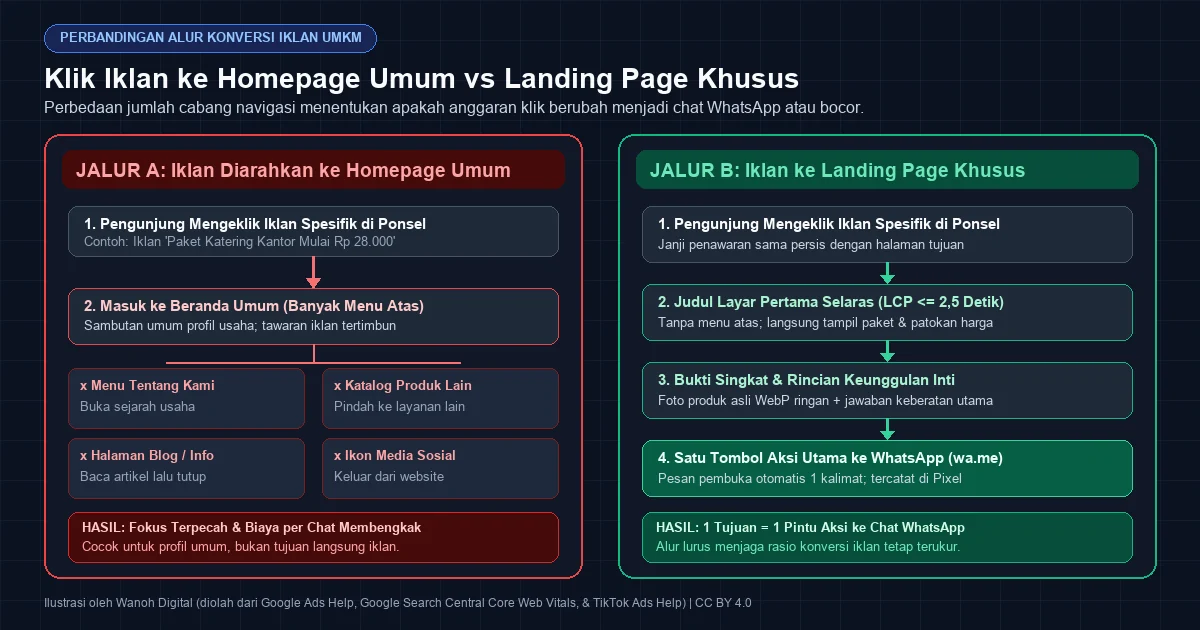
As shown in the flow diagram at the top of this article, sending paid ad clicks to a general website homepage is like dropping prospective buyers into a large building lobby full of exit doors. Some get distracted clicking About Us, browsing unrelated categories, or jumping to social media icons and forget the ad offer they came for. Positioning this independent digital asset also pairs with the guidance in when a business needs its own website vs social media or marketplaces.
When is one landing page enough for SME ads and seasonal promos?
An SME only needs one landing page when running paid ads for a flagship product, testing market demand for a new service, or launching a time-limited seasonal promo where all transactions route to one WhatsApp admin number [2, 10]. At this stage, launch speed and ad message match matter far more than multi-page company history.
In Google Ads, landing page experience is one of the three components determining your 1-to-10 Quality Score alongside expected Click-Through Rate (CTR) and ad relevance [2]. Google rates landing page experience as "Above average", "Average", or "Below average" based on how useful and relevant the page is to the searcher's keywords [2]. A dedicated page displaying the exact package promised in the ad helps keep that score competitive.
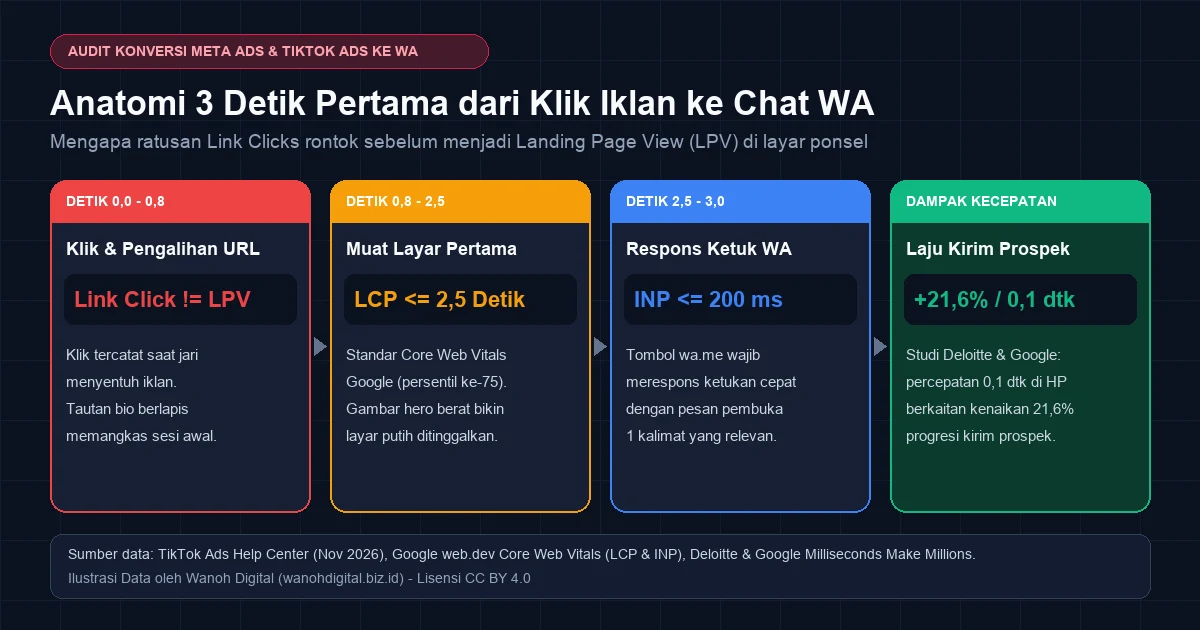
The same principle applies to mobile social campaigns. Referring to November 2026 TikTok Ads Manager guides and Meta Pixel docs, a Landing Page View (LPV) is only recorded once an ad is clicked, the destination page finishes loading, and the user stays in the browser session [10, 11]. A light single-column page without layered menu overhead reduces early drop-offs, as analyzed in detail in our first-3-seconds audit when ads get clicks but few WhatsApp chats.
What is the difference between a regular homepage and an ad landing page?
The difference between a regular homepage and a dedicated ad landing page lies in visitor source and navigation freedom [1, 2]. A homepage is your domain's main front door (such as usahaanda.com), built as a crossroads leading to Catalog, Portfolio, Articles, and Contact pages for people searching your brand directly.
By contrast, an ad landing page (such as usahaanda.com/paket-aqiqah) deliberately strips away top navigation bars and unnecessary outbound links. Every section flows in one direction down the page: continuing the ad promise, detailing package contents and pricing anchors, showing real proof of work, and guiding the reader's thumb to a single WhatsApp chat button [2].
Is a landing page considered a website?
Yes, technically a landing page is part of a website because it is a web page document accessed through a domain address in a browser [1]. Under MDN's web architecture definition, a website is a collection of linked web pages under one resource name, and even a site made of just one page still qualifies as a single-page website [1].
This means that once you buy your own domain and launch one landing page on it, you already own the foundation of an official website. You are simply opening your highest-yielding room first before building additional rooms later.
When does a business need a full website for local Google search and client trust?
A business needs a full multi-page website when marketing multiple distinct service categories searched organically on Google, relying on local Google Maps rankings, or targeting corporate and B2B clients who verify official vendor credentials before requesting a quote [3, 4]. A single promo page simply lacks the structure to carry all three jobs at once.
Two growth milestones strongly signal that one landing page is no longer enough:
- Capturing Local Google Search & Multi-Service Organic Traffic: Under official Google Business Profile guidance, local search rankings depend on three main factors: relevance, distance, and prominence [3]. Prominence is influenced by how thoroughly your business appears across the web, customer reviews, and web links pointing to your business site [3]. In addition, Google Search Central's SEO Starter Guide recommends organizing distinct topics into separate, clearly linked directory and page structures [5]. A dental clinic, for example, needs separate pages for braces, scaling, and wisdom-tooth extraction so each service can rank for Google searchers.
- Passing Corporate (B2B) Buyer Due Diligence: Stanford University's 3-year web credibility research across more than 4,500 participants concluded that visitors judge a website's trustworthiness by tangible evidence of the organization behind it [4]. That proof includes displaying a physical office or workshop address, team photos and expertise profiles, detailed service documentation, and clear ways to reach you by phone, official email, or street address [4]. In our ongoing support maintaining an industrial coating company's profile website in Bandung since 2016, factory procurement teams almost always inspect technical specification pages, facility addresses, and past project records before passing contacts to purchasing.

Source: Jan Vasek (Jeshoots), Wikimedia Commons / Unsplash, https://commons.wikimedia.org/wiki/File:Businessman_working_and_writing_notes_in_office_%28Unsplash%29.jpg. License: CC0 1.0.
The laptop review shown above reflects typical B2B and high-ticket service buyer behavior. Unlike impulse retail buyers on mobile ready to order off a single promo page, corporate purchasing managers usually open multiple tabs side by side to compare legal credentials and portfolios across vendors [4].
How much does a landing page cost vs a full website, and how does it affect WhatsApp conversions?
As a practical benchmark in Indonesia's current web market, building one landing page runs roughly Rp 1.000.000 to Rp 2.500.000 one-time (or from Rp 69.000 per month on a ready-to-run subscription), while a multi-page company profile and catalog website typically runs Rp 2.500.000 to Rp 6.000.000 excluding annual renewals. Year-two domain and server renewals should be factored in from the start by checking our website creation cost breakdown including overlooked expenses.
The five-parameter table below maps differences in cost, search capability, build timeline, and impact on your WhatsApp chat flow:
| Comparison Parameter | Landing Page (1 Focused Page) | Full Website (Multi-Page) |
|---|---|---|
| 1. Primary Traffic Goal | Paid ad campaigns (Meta Ads, TikTok Ads, Google Ads) and specific seasonal promo offers [2, 10] | Organic local Google search, business card or proposal referrals, and B2B credibility checks [3, 4] |
| 2. Action Buttons & Menus | No branching navigation menus; guides readers to 1 WhatsApp CTA button (wa.me) or single form | Top and footer navigation (Home, About, Services, Portfolio, Articles, Contact) for self-guided exploration [5] |
| 3. Market Cost vs Wanoh Digital Plans | Market (rule of thumb): Rp 1.000.000 to Rp 2.500.000 one-time + annual domain & hosting; Wanoh Digital Plan: Website Siap Jalan Rp 69.000/month (12-mo minimum Rp 828.000/year, includes domain, hosting, Secure Sockets Layer (SSL), & initial setup) | Market (rule of thumb): Rp 2.500.000 to Rp 6.000.000 one-time + annual renewals; Wanoh Digital Plan: Website Usaha from Rp 3.000.000 one-time (multi-page connected to WA & Google, includes 1 month Temani Website care & full code/domain ownership) |
| 4. Organic SEO Fit | Limited to ranking 1 narrow keyword group on a single URL | Strong at capturing dozens of distinct keywords across service category pages and supporting articles [5] |
| 5. Build Time & Impact on WA Chats | Around 1 to 5 business days; yields higher click-to-WA chat rates on cold ad traffic | Around 2 to 4 weeks; filters more mature prospects for long-term contract deals [4] |
To see the financial impact on daily ad spend, calculate an illustrative scenario for an office catering test campaign with a Rp 450.000 budget and an average cost per click of Rp 1.500 (producing 300 clicks):
- Path A: Ads Sent to a General Homepage (Assumed 4% Conversion in Illustrative Scenario): Because visitors have to hunt for the catering package among profile and other product menus, only 4% of the 300 clickers tap the WhatsApp button. In this illustrative scenario, you get 12 incoming chats at an acquisition cost of Rp 37.500 per chat.
- Path B: Ads Sent to a Dedicated Landing Page (Assumed 10% Conversion in Illustrative Scenario): With the same Rp 450.000 budget and 300 clicks landing on one focused office-catering page loading under 2.5 seconds, a 10% WhatsApp button tap rate yields 30 incoming chats. In this illustrative scenario, cost per conversation drops to Rp 15.000 per chat, saving Rp 22.500 per lead while adding 18 more deal opportunities on the exact same ad budget.
Keeping the destination page lightweight in the scenario above aligns with the 4-week Milliseconds Make Millions study by Google, Deloitte Digital, and Fifty-Five across 37 commercial brands [8]. That study found a 0.1-second mobile load speed improvement correlated with a 21.6% lift in lead-generation site visitors progressing to form submission, and a 20.6% increase in progression toward the contact page on retail sites [8].
Enter your planned ad budget and number of service categories in the calculator below to compare estimated cost per chat and see the recommended page-build stage:
Ad Conversion Simulator & Landing Page vs Website Selector
Adjust your test ad budget, cost per click, and business service profile to compare cost per WhatsApp chat and determine the leanest page format for your current stage.
Test ad budget: Rp 450.000 (est. 300 clicks @ Rp 1.500/click)
- General homepage (4.0%): 12 WA chats (Rp 37.500/chat)
- Focused landing page (10.0%): 30 WA chats (Rp 15.000/chat)
Recommendation: Start with 1 Focused Landing Page on your own domain, then expand into a multi-page website once the offer produces steady sales.
Note: Figures above are an illustrative scenario based on the parameters you enter. Market price ranges reflect practical benchmarks for SME web services in Indonesia, while actual chat volume depends on offer fit and mobile load speeds under 2.5 seconds.
How do you start without wasting budget by testing one page first and expanding once it sells?
The safest way to start without burning cash upfront is launching one landing page on your own official domain in week one to test how well the offer sells, then adding profile, catalog, and article pages onto the same domain once sales stabilize [5, 6]. This phased path keeps cash flexible without giving up brand ownership or ad learning data.
Follow this three-stage time-bound roadmap so every Rupiah invested in your web presence matches revenue growth:
- Stage 1, Days 1 to 5 (Launch 1 Test Page on Your Own Domain): As a practical rule over the first five days, register your own business domain, turn on encrypted
HTTPSwith SSL, and publish one focused page for the product or service with your healthiest margin [1, 5]. Place onewa.mebutton with a prefilled opening message and base ad pixel code from day one [9, 11]. - Stage 2, Days 6 to 30 (Validate Ads & Log Buyer Questions): Run a measured test ad budget for three weeks, track your LPV ratio and real cost per WhatsApp chat, and collect the questions prospective buyers ask your admin most often [10, 11]. Those real buyer objections and questions become the sharpest material for your next pages.
- Stage 3, Month 2 Onward (Expand into a Multi-Page Website Without Switching Domains): Once the core offer produces consistent gross margin, expand the same domain into a full website by adding a main Homepage, About Us, per-category service pages, and portfolio proof [4, 5]. Keep your original ad landing page URL live in a dedicated subfolder (such as
usahaanda.com/promo-katering) so active ad campaigns never lose their learning history [6].
Before contacting a web provider or assigning an internal team, copy and verify the 8-point readiness checklist below:
8-Point Checklist Before Ordering an SME Landing Page or Website
Check off each verified item below, or click Copy Checklist to send it to your team or website provider.
If you want to apply this phased sequence cleanly, inspect Wanoh Digital website and app examples first, then test one offer page with Website Siap Jalan (Rp 69.000/month with a 12-month minimum contract at Rp 828.000/year, covering domain, hosting, SSL, one ready-to-use template page, and a WhatsApp button, upgradeable anytime) or build Website Usaha directly (from Rp 3.000.000 one-time for a multi-page site wired to WhatsApp and Google, including 1 month of Temani Website maintenance plus full domain, hosting, and source code ownership in your name) on our Wanoh Digital pricing and workflow page.
If you already have a live site and want to verify its speed is ready for paid ads, you can also use Free Website Check within 24 Hours or share your current situation free with zero obligation to buy during our Listen via WhatsApp stage at +62 851 8323 1708.
Short technical notes for your ad manager
Share these three brief technical guidelines with your media buyer or web developer so the pages you build support both paid campaigns and organic search cleanly:
- Mobile Load Speed (Core Web Vitals): Under Google Search Central standards, ensure the page hits LCP within 2.5 seconds, Interaction to Next Paint (INP) tap responsiveness under 200 milliseconds, and Cumulative Layout Shift (CLS) below 0.1 on mobile devices [7]. Avoid autoplaying videos or stacked third-party chat scripts that delay the WhatsApp button from appearing [7, 8].
- Centralized Setup for Meta Pixel, TikTok Pixel, and Google Tag: Place a single GTM container in the page header so your ad team can install and update Google Ads conversion tags, Google Analytics, Meta Pixel (
PageViewplusContactclick events), and TikTok Pixel via the web interface without editing site source code repeatedly [9, 11]. Fire the conversion event right when a visitor taps thewa.mebutton, not solely on page load [10, 11]. - Choosing a Subdomain (
promo.usahaanda.com) vs Dedicated Page / Subfolder (usahaanda.com/promo): Referring to Google Search Central's URL structure documentation and official guidance, search engines can crawl and index both structures effectively [5, 6]. Use a subfolder (usahaanda.com/promo) when the landing page lives inside the same main website system for tidy management in a single Search Console property, or use a subdomain (promo.usahaanda.com) if your ad team uses a separate page-builder server from your main profile site [6].
Sample clean WhatsApp click-tracking markup to hand over to your GTM manager or developer [9, 11]:
<!-- Landing Page CTA button with data-event attributes for Google Tag Manager / Meta Pixel -->
<a
href="official-wa-me-link-for-your-business-number"
id="cta-wa-promo-utama"
data-cta-channel="whatsapp"
data-offer-name="paket-katering-kantor"
rel="noopener"
>
Check Schedule & Package Pricing via WhatsApp
</a>
<script>
// Example Contact event trigger when the WhatsApp button is tapped
document.getElementById('cta-wa-promo-utama')?.addEventListener('click', function () {
if (typeof window.fbq === 'function') {
window.fbq('track', 'Contact', { content_name: 'paket-katering-kantor' });
}
window.dataLayer = window.dataLayer || [];
window.dataLayer.push({ event: 'wa_lead_click', offer: 'paket-katering-kantor' });
});
</script>Also watch John Mueller from Google Search Central explain the technical trade-offs between subdomains and subfolders in the official video below:
Frequently asked questions (FAQ)
Can you have both a company profile website and an ad landing page on the same domain?
Yes, and it is strongly recommended so your marketing budget reinforces one shared brand [5, 6]. The root page (usahaanda.com) works as a multi-page official profile for Google searchers and B2B clients, while dedicated pages without top menus (such as usahaanda.com/promo-akhir-tahun) serve as direct ad destinations for Meta Ads, TikTok Ads, or Google Ads [2, 6].
How long does it take to build a landing page compared to a full company website?
As a practical rule of thumb, one landing page with photos and offer copy ready usually takes 1 to 5 business days because it focuses on a single page flow. By contrast, building a multi-page company website takes an average of 2 to 4 weeks to structure navigation menus, dedicated service pages, legal credentials, and baseline search optimization [4, 5].
If you start with a one-page plan, do you have to change to a new domain when upgrading to a full website?
You do not need to change domains as long as the landing page was hosted on your own business domain from day one rather than piggybacking on a third-party platform's free address [1, 5]. When your business expands into a multi-page website, a developer simply adds new pages on the same domain so business cards, Google Business Profile links, and ad pixel history keep running uninterrupted [3, 9].
References
Verified Sources & References (11 Sources)Show References
- MDN Contributors. "Browsing the web: The difference between web page, website, web server, and search engine." MDN Web Docs (Mozilla), 10 July 2025. https://developer.mozilla.org/en-US/docs/Learn_web_development/Getting_started/Environment_setup/Browsing_the_web (accessed 13 November 2026).
- Google Ads Help. "About Quality Score for Search campaigns." Google Ads Help, 18 February 2026. https://support.google.com/google-ads/answer/6167118?hl=id (accessed 13 November 2026).
- Google Business Profile Help. "How to improve your local ranking on Google." Google Business Profile Help, 12 March 2026. https://support.google.com/business/answer/7091?hl=id (accessed 13 November 2026).
- Fogg, B. J., et al. "Stanford Guidelines for Web Credibility." Stanford Persuasive Technology Lab, Stanford University, 01 May 2002 (research archive update). https://credibility.stanford.edu/guidelines/index.html (accessed 13 November 2026).
- Google Search Central. "SEO Starter Guide: The Basics." Google for Developers, 15 February 2026. https://developers.google.com/search/docs/fundamentals/seo-starter-guide?hl=id (accessed 13 November 2026).
- Google Search Central. "URL Structure Best Practices for Google Search." Google for Developers, 20 January 2026. https://developers.google.com/search/docs/crawling-indexing/url-structure?hl=id (accessed 13 November 2026).
- Google Search Central. "Understanding Core Web Vitals and Google Search Results." Google for Developers, 10 February 2026. https://developers.google.com/search/docs/appearance/core-web-vitals?hl=id (accessed 13 November 2026).
- Deloitte Digital, Fifty-Five, and Google. "Milliseconds Make Millions: Why Mobile Speed Can Slow or Grow Your Business." Google web.dev Case Studies, 18 June 2020. https://web.dev/case-studies/milliseconds-make-millions (accessed 13 November 2026).
- Google Tag Manager Help. "Tag Manager Overview." Google Tag Manager Help, 04 February 2026. https://support.google.com/tagmanager/answer/6102821?hl=id (accessed 13 November 2026).
- TikTok Ads Manager Help Center. "Landing Page View." TikTok Business Help Center, 01 November 2026. https://ads.tiktok.com/resources/help/article/landing-page-view (accessed 13 November 2026).
- Meta for Developers. "Meta Pixel Documentation." Meta Platforms, 12 March 2026. https://developers.facebook.com/docs/meta-pixel/ (accessed 13 November 2026).