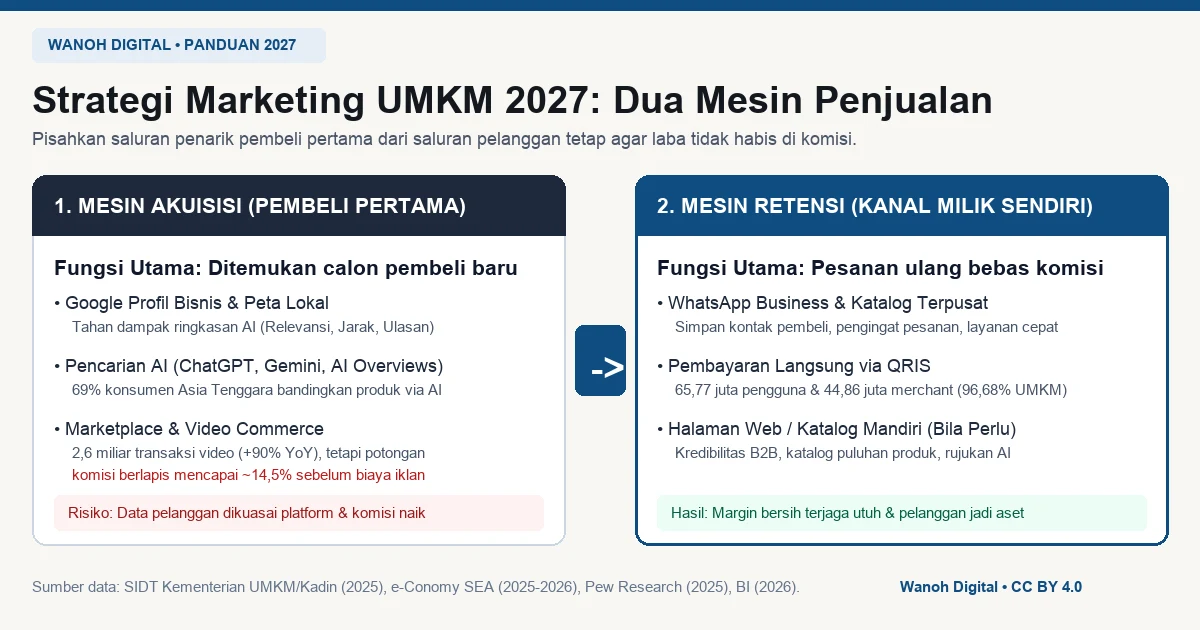
Summary: The core of SME marketing strategy in 2027 is separating channels that attract new buyers from repeat-transaction channels owned by your own business. Government data records 99.70% of Indonesia's 30.21 million non-agricultural Small and Medium Enterprises (SMEs) as micro-scale businesses [1]. As our practical rule of thumb, for teams of one to three people, trying to show up and run ads across every app at once often drains operating cash. Use Google Business Profile and marketplaces to win the first order, then guide repeat purchases to WhatsApp Business and your own catalog so net profit is not eroded by roughly 14.5% commission deductions in an illustrative per-transaction scenario [8].
Many business owners saw steady online store revenue throughout 2026 while the net cash landing in their bank account kept shrinking [10]. Two forces drive that squeeze: layered fee deductions on marketplace platforms and shifting shopper habits as consumers consult Artificial Intelligence (AI) before deciding what to buy [4, 8]. This guide walks through practical steps for business owners to protect profit margins and build a repeat customer base without burning ad capital.
Article Contents
- What is changing in SME marketing heading into 2027?
- Why does high marketplace revenue often leave thin profits?
- How do customers search for local products and services in the AI era?
- What should you audit and fix this week?
- When does an SME need its own website and when are free tools enough?
- Frequently asked questions
- Technical notes
- References
What is changing in SME marketing heading into 2027?
SME marketing heading into 2027 is shifting from a race to open more online storefronts toward managing net margins and keeping business identity clear in AI search engines. The 2026 e-Conomy Southeast Asia (SEA) report notes that in a July 2026 consumer survey of AI users across six major Southeast Asian markets, 69% of respondents used AI tools to compare product options before shopping [4]. At the same time, service fee adjustments across marketplaces since May 2026 require business owners to recalculate net profit on every sales channel [8, 10].
At the macro level, 2021 government data recorded 65.4 million SMEs across all sectors including agriculture, contributing 61% of national Gross Domestic Product (GDP) and absorbing 97% of the workforce [2]. Looking specifically at the verified administrative database of the Ministry of SMEs' Single Data Information System (SIDT) as of 31 December 2025, non-agricultural SMEs totaled 30.21 million units [1]. Out of those 30,209,069 units, 30,119,928 or 99.70% are micro enterprises, while small enterprises account for 0.24% and medium enterprises 0.05% [1].
Indonesia's three largest non-agricultural SME sectors are led by wholesale and retail trade at 14.44 million units, accommodation and food service at 6.41 million units, and manufacturing at 4.17 million units as of late 2025 [1]. On the online transaction side, the e-Conomy SEA 2025 report placed Indonesia's digital economy Gross Merchandise Value (GMV) near US$100 billion, with e-commerce contributing US$71 billion [3]. Video commerce transaction volume jumped 90% in a year to 2.6 billion transactions with 800,000 active sellers [3].
The catch, by our rule of thumb, is that micro businesses run by one to three people rarely have the staff hours or budget to shoot daily videos while fighting price wars across every app [10]. Copying big-brand marketing playbooks that burn budget across every channel quickly drains a small business's operating cash.
Why does high marketplace revenue often leave thin profits?
High sales turnover on marketplaces often leaves thin net profits because fee deductions are calculated as layered percentages of the selling price rather than the seller's profit spread [8, 10]. On Shopee Indonesia as of May 2026, regular store sellers (Non-Star) face category administration fees of 2.50% to 10.00% (with Category A items such as certain apparel and consumer goods reaching 10.00%, while other apparel subcategories sit around 8.25%) plus a Rp1,250 order processing fee per completed order after passing the free quota on the first 50 orders [8].
When sellers join promotional programs such as Gratis Ongkir XTRA for better product visibility, the platform charges an additional service fee of 1% to 8% for regular-sized items or 2.5% to 9.5% for special-sized items, subject to a per-item nominal cap [8]. An analysis by UKMIndonesia.id in May 2026 also highlighted higher per-item commission caps and changes to automated ad billing deducted directly from sales balances [10].
As an illustrative scenario you can adjust to your own product subcategory rates, compare selling one apparel item priced at Rp100,000 with an assumed Cost of Goods Sold (COGS) of Rp60,000 in the table below (actual field rates depend on product subcategory, service fee caps, and business tier) [8, 10, 16]:
| Calculation Component (Illustrative Scenario) | Sale via Marketplace (Non-Star + Ongkir XTRA) | Repeat Order via WhatsApp Business & QRIS |
|---|---|---|
| Selling price to buyer (excluding shipping) | Rp100.000 | Rp100.000 |
| Cost of Goods Sold (COGS, assuming 60% of selling price) | Rp60.000 | Rp60.000 |
| Category administration fee (8.25% scenario; Category A up to 10%) | Rp8.250 [8] | Rp0 (no marketplace commission) |
| Completed order processing fee (after first 50 Non-Star orders) | Rp1.250 [8] | Rp0 (no platform processing fee) |
| Gratis Ongkir XTRA service fee (5% scenario; subject to per-item cap) | Rp5.000 [8] | Rp0 (shipping paid by buyer / agreed separately) |
| QRIS Merchant Discount Rate (MDR) fee (Micro Business up to Rp500.000) | Included in platform payment system [8] | Rp0 (0% MDR per BI policy; 0.3%-0.7% above limit) [16] |
| Total direct transaction deductions | Rp14.500 (14.5%) [8] | Rp0 (Micro Business scenario up to Rp500.000) [16] |
| Remaining contribution margin (before ads, packaging, and admin time) | Rp25.500 (25.5%) | Rp40.000 (40.0%) |
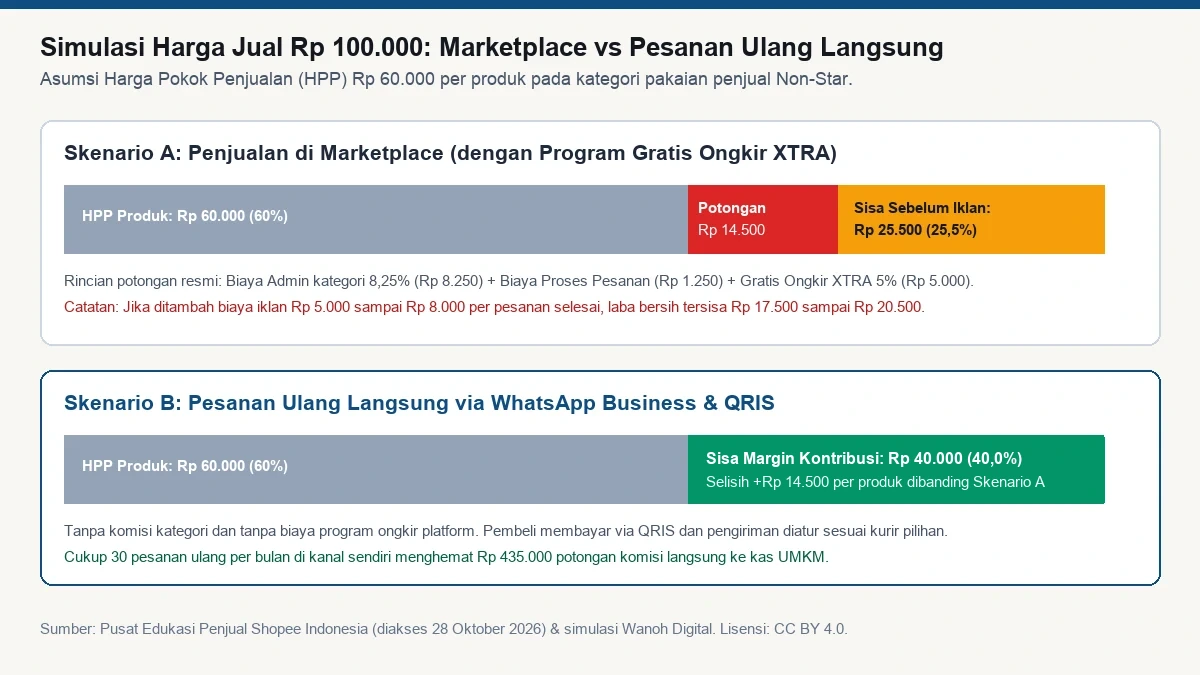
Source: Wanoh Digital (adapted from Shopee Indonesia Seller Education Center data). License: CC BY 4.0.
Figure 1 shows that even before subtracting ad spend, the Rp14.500 deduction in that illustrative scenario trims more than a third of the gross profit you would otherwise keep [8]. As an added illustrative simulation, if you spend a conservative Rp5.000 to Rp8.000 on ads per order to keep the product on top pages, your remaining contribution margin shrinks to Rp17.500 to Rp20.500 per item [10].
By contrast, when that same buyer places a second order through WhatsApp Business and pays using Quick Response Code Indonesian Standard (QRIS), Bank Indonesia sets a 0% (Rp0) Merchant Discount Rate (MDR) for Micro Enterprises on transactions up to Rp500.000 and for Small and Medium Enterprises up to Rp100.000 starting 01 October 2026 (above those thresholds, rates of 0.3% for Micro Enterprises or 0.7% for Small and Medium Enterprises apply) [16]. Note that on both sales paths, you still need to factor in packaging costs, admin time spent answering chats, and shipping arrangements with the buyer as part of operating overhead.
To calculate your store's exact numbers using your own selling price, COGS, and category commission percentage, use the interactive calculator below:
Contribution Margin & Retention Savings Simulator
Enter your product's selling price, Cost of Goods Sold (COGS), and platform fee percentage to calculate remaining contribution margin per unit and potential operating cash saved via repeat orders on WhatsApp Business & QRIS.
*Methodology note: Figures above reflect remaining contribution margin per unit (before fixed overhead such as admin salaries, electricity, extra packaging, return risk, and taxes).
How do customers search for local products and services in the AI era?
Customers now begin by asking an AI assistant for recommendations or reading the AI summary at the top of Google, then checking a shop's credibility through Google Maps and buyer reviews. A March 2025 observational study by the Pew Research Center across 68,879 Google searches from 900 adult respondents in the United States found that when an AI summary (AI Overviews) appeared on screen, the share of users clicking regular website links dropped by nearly half from 15% to just 8% of visits [5, 6]. Direct clicks on source links inside the AI summary box occurred in only 1% of visits, while 26% of users ended their search session right after reading the summary [5, 6].
Even though that observational sample came from U.S. users, the drop in clicks to generic blog pages is an important signal for Indonesian businesses [4, 5]. The e-Conomy SEA 2026 report records 243 million people, or 58% of the working-age population across six major Southeast Asian countries, already using generative AI in under three years [4]. In the July 2026 consumer survey of AI users across those six markets, 69% used AI to compare products and 93% trusted its recommendations, then verified them via search engines, store reviews, and social media before buying [4].
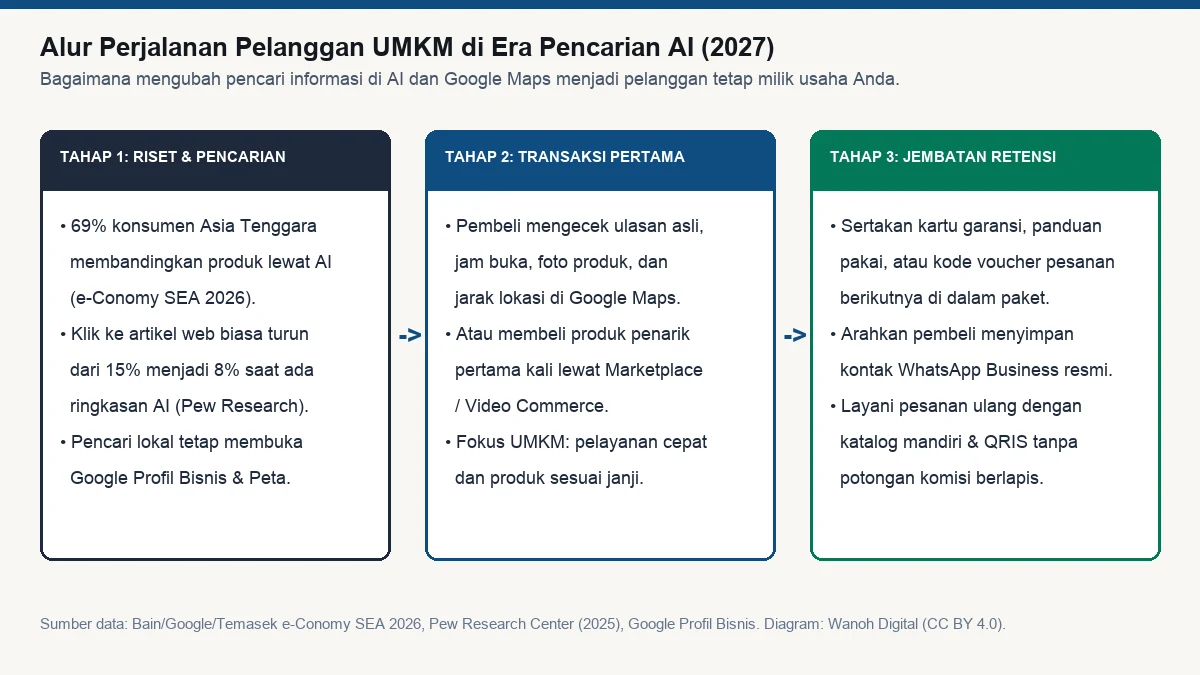
Source: Wanoh Digital (adapted from e-Conomy SEA 2026 and Pew Research Center). License: CC BY 4.0.
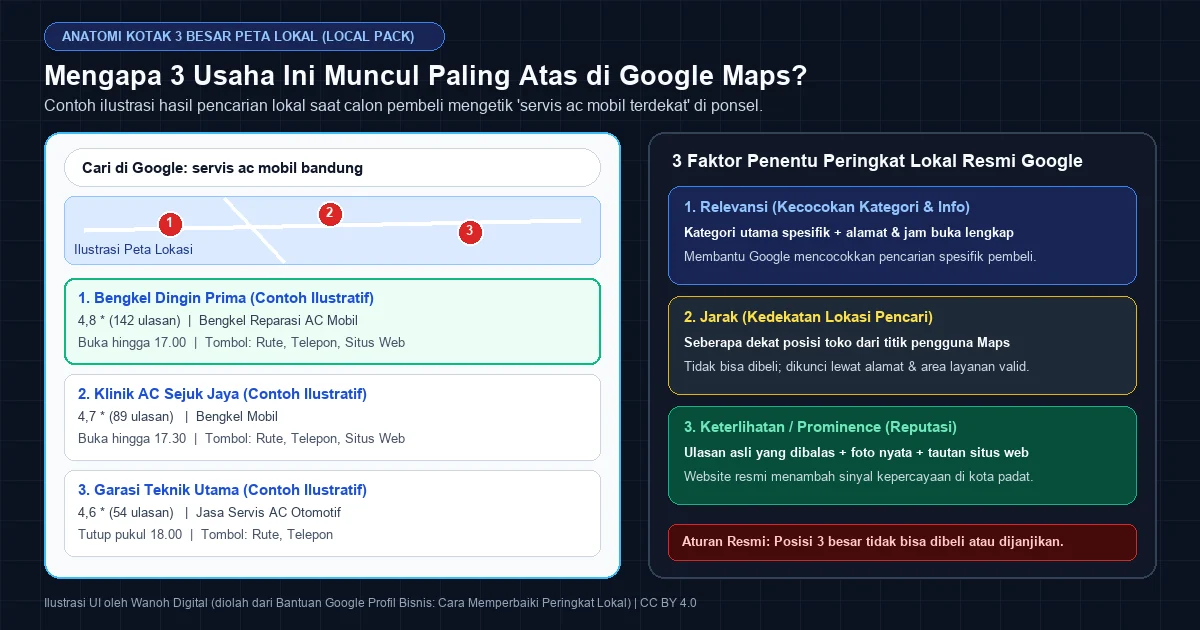
As shown in Figure 2, the SME customer journey heading into 2027 splits into three reinforcing stages: discovery through AI search and Google Business Profile, first purchase to test product and delivery quality, and repeat-order retention through WhatsApp Business and QRIS payments [4, 7, 9]. For local SMEs such as restaurants, repair shops, clinics, caterers, or garment workshops, search engines and AI assistants pull directly from a complete Google Business Profile, whose ranking rests on three official factors: category relevance, physical distance, and prominence built from authentic customer reviews [7].
For a concrete look at how micro-business owners in Indonesia are using Google's AI ecosystem in daily store operations, watch this short documentation from the Jakarta Provincial Office of Industry, Trade, Cooperatives, and SMEs (PPKUKM):
What should you audit and fix this week?
Immediate actions an SME owner can complete this week without adding ad spend center on three foundations: recalculating remaining contribution margin per item, completing your Google Business Profile, and preparing an after-sales bridge on WhatsApp Business. Together, these steps plug margin leaks while raising your visibility in Google local search and AI assistants [4, 7, 8].
Walk through this four-step checklist with your admin team this week:
- Step 1, separate customer-acquisition items from repeat-order items: Keep single-unit items with healthy margins listed on marketplaces as your storefront to attract first-time buyers, while preparing refill packs or after-sales service through your store's own official channel [8, 10].
- Step 2, fill out your Google Business Profile to 100%: Make sure your business name, physical address, opening hours including holidays, specific category, and product price list are complete using our guide Register Google Business Profile in 10 Minutes: Pass Maps Verification, then regularly collect and reply to customer reviews following How to Ask for Google Reviews Without Breaking the Rules: SME Guide [7].
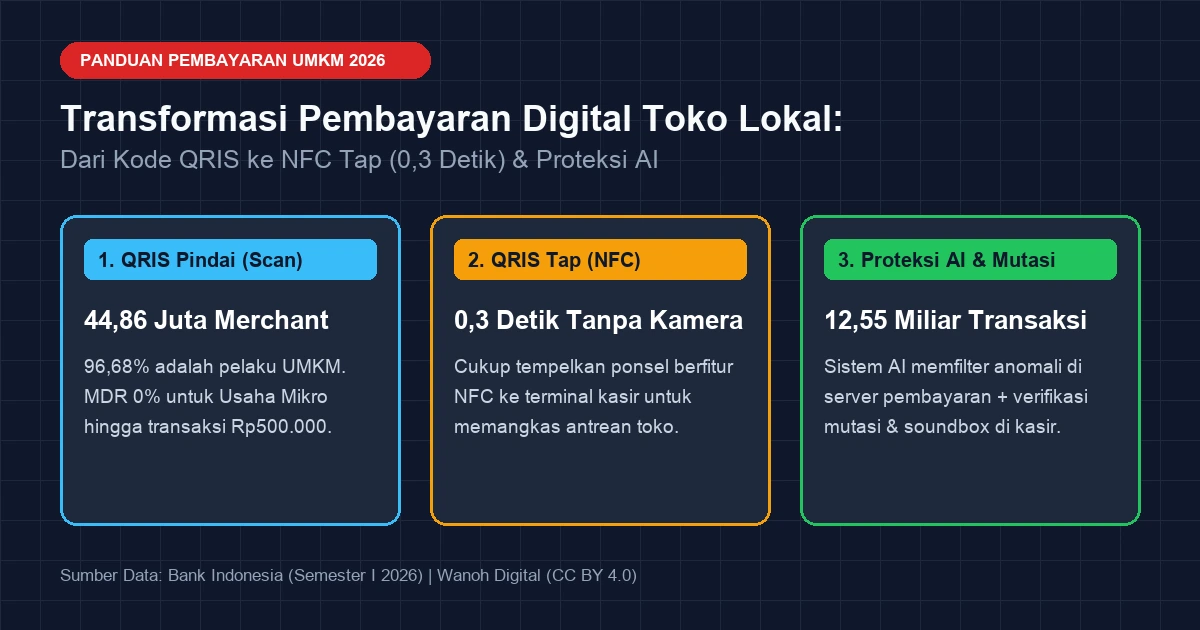
- Step 3, set up fast replies and a catalog in WhatsApp Business: The e-Conomy SEA 2026 report notes that digital platforms and businesses integrating AI-driven multimodal product discovery, guided in-app chat assistants, and relevant recommendations saw order volumes climb by up to 75% [4]. For a micro business, you do not need complex AI software; simply apply that speed-of-reply and catalog-clarity principle inside WhatsApp Business paired with digital payments as covered in Indonesia's Digital Payment Transformation: QRIS and AI, especially as QRIS reached 65.77 million users and 44.86 million merchants by June 2026, with 96.68% of them being SMEs [9].
- Step 4, include an official warranty and care card inside the package (follow platform rules): Place a usage instructions card, product warranty registration, or official after-sales contact inside physical packaging so buyers learn your brand identity [10]. Platform compliance warning: Never send WhatsApp numbers, external links, or invitations to transact off-app inside marketplace chat rooms, because steering transactions off-platform violates terms of service (such as Shopee's off-platform transaction ban) and can trigger penalty points or store suspension [8]. Keep physical insert cards focused on after-sales care and official warranties per your platform's policies.
To help your admin team apply Steps 3 and 4 neatly and safely on this week's shipments, copy and customize these two operational templates:
Template 1: Official After-Sales & Product Care Insert Card
[Your Brand Name] products. Keep this card for warranty claims, care instructions, and official brand catalog information.08xx-xxxx-xxxxTemplate 2: Quick Reply Shortcut (/catalog) for Customers on WhatsApp Business
[Buyer Name], thank you for reaching out to official support at [Your Store Name].[WA / Web Catalog Link][Official Store Name]. Please reply with your item name and delivery district.If you want to put all four steps into practice right away with your admin team using printable worksheets based on our practical rules (covering a five-SKU margin audit sheet, bundle planner, Google Business Profile audit, six WhatsApp Business quick-reply scripts, and a customer check-in schedule), download this article's companion workbook for free:
If you want to map out your customer messaging flow and see which channels cost least for your business, you can use a Free Wanoh Digital Consultation for an open, no-obligation discussion. For admin teams just learning to manage local search profiles and chat catalogs, Wanoh Digital Educational Guides also provide step-by-step instructions in plain language.
When does an SME need its own website and when are free tools enough?
By our rule of thumb heading into 2027, not every SME needs to spend money building a custom website or app. In our work at Wanoh Digital alongside SMEs and nonprofits since 2016, many sales bottlenecks are resolved simply by organizing customer chat workflows and tidying up Google Business Profile without building a new system.

Source: Clark Street Mercantile via Unsplash / Wikimedia Commons. License: CC0 1.0.
To help you make an objective decision without guessing, use the Sales Channel Diagnostic Matrix below as our rule of thumb by picking the closest column on each row and totaling your score:
| Business Operating Variable (Our Rule of Thumb) | Score 1 (Early Stage) | Score 2 (Growing Stage) | Score 3 (Complex Stage) |
|---|---|---|---|
| 1. Active product variations | Fewer than 20 product types | 20 to 75 product types | More than 75 product types or custom variants |
| 2. Average monthly marketplace commission fees | Under Rp750.000 per month | Rp750.000 to Rp2.500.000 per month | Above Rp2.500.000 per month |
| 3. Admin hours answering repeated catalog questions | Under 1 hour per day | 1 to 3 hours per day | More than 3 hours per day |
| 4. Primary buyer profile | Individual shoppers near your location | Cross-city retail shoppers who reorder often | Companies, agencies, schools, or wholesale resellers (B2B) |
Add up your four business condition scores as a practical benchmark (ranging from 4 to 12 points) and match them with the recommended actions below:
- Total Score 4 to 6 points (Local Foundation Phase, zero system cost rule of thumb): Stick with the free combination of Google Business Profile, WhatsApp Business Catalog, and QRIS. Focus admin hours on gathering authentic customer reviews on Google Maps and improving product photos [7, 9].
- Total Score 7 to 9 points (Hybrid Acquisition and Retention Phase, our rule of thumb): Keep marketplaces specifically for products that draw first-time buyers, while setting up a centralized price list page or single-link catalog so returning customers can reorder via WhatsApp without cutting into contribution margin [8, 10].
- Total Score 10 to 12 points (Independent Web Catalog & B2B Phase, our rule of thumb): Your business is ready for a lightweight independent catalog website connected to WhatsApp, because monthly commission savings and saved admin hours far exceed web maintenance costs [8, 10].
If your business is already at the stage where a centralized catalog page that your admin can update easily makes sense, Wanoh Digital website development can build a lightweight site wired straight to your business WhatsApp number (browse examples on Wanoh Digital portfolio or check an existing site with our Free 24-Hour Website Check). You can also print the two-week execution roadmap inside the SME Marketing Playbook 2027 on Lynk.id to guide daily work with your shop team.
Frequently asked questions
Is selling on marketplaces still profitable for SMEs in 2027?
Selling on marketplaces in 2027 remains profitable when treated as a first-time buyer acquisition channel rather than your only sales venue [8, 10]. With 2.6 billion video commerce transactions in Indonesia [3], marketplaces deliver wide market reach, yet direct fee deductions of around 14.5% in an illustrative scenario before ads require SMEs to build customer loyalty through after-sales care and owned official channels [8, 10].
Why does my business rarely appear when customers search for nearby shops on Google or AI?
Local businesses rarely surface in Google Maps results or AI recommendations when core details on Google Business Profile are incomplete or neglected [7]. Official Google documentation defines three local ranking factors: category match (relevance), physical proximity (distance), and complete opening hours, authentic photos, and customer reviews (prominence) [7].
What is a reasonable digital marketing budget for a micro business?
Micro enterprises, which make up 99.70% of Indonesia's non-agricultural SME population, should begin with zero-subscription organic channels such as Google Business Profile and WhatsApp Business [1, 7]. When testing paid ads or marketplace promo programs, verify that total commissions and ad spend do not consume your remaining contribution margin after calculating Cost of Goods Sold (COGS), shipping, packaging, and admin time [8, 10].
Technical notes
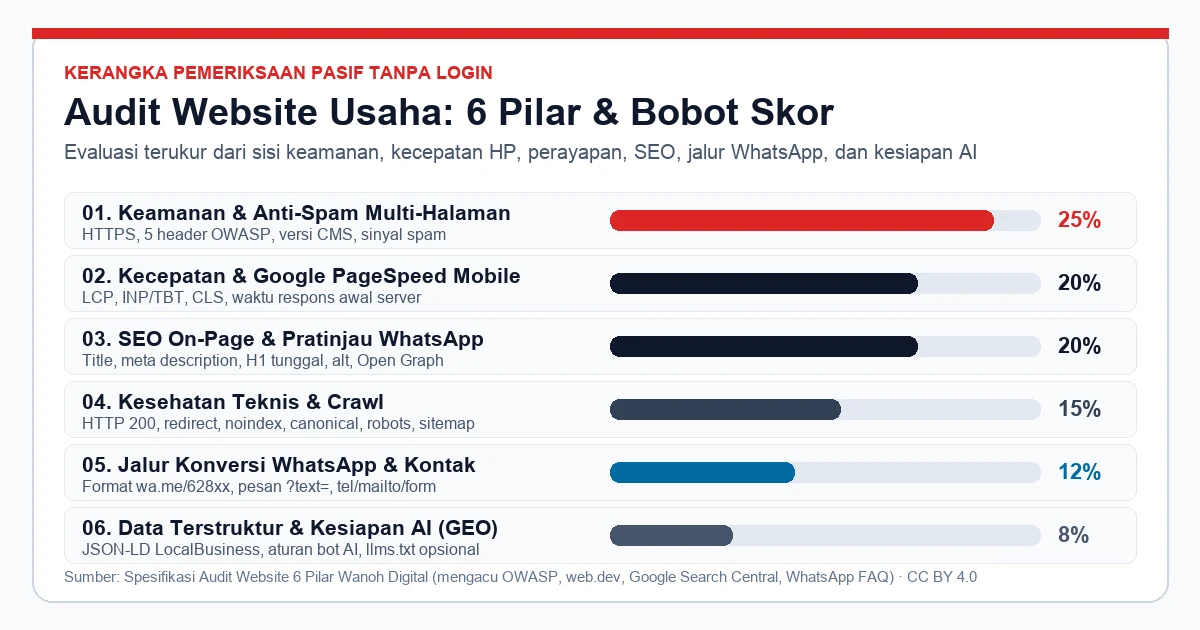
This section is for Information Technology (IT) staff or SME web managers ensuring a business site is easy to read for both traditional search engines and AI answer systems. Generative Engine Optimization (GEO) research by Aggarwal et al. at the 2024 Knowledge Discovery and Data Mining (KDD) conference showed on the GEO-bench benchmark that adding verified facts, clear statistics, and credible citations raised source visibility inside generative answers by up to 40% [11, 12].
Even so, the technical settings below are prerequisites for crawler readability (technical discoverability), not a guarantee that a page will rank first or be cited by AI systems. Final recommendations still depend on content authenticity and genuine customer reviews [7, 11]:
- Structured Data Standards: Embed
LocalBusinessandOrganizationschema types from the standard Schema.org vocabulary written in JavaScript Object Notation for Linked Data (JSON-LD) per World Wide Web Consortium (W3C) recommendations [13]. Ensure Name, Address, Phone (NAP) attributes in structured code match your Google Business Profile exactly [7, 13]. - Complete HTML Metadata and Link Previews: Include
<meta name="description">per Mozilla Developer Network (MDN) HTML reference documentation [14], and set Open Graph protocol tags (og:title,og:description,og:imagefrom the ogp.me specification explained in MDN's webpage metadata guide) so clean page summaries appear when catalog links are shared on WhatsApp or indexed by search engines [17]. - Crawler Access Rules in
robots.txt: Following the Internet Engineering Task Force (IETF) Request for Comments (RFC) 9309 Robots Exclusion Protocol, verify thatrobots.txtdoes not block search crawlers such asGooglebot,OAI-SearchBot, andPerplexityBotfrom product catalog and business profile pages [15].
# Sample robots.txt configuration per RFC 9309 for an SME catalog website
User-agent: Googlebot
Allow: /

User-agent: OAI-SearchBot
Allow: /

User-agent: PerplexityBot
Allow: /
Testing note: The configuration structure above follows standard IETF RFC 9309 syntax and W3C recommendations as of 28 October 2026 [13, 15].
Update and correction policy: All platform fee schedules, QRIS MDR rules, SME statistics, and research citations in this article were verified as of 28 October 2026 [1, 4, 8, 16]. Whenever platform commission policies or official government figures change, this article will be updated with a revision date note.
References
Verified Sources & References (17 Sources)Show References
- Indonesian Chamber of Commerce and Industry (Kadin) (citing Ministry of SMEs SIDT data). "Data dan Statistik UMKM Indonesia." Kadin Indonesia, 15 January 2026. https://kadin.id/data-dan-statistik/umkm-indonesia/ (accessed 28 October 2026) (in Indonesian).
- Ministry of State Secretariat of the Republic of Indonesia. "Kontribusi UMKM bagi Perekonomian Besar, Presiden Tekankan Pentingnya Izin bagi UMKM." State Secretariat RI, 13 July 2022. https://www.setneg.go.id/baca/index/kontribusi_umkm_bagi_perekonomian_besar_presiden_tekankan_pentingnya_izin_bagi_umkm (accessed 28 October 2026) (in Indonesian).
- Google Indonesia, Temasek, and Bain & Company. "e-Conomy SEA 2025: Ekonomi digital Indonesia mendekati GMV $100 miliar tahun ini." Google Indonesia Blog, 06 November 2025. https://blog.google/intl/id-id/company-news/outreach-initiatives/e-conomy-sea-2025-ekonomi-digital-indonesia-mendekati-gmv-us100-miliar/ (accessed 28 October 2026) (in Indonesian).
- Hoppe, Florian, Willy Chang, Aadarsh Baijal, Fock Wai Hoong, and Nitin Gajria. "e-Conomy SEA 2026: Building the intelligent economy." Bain & Company, Google, and Temasek, 21 October 2026. https://www.bain.com/insights/e-conomy-sea-2026/ (accessed 28 October 2026).
- Chapekis, Athena, and Anna Lieb. "Google users are less likely to click on links when an AI summary appears in the results." Pew Research Center, 22 July 2025. https://www.pewresearch.org/short-reads/2025/07/22/google-users-are-less-likely-to-click-on-links-when-an-ai-summary-appears-in-the-results/ (accessed 28 October 2026).
- Chapekis, Athena, et al. "Investigating Click Behaviors On Google Search Result Pages That Produce an AI Overview." arXiv Preprint arXiv:2608.04831, 08 August 2026. https://arxiv.org/abs/2608.04831 (accessed 28 October 2026).
- Google. "How to improve your local ranking on Google." Google Business Profile Help, 10 January 2026. https://support.google.com/business/answer/7091?hl=id (accessed 28 October 2026) (in Indonesian).
- Shopee Indonesia. "Biaya Administrasi Penjual Non-Star, Biaya Proses Pesanan, dan Program Gratis Ongkir XTRA." Shopee Seller Education Hub, 01 May 2026. https://seller.shopee.co.id/edu/article/7187 (accessed 28 October 2026) (in Indonesian).
- Antara News (citing Bank Indonesia Deputy Governor Filianingsih Hendarta). "BI: QRIS dipakai 65,77 juta pengguna dan diterima 44,86 juta merchant." ANTARA News Agency, 21 August 2026. https://www.antaranews.com/berita/5705449/bi-qris-dipakai-6577-juta-pengguna-dan-diterima-4486-juta-merchant (accessed 28 October 2026) (in Indonesian).
- UKMIndonesia.id. "Biaya Marketplace Naik Mei 2026, Seller UMKM Harus Tahu Strategi Bertahan Ini." UKMIndonesia.id (LPEM FEB UI), 12 May 2026. https://ukmindonesia.id/baca-deskripsi-posts/biaya-marketplace-naik-mei-2026-seller-umkm-harus-tahu-strategi-bertahan-ini (accessed 28 October 2026) (in Indonesian).
- Aggarwal, Pranjal, et al. "GEO: Generative Engine Optimization." arXiv Preprint arXiv:2311.09735, 28 June 2024. https://arxiv.org/abs/2311.09735 (accessed 28 October 2026).
- Aggarwal, Pranjal, et al. "GEO: Generative Engine Optimization." Proceedings of the 30th ACM SIGKDD Conference on Knowledge Discovery and Data Mining (KDD 2024), 25 August 2024. https://doi.org/10.1145/3637528.3671900 (accessed 28 October 2026).
- World Wide Web Consortium (W3C). "JSON-LD 1.1: A JSON-based Serialization for Linked Data." W3C Recommendation, 16 July 2020. https://www.w3.org/TR/json-ld11/ (accessed 28 October 2026).
- Mozilla Developer Network (MDN). "The metadata element (<meta>)." MDN Web Docs, 10 July 2026. https://developer.mozilla.org/en-US/docs/Web/HTML/Reference/Elements/meta (accessed 28 October 2026).
- Koster, Martijn, Gary Illyes, Henner Zeller, and Lizzi Sassman. "RFC 9309: Robots Exclusion Protocol." Internet Engineering Task Force (IETF), 01 September 2022. https://www.rfc-editor.org/rfc/rfc9309 (accessed 28 October 2026).
- Antara News (citing Acting Bank Indonesia Governor Destry Damayanti and BI Payment System Policy Department Head Ryan Rizaldy). "BI perluas kebijakan MDR QRIS 0 persen untuk pelaku UMKM." ANTARA News Agency, 16 September 2026. https://jogja.antaranews.com/berita/848451/bi-perluas-kebijakan-mdr-qris-0-persen-untuk-pelaku-umkm (accessed 28 October 2026) (in Indonesian).
- Mozilla Developer Network (MDN). "What's in the head? Metadata in HTML (including the Open Graph ogp.me protocol specification)." MDN Web Docs, 15 July 2026. https://developer.mozilla.org/en-US/docs/Learn_web_development/Core/Structuring_content/Webpage_metadata (accessed 28 October 2026).