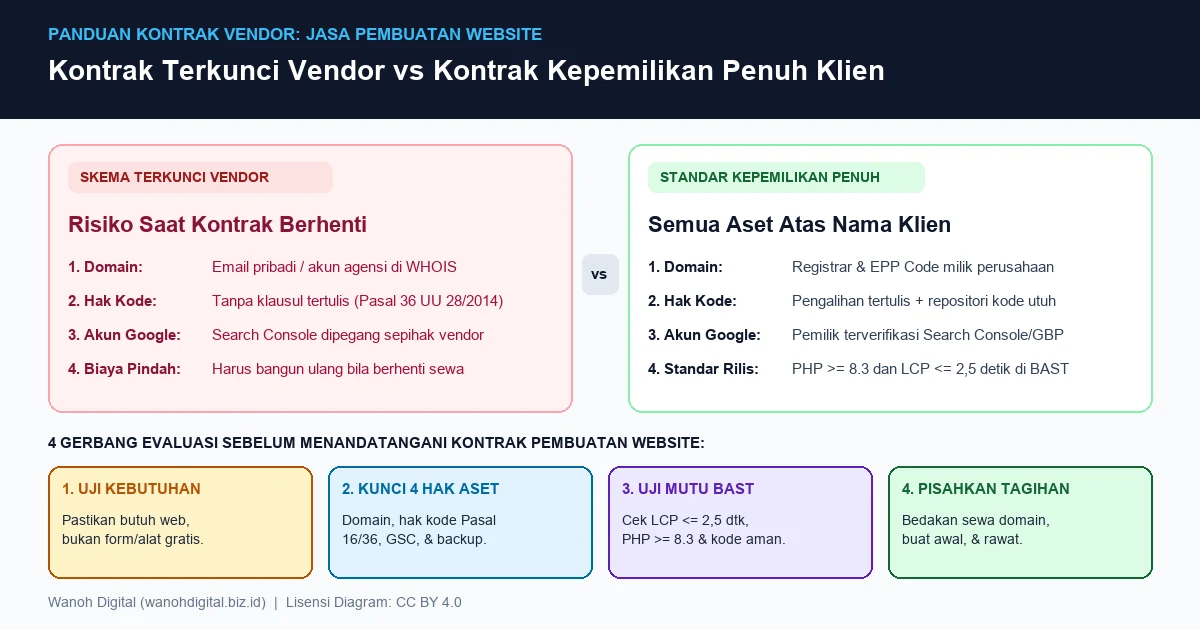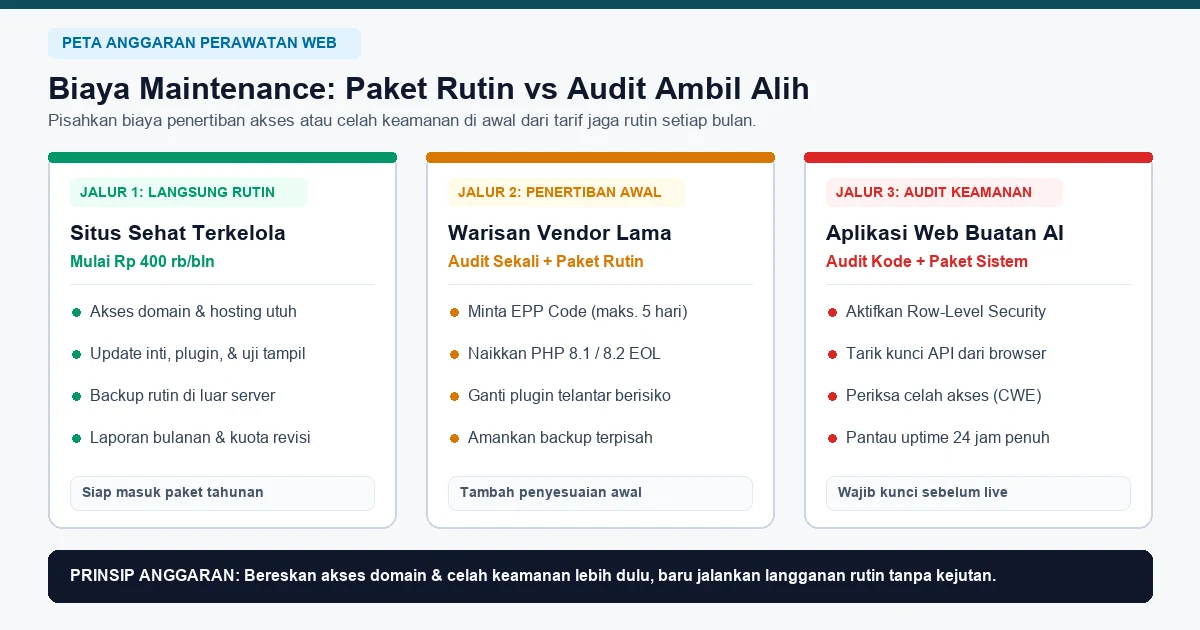

Summary: Calculating the full cost of building a website requires business owners to separate initial build capital (one-time setup) from ongoing annual operational expenses while the site remains live [3, 4, 5]. Based on public rate cards from registrars accredited by the Indonesian Internet Domain Name Registry (PANDI) and the Internet Corporation for Assigned Names and Numbers (ICANN), mandatory infrastructure costs include normal annual domain renewal of Rp50,000 to Rp300,000 per year (for
.or.id,.biz.id,.id,.com, and.co.id) and web hosting rental of Rp300,000 to Rp1,080,000 per year for SME Shared Hosting (or starting at Rp5,640,000 per year for Cloud Hosting), plus initial build labor and periodic security maintenance [1, 2, 3, 5, 19]. Understanding this pricing structure from day one saves your business cash flow from "one-time cheap website" traps that hide year-two renewal spikes, domain ownership hostage risks, and cleanup bills from unmaintained hacked sites [4, 8, 10].
Once you have confirmed your business is ready for its own site using Website, Social Media, or Marketplace: When Does a Business Need a Website? as part of SME Marketing Strategy 2027: Protecting Margins in the AI Search Era, the next question is almost always the same: what is a fair website build cost, and why do quotes in the market range so wildly from a few hundred thousand to tens of millions of rupiah?
That confusion is understandable because many offers spotlight first-year promotional pricing while leaving out year-two and ongoing expenses [3, 5]. Let us break down every component of website ownership costs transparently so you can budget with confidence and avoid unexpected bills down the road.
Table of Contents
- What is the full cost of a business website from year one to year two?
- What is the upfront cost breakdown for domain, hosting, and website build?
- Why does a website need an annual maintenance budget even if its design never changes?
- What are the 5 most overlooked hidden costs of owning a website?
- How can you tell if your business is ready for real website costs?
- Frequently asked questions (FAQ)
- Technical notes (For IT staff or vendors managing your business website)
- References
What is the full cost of a business website from year one to year two?
The cost of owning a business website always splits into two distinct budget lines: year-one cost (initial build service plus year-one domain and hosting rental) and ongoing annual cost from year two onward (standard-rate domain renewal, hosting renewal, and routine security maintenance) [3, 5, 9]. As an illustrative scenario, a healthy SME profile or catalog website requires around Rp1,500,000 to Rp6,000,000 in year one, while ongoing annual operational costs run roughly Rp600,000 to Rp3,600,000 per year.
The easiest way to understand website cost structure is to compare it to buying a commercial delivery vehicle or opening a physical storefront. When you first purchase a business vehicle, you pay capital upfront for the unit and custom fitting. Once it is out delivering orders, you must set aside recurring annual funds for vehicle tax, oil changes, and brake service so it never breaks down on the road [8, 9]. A business website works the exact same way: no commercial website is truly "pay once forever" because domain names and server space are leased annually [3, 4, 5].
As an illustrative scenario drawn from our experience mentoring SMEs and nonprofits since 2016, Table 1 summarizes the Total Cost of Ownership (TCO) across three tiers of business needs in Indonesia [2, 3, 5, 6, 14, 18, 19]:
| Budget Item & Specification | Tier 1: Lightweight Profile Website / Landing Page (1 to 5 Pages) | Tier 2: SME Catalog & Org Profile Linked to WhatsApp/QRIS (5 to 15 Pages) | Tier 3: Automated Checkout Online Store & Custom System |
|---|---|---|---|
| Primary Business Fit | Local service businesses, professional portfolios, or highlighting one flagship product | Retail/F&B/service SMEs (>20 products) closing orders via WhatsApp & QRIS, plus official foundations/orgs [16, 18] | Mid-to-large retail handling thousands of automated monthly orders and warehouse integration |
| 1. Domain Cost Year 1 vs Year 2 (Renewal) | .biz.id promo Rp9,900 (year 1) then renewal Rp60,000/yr; or .or.id/.web.id Rp50,000/yr [3] | .biz.id (renewal Rp60,000/yr), .id (Rp219,000/yr), .com (renewal Rp219,000/yr), or .co.id (Rp300,000/yr) [3] | .co.id (Rp300,000/yr) or .id (Rp219,000/yr) with domain management lock [3] |
| 2. Annual Server Rental (Web Hosting) | Small Shared Hosting: promo Rp180,000 to Rp214,800 (year 1), normal rate Rp300,000 to Rp600,000/yr [5] | Medium Shared Hosting: promo Rp358,800 (year 1), normal rate Rp600,000 to Rp1,080,000/yr [5] | Dedicated-Resource Cloud Hosting: from Rp5,640,000 to Rp11,280,000/yr (Rp470,000 to Rp940,000/mo) [19] |
3. HTTPS Padlock Security Certificate (SSL/TLS) | Rp0 / Free (automated via Let's Encrypt) [6] | Rp0 / Free (automated via Let's Encrypt) [6] | Rp0 / Free (Let's Encrypt) or custom corporate certificate as needed [6] |
| 4. Initial Build Service (One-Time Setup in Year 1) | Rp1,000,000 to Rp2,500,000 (illustrative scenario) | Rp2,500,000 to Rp6,000,000 (illustrative scenario) | Rp7,500,000 to Rp25,000,000+ (illustrative scenario) |
| 5. Annual Maintenance & Off-Site Backup Budget | Rp300,000 to Rp1,200,000/yr (or self-managed on a strict schedule) (illustrative scenario) | Rp1,200,000 to Rp2,400,000/yr (Rp100,000 to Rp200,000/mo for security updates & off-site backups) (illustrative scenario) | Rp3,600,000 to Rp12,000,000/yr (server monitoring, transaction database, and daily security) (illustrative scenario) |
| 6. Per-Transaction Payment Deduction | Rp0 (directed to WhatsApp Business) | Rp0 (0% MDR) via Micro Enterprise QRIS up to Rp500,000/order (or up to Rp100,000 for Small/Medium) [18] | Payment Gateway fees: Rp4,000 per bank Virtual Account, 1.5% to 2% e-wallet, or 0.7% QRIS [14] |
| Estimated Year-1 Total (Initial Capital + Operations) | Rp1,350,000 to Rp3,300,000 (illustrative scenario) | Rp4,100,000 to Rp9,700,000 (illustrative scenario) | Rp16,900,000 to Rp48,500,000+ (illustrative scenario) |
| Estimated Year-2+ Recurring Cost (Per Year) | Rp650,000 to Rp1,860,000 / year (about Rp55,000 to Rp155,000/mo) | Rp1,860,000 to Rp3,780,000 / year (about Rp155,000 to Rp315,000/mo) | Rp9,540,000 to Rp23,580,000+ / year (excluding payment gateway transaction fees) |
What is the upfront cost breakdown for domain, hosting, and website build?
During initial construction, your budget goes toward three core items: registering an official domain name as your site's address (Rp50,000 to Rp300,000 per year for normal Indonesian or .com rates), renting server space or hosting (Rp300,000 to Rp1,080,000 per year for Shared Hosting), and professional design and catalog setup [2, 3, 5]. Meanwhile, standard Hypertext Transfer Protocol Secure (HTTPS) certificates via Secure Sockets Layer (SSL) and Transport Layer Security (TLS) are free (Rp0) through the public certificate authority Let's Encrypt [6, 22].
Figure 1 compares the three pricing layers of domain names in Indonesia alongside web application security risk data explaining why an annual maintenance budget is necessary [2, 3, 4, 5, 6, 7, 10, 14, 18].
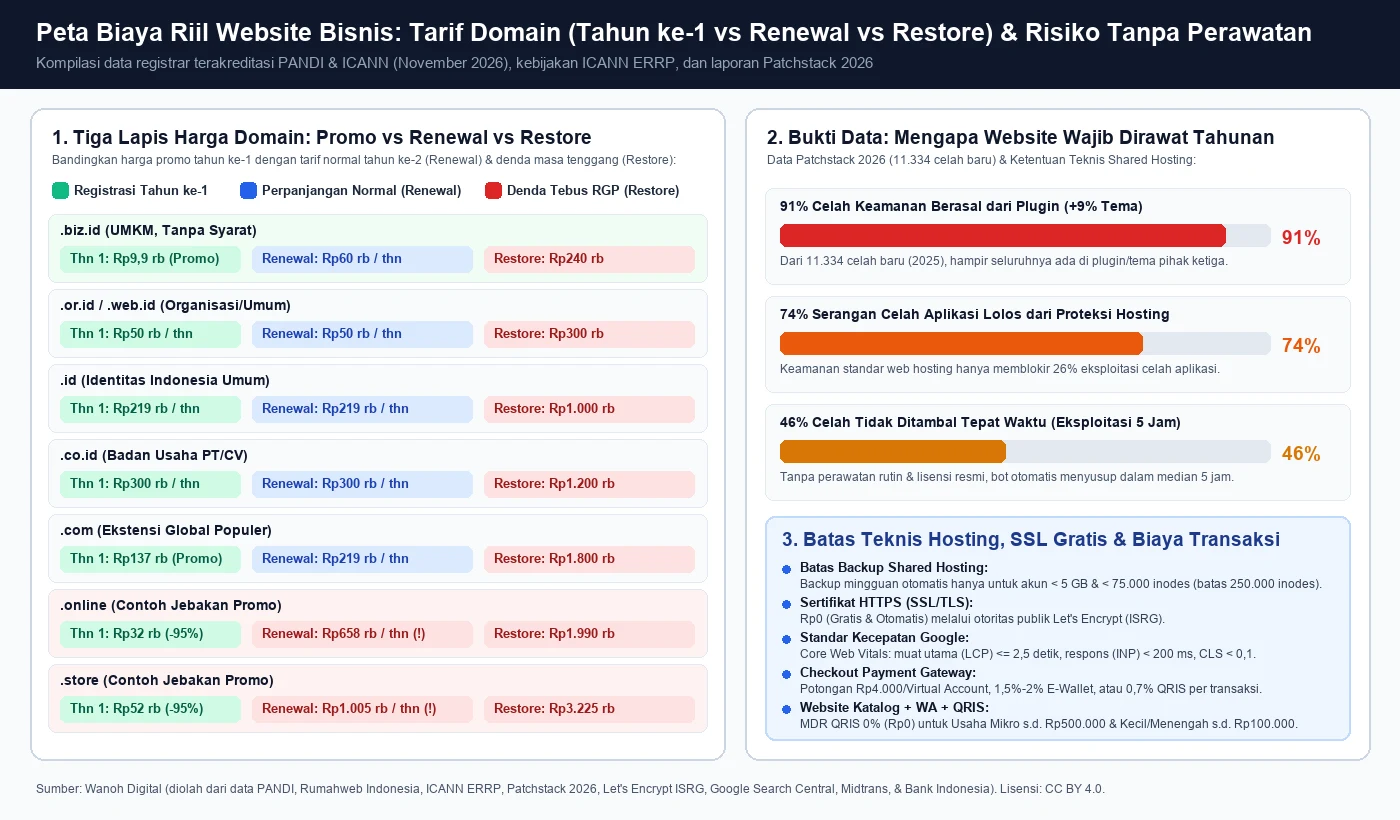
Source: Wanoh Digital (compiled from PANDI, Rumahweb Indonesia, ICANN ERRP, Patchstack 2026, Let's Encrypt ISRG, Google Search Central, Midtrans, and Bank Indonesia). License: CC BY 4.0.
To make sure you choose the right specifications from the start, here is the breakdown of those three components along with their official data sources:
1. Domain Name Cost Breakdown (Your Official Business Address Online)
A domain name is the unique address customers type to open your website (such as wanohdigital.biz.id). In Indonesia, the Indonesian Internet Domain Name Registry (PANDI) reported that as of 31 July 2026, registered .id domains reached 1,523,504 across 13 Second Level Domain (SLD) options matched to business and institutional types [1, 2].
The single most important detail to know before buying a domain is that every PANDI- and ICANN-accredited registrar applies three pricing layers (as shown on Rumahweb Indonesia's public rate card as of 6 November 2026): (1) Year-1 Registration Price, often discounted on promotion; (2) Normal Renewal Price from year two onward; and (3) Redemption / Restore Fee if you renew late after expiration [3, 4]. Table 2 details all three:
| Domain Extension | Intended Use & Official Document Rules [2, 3] | Year-1 Price (Registration / Promo) [3] | Year-2+ Price (Normal Renewal) [3] | Redemption Fee (RGP Restore) If Late [3, 4] |
|---|---|---|---|---|
.biz.id | Indonesian SMEs (No corporate legal deed required) | Rp9,900 / year (84% promo discount) | Rp60,000 / year | Rp240,000 |
.my.id | Personal portfolios & creators (No document requirements) | Rp9,900 / year (60% promo discount) | Rp25,000 / year | Rp100,000 |
.or.id | Organizations, foundations, & associations (Requires: Notarial Deed/Org Decree, Indonesian ID/KTP, & Board Decree) | Rp50,000 / year | Rp50,000 / year | Rp300,000 |
.web.id | General informational sites & communities (No document requirements) | Rp50,000 / year | Rp50,000 / year | Rp300,000 |
.id | General Indonesian business & brand identity (No document requirements) | Rp219,000 / year | Rp219,000 / year | Rp1,000,000 |
.co.id | Registered legal entities (Requires: Indonesian ID/KTP + Business Registration Number / NIB, Corporate Tax ID/NPWP, or Ministry of Law Decree) | Rp300,000 / year | Rp300,000 / year | Rp1,200,000 |
.com | Popular global commercial extension (No document requirements) | Rp137,000 / year (37% promo discount) | Rp219,000 / year | Rp1,800,000 |
.online (Promo extension example) | General global (No document requirements) | Rp32,000 / year (95% promo discount) | Rp658,000 / year (Jumps 20x) | Rp1,990,000 |
.store (Promo extension example) | Global online store (No document requirements) | Rp52,000 / year (95% promo discount) | Rp1,005,000 / year (Jumps 19x) | Rp3,225,000 |
Notice the .biz.id, .or.id, .id, and .co.id rows in Table 2 above: official Indonesian extensions managed by PANDI have predictable, reasonable annual renewal fees (Rp50,000 to Rp300,000 per year) [2, 3]. By contrast, promo extensions like .online or .store look cheap in year one (Rp32,000 to Rp52,000) but hit your cash flow with Rp658,000 to Rp1,005,000 per year when year-two renewal arrives [3].
2. Web Hosting (Server Storage) Costs & Free HTTPS Certificates
If your domain is your shopfront address, web hosting is the building storing your product photos, catalog text, and code so visitors can reach it 24 hours a day [5]. In the Indonesian market, web hosting splits into two main classes based on public provider specs as of November 2026 [5, 19]:
- Shared Hosting Class (Shared Server Resources for SME Profiles & Catalogs): First-year promo rates start at Rp15,000 per month (normal price Rp25,000 per month or Rp300,000 per year for 1 Central Processing Unit /
CPUcore, 512 Megabytes /MBof Random Access Memory /RAM, and 1 Gigabyte /GBstorage), starter plans at promo Rp17,900 per month (normal price Rp50,000 per month or Rp600,000 per year for 1CPUcore and 1GBRAM), up to mid-tier SME plans at promo Rp29,900 per month (normal price Rp90,000 per month or Rp1,080,000 per year for 1.5CPUcores and 2GBRAM) [5]. - Dedicated-Resource Cloud Hosting Class (Dedicated Resources for High-Traffic Online Stores): Built for larger e-commerce sites or information systems that cannot afford noisy neighbors, starting from Rp470,000 per month (Rp5,640,000 per year for 1 dedicated
vCPU, 2GBdedicatedRAM, and 30GBSolid State Drive /SSDstorage) up to Rp940,000 per month (Rp11,280,000 per year for 2vCPUand 4GBRAM) [19].
Why should you avoid overloaded bargain hosting for a business site? Official Google Search Central documentation on Core Web Vitals sets three page performance benchmarks for a good user experience in Google Search: Largest Contentful Paint (LCP) must render within the first 2.5 seconds, Interaction to Next Paint (INP) under 200 milliseconds, and Cumulative Layout Shift (CLS) under 0.1 [7]. Undersized hosting prevents catalog pages from meeting that 2.5-second threshold, causing prospective buyers to close the tab before seeing your products [7].
One more infrastructure note: do not pay hundreds of thousands of rupiah extra per year just for a standard HTTPS padlock. Let's Encrypt, the public Certificate Authority (CA) operated by the nonprofit Internet Security Research Group (ISRG), provides HTTPS (SSL/TLS) digital certificates for free (Rp0) and fully automated for any domain owner [6], and standard hosting plans already include them at no extra cost [5].
3. Initial Build Service Costs (Design, Structure, and Catalog Setup)
The third component is professional labor to design, build, and configure the site for launch. Build fees depend heavily on the complexity of features you request:
- Why do you rarely need an expensive automated shopping-cart checkout right away? Data from the Ministry of SMEs Single Data Information System (SIDT) shows 99.70% (30,119,928 out of 30,209,069 units) of non-agricultural SMEs in Indonesia are micro enterprises [15]. Furthermore, Statistics Indonesia's (BPS) Statistik E-Commerce 2024 (Publication No.
06300.25015), analyzed in the Ministry of Trade RI's 2025 Indonesian Electronic System Trading (PMSE) Performance Report, proves that 94.76% of Indonesian online businesses sell through instant messaging apps like WhatsApp and 84.21% of the Rp1,288.93 trillion total transaction value occurs outside marketplaces [16, 17]. - That means as a rule of thumb for most retail, F&B, apparel, catering, and service SMEs, building a lightweight Catalog Website linked straight to WhatsApp Business and QRIS payment costs far less upfront (roughly Rp2,500,000 to Rp6,000,000 in an illustrative scenario) and aligns much better with Indonesian buying habits than building an automated checkout store costing tens of millions of rupiah [16, 17, 18].
Why does a website need an annual maintenance budget even if its design never changes?
A business website is not a printed brochure left on a counter; it is live software connected to the internet 24 hours a day and requires ongoing security updates and off-site backups even if you never change a word or photo [8, 9, 10]. Leaving a website running for months without a maintenance budget exposes newly discovered software flaws to automated hacker bots that inject online gambling pages, erode customer trust, and get your site removed from Google Search results [8, 10, 12].
Many business owners ask fairly: "If the website was built in year one and I never change its layout, why do I have to budget for maintenance in year two on top of domain and hosting renewals?" The answer is not vendor opinion; it rests on recorded national and global cybersecurity data:
- Warnings from BSSN and UGM Software Engineering Faculty: Indonesia's National Cyber and Crypto Agency (BSSN) records an average of 1.25 billion internet traffic anomalies per year in Indonesian cyberspace and 184,359 cyber traffic anomalies directly tied to online gambling from January to June 2025 [8, 9]. Responding to those figures, Universitas Gadjah Mada (UGM) Faculty of Engineering Professor Prof. Dr. Ir. Ridi Ferdiana noted that widespread site compromises occur in Indonesia because many information systems are built and deployed but forgotten when it comes to maintenance [9].
- Thousands of New Vulnerabilities Surface Every Year in Website Components: Patchstack's State of WordPress Security in 2026 report recorded 11,334 new security vulnerabilities across 2025 (up 42% from 7,966 in 2024), with 91% originating in third-party plugins and 9% in themes [10, 11]. This matches the Open Worldwide Application Security Project (OWASP) Top 10 classification listing vulnerable and outdated components among the most critical web application risks [24]. Worse still, 46% of those vulnerabilities had no timely patch available at disclosure, and the median time for automated attack bots to mass-exploit popular flaws is only 5 hours [10].
- Standard Hosting Security Blocks Only 26% of Application Exploits: Business owners often assume paying annual hosting rent automatically shields their site from hacking [10]. In reality, large-scale penetration testing by Patchstack across popular web hosting providers proved that only 26% of application vulnerability exploits are blocked by standard hosting security layers (meaning 74% of attacks get through if the website application inside is not updated and maintained) [10].

Source: Jens Kreuter via Unsplash / Wikimedia Commons. License: CC0 1.0.
When you allocate a website maintenance budget (whether via an annual maintenance plan with a technical partner around Rp100,000 to Rp300,000 per month in an illustrative scenario, or by assigning competent internal staff), that budget buys four concrete protections:
- Component Updates and Compatibility Testing: Updating core software, themes, and plugins systematically so your site does not join the thousands infected with malware and SEO spam [10, 11, 24].
- Off-Site Backups Outside the Server: Many business owners never read the fine print of Shared Hosting terms. Even when plans advertise Unlimited Storage and Weekly Backup, official technical terms impose a ceiling of 250,000 files (inodes) and state that automatic weekly backups only run on accounts using under 5 GB of storage and/or under 75,000 inodes, while the hosting provider accepts no liability for data loss if a server fails [5]. As a rule of thumb, proper maintenance copies backups to separate storage outside the main server (in line with the defense principles in SME Ransomware in Indonesia Up 42%: Causes & Prevention) [5].
- File Integrity Audits Against Hidden Intrusions: In production incident observations on rarely audited servers, attackers plant backdoor scripts inside public icon folders and alter
.htaccessconfiguration files without triggering standard firewall alerts [20]. Routine checks catch these anomalies before your pages are hijacked (see the full guide in Website Looks Normal but Hacked? How to Check & Secure It). - Protecting Google Search Reputation and PDP Law Compliance: Google Search Central documentation confirms that sites detected serving hacked content will be demoted or removed from Google Search results to protect users [12]. Moreover, if a website breach leaks customer or donor personal data, Article 46 Paragraph (1) of Law Number 27 of 2022 on Personal Data Protection (PDP) requires the data controller to deliver written notification within at most 3 x 24 hours (72 hours) to affected data subjects and the supervisory authority [13].
What are the 5 most overlooked hidden costs of owning a website?
The five hidden costs that most often drain SME budgets after a website goes live are year-two domain and hosting renewal price hikes, Redemption Grace Period (RGP) domain restore penalties, rebuild expenses when domain accounts are locked under a vendor's name, hack-cleanup bills from pirated (nulled) themes, and per-transaction gateway deductions if you force automated checkout on low-ticket orders [3, 4, 10, 14].
Before accepting a website quote that looks unusually cheap on the surface, check these five hidden cost traps:
1. Year-Two Renewal Shock and Redemption Grace Period Restore Fees
Some Rp200,000 to Rp400,000 website packages advertised on social media hold down upfront pricing by pairing first-year promo domain extensions (such as .online at Rp32,000 or .store at Rp52,000) with year-one discounted hosting plans [3, 5]. When month 13 arrives, the renewal bill for that domain jumps to Rp658,000 to Rp1,005,000 per year [3].
An even bigger financial hit happens if you miss renewal deadlines. Under ICANN's global consensus Expired Registration Recovery Policy (ERRP) (Sections 2.2 and 3.1 to 3.3), as soon as a domain's active period ends, the provider must disable DNS resolution, instantly taking your website and business email offline [4]. If left unrenewed until deletion, the domain enters a 30-day Redemption Grace Period (RGP) [4]. To recover a domain inside RGP, you must pay a Restore Fee reaching Rp240,000 for .biz.id, Rp1,000,000 for .id, Rp1,200,000 for .co.id, up to Rp1,800,000 for .com on top of the annual renewal rate [3, 4].
2. "Hostage Access" Costs When a Domain Is Registered in a Vendor's Personal Name
ICANN ERRP Sections 1.1 and 2.1 establish that renewal rights belong to the Registrant at Expiration (RAE), and the registrar must send expiration reminders (roughly 1 month before, 1 week before, and within 5 days after expiration) directly to that RAE email address [4].
If a web developer registers your business domain inside their own personal account and email as RAE, two costly problems follow: first, you never receive expiration alerts when the domain is about to go down; second, if you want to switch providers next year and the vendor demands unreasonable release fees or vanishes, you risk losing a domain name already printed on packaging, letterheads, and your Google Maps pin [4].
3. The Time Bomb of Pirated (Nulled) Themes and Plugins in Ultra-Cheap Packages
In an illustrative field scenario, how can a web agency sell an all-in Rp300,000 package claiming to include a commercial theme whose official license alone costs Rp800,000 per year? Almost always by installing pirated (nulled) theme or plugin files downloaded from unofficial sites with official update channels disabled.
Patchstack's State of WordPress Security in 2026 report uncovered a critical fact: paid (premium) plugins and themes actually record 3 times more Known Exploited Vulnerabilities (KEV) than free components [10]. Installing pirated premium components that cannot receive official security patches opens the door wide to automated attackers. The cost of cleaning an infected site and rebuilding customer trust far outweighs saving a few hundred thousand rupiah upfront [10, 12].
4. Payment Gateway Per-Transaction Fees on Automated Checkout Stores
Many SME owners assume a proper online store must have a shopping cart with automated Virtual Account (VA) and e-wallet checkout via a third-party payment gateway. Yet looking at Midtrans's official public fee schedule as of November 2026, every successful payment gateway transaction carries a deduction [14]:
- Bank Transfer / Virtual Account (major national and regional banks): Rp4,000 per transaction (plus a Rp5,000 interbank withdrawal fee when settling to a different bank) [14].
- E-Wallets: GoPay and ShopeePay at 2% per transaction, Dana and Ovo at 1.5% per transaction, and QRIS via payment gateway at 0.7% per transaction [14].
- Convenience Store Counters (Indomaret/Alfamart): Rp5,000 per transaction, and Credit Cards at 2.9% + Rp2,000 per transaction [14].
In an illustrative scenario where your shop sells a Rp50,000 food item or daily essential and the buyer checks out via bank Virtual Account, the fixed Rp4,000 fee takes 8% straight off your gross sale [14]. Compare that with using a lightweight Catalog Website that routes order buttons to WhatsApp Business and sends your store's official Quick Response Code Indonesian Standard (QRIS) code: under Bank Indonesia policy effective 1 October 2026, the QRIS Merchant Discount Rate (MDR) is 0% (Rp0) for Micro Enterprises up to Rp500,000 and for Small and Medium Enterprises up to Rp100,000 per transaction (see details in Indonesia's Digital Payment Transformation: From QRIS to SME AI) [18].
5. Extra Fees for Page Revisions, Product Photography, and Business Email
In many low-cost instant website packages, page edits are capped at 1 to 3 pages while adding new pages triggers extra charges (for example, Rp50,000 per new page, Rp20,000 per page revision, and Rp15,000 per image edit) [5]. Likewise, if your business or foundation requires large-capacity collaborative email beyond basic hosting mailboxes (such as Google Workspace with 30 GB to 2 Terabytes / TB per user), per-account monthly subscriptions must be budgeted separately [5].
As an illustrative simulation, use the interactive calculator below to estimate your own year-one spending, year-two recurring expenses, and 3-year Total Cost of Ownership based on your domain and payment method choices:
Website Build & Annual Maintenance Estimator (3-Year TCO)
Enter your domain extension, hosting, initial build fee, monthly maintenance budget, and payment method to calculate year-one cash outlay, year-two recurring costs, and a 3-year projection.
How can you tell if your business is ready for real website costs?
Your business is ready to work with a professional web developer when you view a website as a long-term working asset with predictable annual renewal and maintenance budgets, rather than a one-off purchase with no ongoing upkeep [4, 9, 10]. Conversely, if current business cash flow cannot yet support annual renewal and routine maintenance, delaying a website build and maximizing free official channels is much safer for your finances [15, 16].
At Wanoh Digital, we believe upfront cost transparency saves time on both sides. We do not sell "Rp300,000 pay-once-forever websites" because from a software engineering standpoint, that model cannot run without compromising your domain ownership, installing pirated components, or abandoning site security in year two [3, 4, 10]. Table 3 helps you assess honestly whether your business should hold off for now or is ready to build a healthy site:
| Owner / Admin Readiness Aspect | Better to Wait on Building a Website (Use Free Official Channels) | Ready to Build a Healthy, Maintained Business / Org Website |
|---|---|---|
| Budget & Ongoing Cost Expectations | Looking for an "all-in Rp200,000 to Rp500,000 one-time payment" website and reluctant to budget for annual renewal and maintenance. | Understands the split between initial setup cost and annual operating costs (domain, hosting, and periodic maintenance) to protect the asset [3, 5, 9]. |
| Basic Digital Foundation Readiness | Store pin is not listed on Google Maps yet and WhatsApp replies are still chaotic (complete Register Google Business Profile in 10 Minutes for free first) [25]. | Google Business Profile and WhatsApp Business are already running, and you need an official catalog/profile page to save admin hours and platform fees [16, 17, 25]. |
| Asset Ownership & Security Principles | Does not care who owns the domain account or whether installed themes are genuine/pirated as long as the price is lowest. | Requires an official domain (.biz.id, .co.id, .or.id, .id, or .com) registered 100% in your own name [2, 3, 4] and properly licensed components protected from illegal page injections [8, 10]. |
| Measurable Business Goal | Just following trends because competitors have a website without knowing who will visit it. | Shifting repeat orders away from marketplace commissions (see SME Marketplace Admin Fee Rules: 50% Discount & How to Claim), organizing dozens of products in a clean catalog, or meeting corporate (B2B) verification and donor transparency standards (see How to Create an Organization Cash Report Donors Trust). |
In the official Google Search Central guide video below, Maile Ohye explains why business owners should be wary of web/SEO providers promising cheap instant results without transparency, along with the questions you must ask before hiring any web consultant or developer [19]:
Before signing a contract or transferring an upfront deposit to any freelancer or web agency, use the two operational checklists below to protect your ownership rights and budget:
Checklist 1: 7 Cost Transparency & Ownership Clauses Before Paying a Website Vendor
Check off items you have verified below, or click Copy Checklist to share it with your team or web vendor.
Checklist 2: 6 Annual Maintenance Audit Items for a Business Website
Check off items you have verified below, or click Copy Checklist to share it with your team or web vendor.
Once you understand the cost structure above and want to discuss building or fixing a website openly without sales pressure, you can review our pricing details and four-stage workflow on How Wanoh Digital Works & Pricing, and compare post-launch items in monthly website maintenance fees and takeover audits or our Website Maintenance Services page. You can also browse real project examples on Our Work or inspect an existing business site through our 24-Hour Free Website Check, knowing domain and source code ownership always stays 100% in your name [4].
To choose properly between a single ad offer page and a multi-page business site while keeping budgets predictable, read our comparison of landing page vs website differences and typical cost ranges.
Frequently asked questions (FAQ)
Why are some web services priced at Rp300,000 all-in while other vendors charge Rp3,000,000 to tens of millions of rupiah?
That sharp difference comes from infrastructure quality, software licensing status, and asset ownership behind the scenes. Rp300,000 packages commonly use first-year promotional domains whose renewal fees jump in year two [3], pack dozens of sites into a cramped shared hosting account capped at 250,000 inodes [5], use pirated (nulled) themes/plugins without official security updates [10], and exclude annual maintenance. By contrast, fees of Rp2,500,000 to Rp6,000,000 in an illustrative scenario cover catalog architecture engineered for Google Core Web Vitals speed standards [7], official domain registration in the business owner's own name [2, 4], properly licensed components, and clear technical support.
What happens if I forget or am late to renew my business website domain name?
Under ICANN's official Expired Registration Recovery Policy (ERRP), once a domain's active period expires without renewal, the domain provider must halt DNS resolution, immediately stopping your website and business email [4]. If it passes the post-expiration renewal grace period and gets deleted, the domain enters a 30-day Redemption Grace Period (RGP) [4].
During this 30-day RGP window, you can still rescue the domain, but you must pay a steep Restore Fee on top of normal renewal pricing: Rp240,000 for .biz.id, Rp300,000 for .or.id, Rp1,000,000 for .id, Rp1,200,000 for .co.id, up to Rp1,800,000 for .com [3, 4]. If it goes unredeemed past 30 days of RGP, the domain is released back to the public and risks being bought by someone else [4].
Do I have to pay hundreds of thousands of rupiah every year for an SSL certificate so my business website has the HTTPS padlock?
No, not for company profiles, foundations, or SME product catalogs. Today, Let's Encrypt (the public certificate authority operated by the nonprofit Internet Security Research Group / ISRG) provides Domain Validation HTTPS (SSL/TLS) digital certificates for free (Rp0), renewed automatically every 90 days in the background [6]. Most official web hosting providers in Indonesia also enable Free SSL Let's Encrypt at no extra charge [5].
What is the safest way to save money on building and maintaining a website for an SME?
As a rule of thumb, three healthy cost-saving steps protect your site without cutting corners on security: first, pick an official Indonesian domain extension with stable annual renewal pricing such as .biz.id (normal renewal Rp60,000 per year with no PT/CV deed required) or .or.id and .web.id (Rp50,000 per year) [2, 3]; second, build a lightweight Catalog Website that sends order buttons straight to WhatsApp Business and SME QRIS payment (0% MDR up to Rp500,000 for Micro Enterprises [18]) instead of paying for a complex shopping cart charging Rp4,000 per Virtual Account transaction [14]; and third, install as few extra plugins as possible because 91% of WordPress ecosystem vulnerabilities come from third-party plugins [10].
Technical notes (For IT staff or vendors managing your business website)
Note: The domain registration protocol checks, encryption certificate automation, filesystem limits, and page performance thresholds below are technical discoverability, infrastructure reliability, and baseline security prerequisites [4, 6, 7], not an automatic guarantee of top search engine rankings or AI assistant citations.
When assigning internal Information Technology (IT) staff or hiring a vendor to build and maintain your business website, ask them to verify these four technical parameters prior to handover:
- Verify Registrant at Expiration (RAE) Contact via
RDAP/WHOIS: Under ICANN ERRP Sections 1.1 and 2.1 and Internet Engineering Task Force (IETF) Request for Comments (RFC) 7480, confirm the business owner's official email is listed on the registrant object in Registration Data Access Protocol (RDAP) orWHOISrecords, and that transfer lock (clientTransferProhibited) is active [4, 23]. - Automate Let's Encrypt TLS Certificate Renewal (
ACME): Ensure the Automated Certificate Management Environment (ACME) agent per IETF RFC 8555 (such ascertbotor server panel AutoSSL) runs a scheduled task (timer /cron) that renews certificates before the 90-day expiry window [6, 22]. - Audit Disk Usage and Inode Quotas for Off-Site Backups: Since Shared Hosting caps accounts at 250,000 inodes and halts automatic weekly backups once usage exceeds 5
GBor 75,000 inodes [5], IT staff must configure independent backup scripts pushing encrypted archives to external object storage (off-site storage). - Test Google Core Web Vitals Thresholds: Benchmark the homepage and catalog pages using PageSpeed Insights or Search Console to verify Largest Contentful Paint (
LCP) stays at or below 2.5 seconds, Interaction to Next Paint (INP) below 200 milliseconds, and Cumulative Layout Shift (CLS) below 0.1 [7].
Below is a quick shell inspection script (POSIX sh / bash) that IT staff or server administrators can run to check remaining HTTPS (TLS) certificate lifetime, disk space usage, and file (inode) count on the server:
#!/usr/bin/env bash
# Quick audit script for SME website infrastructure health (TLS, Disk, & Inodes)
# Tested on: Ubuntu 24.04 LTS / Debian 12 with OpenSSL 3.x & GNU coreutils

DOMAIN="${1:-wanohdigital.biz.id}"
WEB_ROOT="${2:-/var/www/html}"

echo "=== 1. Check HTTPS (TLS) Certificate Validity for ${DOMAIN} ==="
EXPIRY_DATE=$(echo | openssl s_client -servername "${DOMAIN}" -connect "${DOMAIN}:443" 2>/dev/null \
  | openssl x509 -noout -enddate 2>/dev/null | cut -d= -f2)

if [ -n "${EXPIRY_DATE}" ]; then
  echo "TLS certificate valid until: ${EXPIRY_DATE}"
else
  echo "WARNING: Failed to read TLS certificate on ${DOMAIN}:443"
fi

echo ""
echo "=== 2. Check Disk Space & Inodes Usage on ${WEB_ROOT} ==="
if [ -d "${WEB_ROOT}" ]; then
  DISK_USAGE=$(du -sh "${WEB_ROOT}" 2>/dev/null | awk '{print $1}')
  INODE_COUNT=$(find "${WEB_ROOT}" 2>/dev/null | wc -l | tr -d ' ')
  echo "Total web directory size : ${DISK_USAGE} (Safe limit for auto shared hosting backup: < 5 GB)"
  echo "Total files / inodes     : ${INODE_COUNT} inodes (Safe limit for auto shared hosting backup: < 75,000 inodes)"
fi
Testing note: The openssl and find checks above are read-only, safe to run in Linux/Unix production environments, and verified for syntax as of 6 November 2026 [5, 6].
Update and correction policy: All public domain registrar and web hosting rate cards, payment gateway transaction fees, Bank Indonesia QRIS MDR rules, and web application vulnerability statistics in this article were verified as of 6 November 2026 [1, 3, 5, 10, 14, 18]. If registry pricing or regulations change in the future, this article will be updated with a dated revision note.
References
Verified Sources & References (25 Sources)Show References
- Indonesian Internet Domain Name Registry (PANDI). "Dua Dekade PANDI: Dari 1,52 Juta Domain .id Menuju Panggung Global ICANN87 Bali." Official PANDI Press Release, 1 September 2026. https://pandi.id/en/siaran-pers/dua-dekade-pandi-dari-152-juta-domain-id-menuju-panggung-global-icann87-bali (accessed 6 November 2026) (in Indonesian).
- Indonesian Internet Domain Name Registry (PANDI). "Apa itu domain .id dan 13 Pilihan Second Level Domain (SLD) Indonesia (.biz.id, .co.id, .or.id, .my.id, .web.id)." Official PANDI .id Domain Portal, 15 January 2026. https://domain.id/id (accessed 6 November 2026) (in Indonesian).
- Rumahweb Indonesia (PANDI and ICANN Accredited Registrar). "Daftar Harga Domain Indonesia dan Internasional (Registrasi Tahun Pertama, Perpanjangan Normal Renewal, Biaya Penebusan Restore, dan Persyaratan Dokumen)." Rumahweb Indonesia, 1 November 2026. https://www.rumahweb.com/domain-murah/ (accessed 6 November 2026) (in Indonesian).
- Internet Corporation for Assigned Names and Numbers (ICANN). "Expired Registration Recovery Policy (ERRP)." Official ICANN Consensus Policy, 21 February 2024. https://www.icann.org/en/contracted-parties/consensus-policies/expired-registration-recovery-policy/expired-registration-recovery-policy-28-02-2013-en (accessed 6 November 2026).
- Rumahweb Indonesia. "Spesifikasi Paket Shared Hosting, Batasan Inodes 250.000, Ketentuan Backup Mingguan, dan Jasa Pembuatan Website." Rumahweb Indonesia, 1 November 2026. https://www.rumahweb.com/hosting-murah/ (accessed 6 November 2026) (in Indonesian).
- Internet Security Research Group (ISRG). "About Let's Encrypt: Free, Automated, and Open Certificate Authority." Official Indonesian Let's Encrypt Documentation, 12 February 2021. https://letsencrypt.org/id/about/ (accessed 6 November 2026) (in Indonesian).
- Google Search Central. "Understanding Core Web Vitals and Google search results (LCP, INP, and CLS)." Google Developers Documentation, 18 December 2025. https://developers.google.com/search/docs/appearance/core-web-vitals?hl=id (accessed 6 November 2026) (in Indonesian).
- Antara News (quoting National Cyber and Crypto Agency Head Nugroho Sulistyo Budi). "BSSN catat 184.359 anomali terkait judi online." ANTARA News Agency, 8 July 2025. https://babel.antaranews.com/berita/498361/bssn-catat-184359-anomali-terkait-judi-online (accessed 6 November 2026) (in Indonesian).
- Universitas Gadjah Mada (quoting UGM Faculty of Engineering Professor Prof. Dr. Ir. Ridi Ferdiana and BSSN RI data). "Marak Serangan Siber Judi Daring, Pakar UGM Imbau Pentingnya Perawatan Sistem." Universitas Gadjah Mada, 27 August 2025. https://ugm.ac.id/id/berita/marak-serangan-siber-judi-daring-pakar-ugm-imbau-pentingnya-perawatan-sistem/ (accessed 6 November 2026) (in Indonesian).
- Patchstack (in collaboration with Monarx). "State of WordPress Security in 2026." Patchstack Whitepaper, 25 February 2026. https://patchstack.com/whitepaper/state-of-wordpress-security-in-2026/ (accessed 6 November 2026).
- Patchstack. "State of WordPress Security in 2025." Patchstack Whitepaper, 15 January 2025. https://patchstack.com/whitepaper/state-of-wordpress-security-in-2025/ (accessed 6 November 2026).
- Google Search Central. "Spam Policies for Google Web Search: Hacked Content." Google Developers Documentation, 10 March 2026. https://developers.google.com/search/docs/essentials/spam-policies#hacked-content (accessed 6 November 2026).
- Government of the Republic of Indonesia. "Undang-Undang (UU) Nomor 27 Tahun 2022 tentang Pelindungan Data Pribadi." Legal Documentation and Information Network of the Audit Board (JDIH BPK RI), 17 October 2022. https://peraturan.bpk.go.id/Details/229798/uu-no-27-tahun-2022 (accessed 6 November 2026) (in Indonesian).
- PT Midtrans (Midtrans). "Biaya Transaksi Pembayaran Online (Transfer Bank Virtual Account, E-Wallet, QRIS, Kartu Kredit, Minimarket, dan Tarik Dana)." Midtrans Indonesia, 1 November 2026. https://midtrans.com/id/biaya (accessed 6 November 2026) (in Indonesian).
- Indonesian Chamber of Commerce and Industry (Kadin Indonesia, citing Ministry of SMEs SIDT data as of 31 December 2025). "Data dan Statistik UMKM Indonesia." Kadin Indonesia, 15 January 2026. https://kadin.id/data-dan-statistik/umkm-indonesia/ (accessed 6 November 2026) (in Indonesian).
- Statistics Indonesia (BPS RI). "Statistik E-Commerce 2024 (Publication No. 06300.25015)." Badan Pusat Statistik, 28 November 2025. https://www.bps.go.id/id/publication/2025/11/28/647323224ecc656c2933571b/statistik-e-commerce-2024.html (accessed 6 November 2026) (in Indonesian).
- Domestic Trade Policy Center, Trade Policy Agency, Ministry of Trade of the Republic of Indonesia. "Kinerja Perdagangan Melalui Sistem Elektronik (PMSE) Indonesia Tahun 2025." Ministry of Trade RI, 20 December 2025. https://bkperdag.kemendag.go.id/unduhan-file/a11ba920-123c-4a4f-856b-cdbb1f0f64c4 (accessed 6 November 2026) (in Indonesian).
- Antara News (quoting Bank Indonesia Acting Governor Destry Damayanti and Payment System Policy Department Head Ryan Rizaldy). "BI perluas kebijakan MDR QRIS 0 persen untuk pelaku UMKM." ANTARA News Agency, 16 September 2026. https://jogja.antaranews.com/berita/848451/bi-perluas-kebijakan-mdr-qris-0-persen-untuk-pelaku-umkm (accessed 6 November 2026) (in Indonesian).
- Rumahweb Indonesia. "Spesifikasi dan Harga Layanan Cloud Hosting Dedicated Resource (Dedicated CPU dan RAM)." Rumahweb Indonesia, 1 November 2026. https://www.rumahweb.com/cloud-hosting/ (accessed 6 November 2026) (in Indonesian).
- Open Worldwide Application Security Project (OWASP). "File Upload Cheat Sheet." OWASP Cheat Sheet Series, 2026. https://cheatsheetseries.owasp.org/cheatsheets/File_Upload_Cheat_Sheet.html (accessed 13 November 2026).
- Google Search Central (hosted by Maile Ohye). "How to hire an SEO." Official Google Search Central YouTube Channel, 15 February 2017. https://www.youtube.com/watch?v=piSvFxV_M04 (accessed 6 November 2026).
- Barnes, Richard, Jacob Hoffman-Andrews, Daniel McCarney, and James Kasten. "RFC 8555: Automatic Certificate Management Environment (ACME)." Internet Engineering Task Force (IETF), 1 March 2019. https://www.rfc-editor.org/info/rfc8555/ (accessed 6 November 2026).
- Newton, Andrew, Byron Ellacott, and Ning Kong. "RFC 7480: HTTP Usage in the Registration Data Access Protocol (RDAP)." Internet Engineering Task Force (IETF), 1 March 2015. https://www.rfc-editor.org/info/rfc7480/ (accessed 6 November 2026).
- Open Worldwide Application Security Project (OWASP). "OWASP Top 10:2021: The Ten Most Critical Web Application Security Risks (A05 Security Misconfiguration & A06 Vulnerable and Outdated Components)." OWASP Foundation, 24 September 2021. https://owasp.org/projects/top-ten (accessed 6 November 2026).
- Google. "Tips to improve your local ranking on Google." Google Business Profile Help, 10 January 2026. https://support.google.com/business/answer/7091?hl=id (accessed 6 November 2026) (in Indonesian).