

Summary: Building an SME customer database or organization member list through WhatsApp and email is the most cost-effective way to maintain engagement and repeat orders without depending on social media algorithms [1, 2]. Entrepreneurship guides from UKMIndonesia.id at the Faculty of Economics and Business (FEB), Universitas Indonesia, recommend collecting a customer database, segmenting it by purchase history, and sending periodic newsletters to nurture long-term relationships [1, 2]. Given that Statistics Indonesia (BPS) records 94.76% of Indonesian online businesses communicating through instant messaging such as WhatsApp while only 2.78% use email [3, 4], as a rule of thumb combine WhatsApp Business Labels and Broadcast Lists for quick reminders with email newsletters for educational updates and regular reports based on customer consent [8, 9, 10].
Many Micro, Small, and Medium Enterprise (SME) owners and nonprofit administrators spend hours chasing social media followers, yet still have to pay for ads every time they want new sales or donations [4, 6]. When organic reach drops or an account faces restrictions, communication with customers cuts off immediately [5, 9]. This article breaks down how to move beyond chasing follower counts to managing a compliant customer and member database via WhatsApp Business and email newsletters, continuing from SME Marketing Strategy 2027: Protecting Margins in the AI Search Era.
Table of Contents
- Why is chasing followers not the same as owning your own customer database?
- WhatsApp Business or email newsletter: which fits customers and members in Indonesia better?
- How can you collect and segment a customer database for free without expensive software?
- What kind of newsletter and recurring message content do customers welcome instead of marking as spam?
- What PDP Law rules and anti-ban policies must SMEs comply with?
- Frequently asked questions
- Technical notes
- References
Why is chasing followers not the same as owning your own customer database?
Social media followers and marketplace buyers are borrowed audiences whose access is entirely governed by third-party platform algorithms and policies, whereas a customer database on WhatsApp and email is a relationship asset your business owns directly [1, 4, 5]. If a social media account is restricted or platform commission fees increase, you can still reach customers and members whose contacts are stored legitimately in your business records [5, 6, 8].
Relying on social media followers and marketplace buyers without keeping your own database carries three direct risks to business cash flow. First, on the regulatory side, Minister of Trade Regulation (Permendag) Number 31 of 2023 on Electronic System Trading (PMSE), Article 1 point 17 and Article 21 paragraph (3), strictly prohibits Social-Commerce operators (social media platforms offering product promotion features) from facilitating direct payment transactions inside their electronic systems [5]. That means thousands of social media followers still have to be directed outside the app to complete payment [5].
Second, organic reach on search engines and social media is increasingly unpredictable. An observational study by Pew Research Center across 68,879 Google searches from 900 adult respondents in the United States in March 2025 showed that the appearance of Artificial Intelligence (AI) summaries lowered click-through rates to websites from 15% to 8% of visits [20, 21]. Third, the Indonesian Ministry of Trade's 2025 electronic commerce performance report notes that over 80% of Indonesia's marketplace Gross Merchandise Value (GMV) is concentrated in two main player groups (Shopee at 46%, plus Tokopedia at 23% and TikTok Shop at 11%), while Bukalapak discontinued physical product marketplace services on 7 January 2025 [4].
On marketplaces like Shopee Indonesia, combined category administration fees (2.5% to 10%), order processing fees (Rp1,250 per completed order), and the Free Shipping XTRA program (1% to 8%) deduct around Rp14,500 (14.5%) in an illustrative scenario for a Rp100,000 product before ad spend [6]. Even when sellers have claimed the 50% base service fee discount through the SAPA UMKM app under Minister of SMEs Regulation Number 3 of 2026 Article 15 paragraphs (1) and (2), as covered in SME Marketplace Admin Fee Rules: 50% Discount & How to Claim, the illustrative transaction deduction still hovers around Rp10,375 (10.38%) per order [6, 7].
For that reason, UKMIndonesia.id entrepreneurship guides (15 January 2025 and 6 May 2025) advise SMEs to build their own customer database, apply segmentation based on purchase history or interest, and send periodic newsletters to maintain closeness and repeat orders [1, 2]. This aligns with findings from the e-Conomy Southeast Asia (SEA) 2026 report that on digital platforms and companies applying targeted conversational interactions and relevant personalized recommendations, order volume rises by up to 75% [19]. Table 1 summarizes how these four channels compare [1, 3, 4, 5, 6, 7, 10, 12, 15]:
| Management & Cost Aspect | Social Media Followers | Marketplace Buyers | Owned WhatsApp Business Database | Owned Email Newsletter Database |
|---|---|---|---|---|
| Contact ownership status | Borrowed audience (owned by the social platform) [5] | Borrowed audience (buyer numbers masked by platform) [4] | Owned asset (phone numbers with opt-in consent) [8, 9] | Owned asset (email addresses with opt-in consent) [1, 8] |
| Message reach control | Depends on algorithms and ad budget | Depends on search ranking and store ads [6] | Lands in private chat if the store number is saved [10] | Lands in the customer inbox if authentication passes [12] |
| Fee deduction on repeat orders | Prohibited from processing direct payments in-app (Art. 21(3) Permendag 31/2023) [5] | Around 10.38% to 14.5% in an illustrative scenario before ads [6, 7] | Rp0 platform commission (paid via 0% MDR QRIS within Bank Indonesia limits) [15] | Rp0 platform commission (directed to WhatsApp or official catalog) [1, 15] |
| Best suited for | Attracting new prospective buyers through visual content [1] | Reaching first-time buyers who want escrow protection [4, 6] | Consumable restock reminders, tracking updates, and quick coupons [3, 10] | Biweekly educational bulletins, corporate catalogs, and member reports [1, 2] |
WhatsApp Business or email newsletter: which fits customers and members in Indonesia better?
In Indonesia, SME owners and organization administrators do not need to pit WhatsApp against email because both serve complementary customer reading habits [1, 3]. BPS's Statistik E-Commerce 2024 publication referenced by the Ministry of Trade shows that 94.76% of online businesses communicate via instant messaging apps like WhatsApp while only 2.78% use email [3, 4]. Use WhatsApp Business for quick transaction reminders and retail after-sales service, and use email newsletters for educational bulletins, Business-to-Business (B2B) proposals, and routine member reports [1, 2, 3].
Reading the local consumer behavior map is critical so you do not copy foreign marketing playbooks that rely 100% on email. Based on administrative data from the Ministry of SMEs' Single Data Information System (SIDT) as of 31 December 2025, 99.70% (30,119,928 out of 30,209,069 units) of non-agricultural SMEs in Indonesia are micro enterprises [14]. The BPS survey in publication number 06300.25015 (released 28 November 2025) also shows that among the 42.02% of businesses selling online (97.38% micro enterprises), 94.76% use instant messaging apps, 29.66% social media, 17.23% marketplaces, 2.78% email, and 1.36% websites, with 84.21% of the Rp1,288.93 trillion total transaction value occurring outside marketplaces [3, 4].
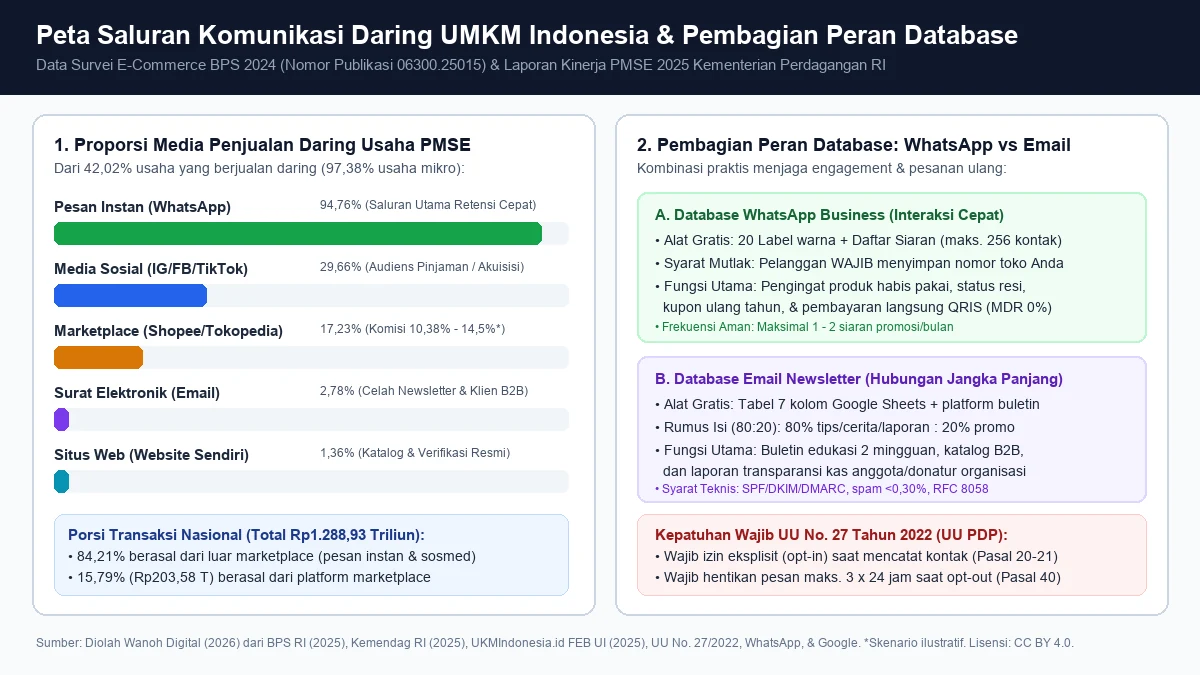
Source: Wanoh Digital (compiled from BPS RI 2025, Ministry of Trade RI 2025, UKMIndonesia.id FEB UI 2025, Law No. 27/2022, WhatsApp, & Google). License: CC BY 4.0.
As visualized in Figure 1, the low 2.78% email adoption rate does not mean newsletters are useless; rather, each channel plays a distinct role in the customer journey [1, 2, 3]. As a rule of thumb from our work mentoring SMEs and nonprofits at Wanoh Digital since 2016, split the two channels based on message intent:
- Use your WhatsApp Business database for fast-turnaround transactional messages: Highly effective for consumable retail reminders (coffee beans, rice, skincare, bottled water, or pet feed), scheduled service reminders (workshops, clinics, laundries), shipping confirmations, and direct payments using the Quick Response Code Indonesian Standard (QRIS) [3, 10, 15]. Bank Indonesia policy sets the QRIS Merchant Discount Rate (MDR) at 0% (Rp0) for Micro Enterprises on transactions up to Rp500,000 and for Small and Medium Enterprises up to Rp100,000 effective 1 October 2026, as reviewed in Indonesia's Digital Payment Transformation: From QRIS to SME AI [15].
- Use your email database (newsletters) for deeper relationships, corporate clients, and organization members: As emphasized in the 6 May 2025 UKMIndonesia.id guide, email is a personal channel for sharing behind-the-scenes stories, longer product usage guides, early-bird launch announcements, and customer satisfaction surveys without crowding their daily chat window [2]. In addition, for businesses serving corporate or institutional procurement as discussed in Website, Social Media, or Marketplace: When Does a Business Need a Website?, or foundations and cooperatives sending regular financial statements as covered in How to Create an Organization Cash Report Donors Trust, email newsletters leave a formal paper trail that recipients can easily search in their inbox [1, 2].
How can you collect and segment a customer database for free without expensive software?
As a rule of thumb for micro businesses or organizations with fewer than 500 active customers or members, you do not need to pay for Customer Relationship Management (CRM) subscriptions yet. Simply combine the free Labels feature in the WhatsApp Business app, which provides up to 20 color-coded labels to group chats on your phone, the Broadcast Lists feature holding up to 256 contacts per list, and one seven-column Google Sheets table as a backup and source for sending email newsletters [1, 2, 10, 11].
Official WhatsApp Help Center documentation explains that Labels (which are also rolled out gradually under the name Lists) let businesses create up to 20 distinct labels with different colors or names to tag chats and specific messages [11]. To keep your admin team from getting confused by too many categories, start with five primary color labels reflecting the customer relationship stage as a rule of thumb:
- Blue Label (
1-New Lead): Prospective buyers or prospective members who have asked about pricing or catalogs but have not yet transacted. - Yellow Label (
2-First-Time Buyer): Customers who have purchased once and are awaiting delivery or post-delivery satisfaction check-in. - Green Label (
3-Repeat Customer): Customers who have ordered at least twice and agreed to receive new product updates or restock reminders. - Purple Label (
4-Wholesale Client / Regular Donor): Bulk partners, institutional clients, or regular foundation donors/members who also subscribe to the email newsletter. - Red Label (
5-Do Not Contact / Opt-Out): Contacts who asked to stop receiving promotional messages and must be excluded from broadcast lists [8, 9].

Source: Melinda Pack via Unsplash / Wikimedia Commons. License: CC0 1.0.
As illustrated in the photo above, tagging labels on a phone alone is not enough because if the device breaks or the number runs into issues, customer history notes can be lost. Therefore, copy contacts who have given consent into a Google Sheets spreadsheet using the seven-column structure in Table 2 below as a rule of thumb so WhatsApp and email newsletter segmentation stays in sync [1, 2, 8, 9]:
| Database Table Column # & Name | Data Recorded | Real Entry Example (Illustrative Scenario) | Role for Retention & Compliance |
|---|---|---|---|
1. Entry Date (Join_Date) | Date the contact first granted consent | 8 November 2026 | Tracks relationship age and data retention period under Article 21 of the PDP Law [8] |
2. Preferred Name (Name) | Friendly greeting along with customer/member full name | Ms. Rina (Rina Wulandari) | Enables personal greetings at the start of WhatsApp messages and newsletters [2] |
3. WhatsApp Number (WA_Number) | Active number with country code (628...) | 6281234567890 | Target for reorder reminders and Broadcast Lists [10] |
4. Email Address (Email) | Active email address (when provided by the customer/member) | rina.wulan@contoh.id | Target for biweekly newsletter bulletins or cash reports [1, 2] |
5. Interest / Segment (Segment) | Product category purchased or membership tier | Arabica Coffee 250g (3-Week Cycle) | Key to segmentation so you never send irrelevant offers [2] |
6. Last Transaction (Last_Order) | Date of most recent purchase or contribution | 5 November 2026 | Sets timing for restock reminders or re-engaging inactive customers [2] |
7. Consent Record (OptIn_Status) | Explicit consent status & whether the store number is saved | Active - Package Warranty Form (WA & Email) | Proof of compliance with Art. 20(2) PDP Law & WA Broadcast requirements [8, 9, 10] |
When starting to send periodic messages through the Broadcast List feature in the WhatsApp Business app, many business owners complain that messages fail to reach some customers. Official WhatsApp Help Center documentation states three technical Broadcast List rules: each broadcast list holds a maximum of 256 contacts, the feature in the standard app is only supported on Android or iOS mobile devices (not supported on Web or Desktop), and only recipients who have saved your phone number in their phone address book will receive the broadcast message [10].
This means the admin's most important job is not secretly collecting thousands of numbers, but giving customers an honest reason to voluntarily save your store's official number and register their email [2, 10]. As a rule of thumb, apply these three value exchanges (lead magnets):
- Warranty and care cards inside physical packaging: Include a printed card inside the package guiding buyers to save your official WhatsApp number and fill out a short form to activate their warranty or download a product care guide (without violating marketplace rules against diverting transactions inside platform chat) [6, 10].
- Confirming the benefit of saving your number on the first order: When a buyer orders via WhatsApp for the first time, ask them to save your store number so shipping tracking updates and next month's refill coupon reminder can reach their phone [10].
- Tips bulletin or activity report signup in your bio link: Place a simple signup form in your social media bio or web page (and when inviting genuine customer reviews under How to Ask for Google Reviews Without Breaking the Rules: SME Guide) in exchange for a digital pocket guide, wholesale price list, or monthly community schedule [1, 2].
To calculate how much marketplace commission your business can save each year from repeat orders through your own database and view recommended management architecture, use the interactive calculator below:
Customer Database Economic Value Calculator & Retention Channel Advisor
Enter your customer/member contact count and average order value to estimate marketplace commission savings and view recommended WhatsApp & email database workflows (illustrative simulation).
What kind of newsletter and recurring message content do customers welcome instead of marking as spam?
Customers and members open email newsletters and WhatsApp updates when the contents help solve their problems rather than pushing sales every single day [2]. As a rule of thumb, apply an 80% useful content ratio (usage tips, behind-the-scenes stories, or activity reports) and at most 20% sales offers, sending consistently once every two weeks for email and one to two times per month for promotional WhatsApp broadcasts [1, 2].
The guide 10 Email Marketing Tips for SMEs: Building Lasting Customer Relationships published by UKMIndonesia.id on 6 May 2025 highlights that customer inboxes are already crowded with ads, so SMEs that consistently provide helpful content build more trust and stay top-of-mind [2]. Based on that guide, you can rotate five content formats across your monthly business or organization calendar [1, 2]:
- Welcome message for new customers or members: Sent once right after someone joins the database to thank them, introduce core services, and explain what updates to expect going forward [2].
- Practical tips and care guides (How-To): Tailored to what that segment bought; for example, a clothing store sharing how to wash linen without shrinking, or a healthy catering business sharing a week of school lunchbox ideas [2].
- Behind-the-scenes stories and impact reports: Share how raw ingredients are sourced from local farmers, stories from the production team, or for foundations and cooperatives, a summary of fund disbursements and field photos from the current month [2].
- Special-occasion greetings and refill reminders: Send birthday wishes or a timely check-in right when the customer's previous purchase is likely running low (such as day 25 for 30-day supply coffee or skincare), paired with a dedicated appreciation voucher [2].
- Subscriber-only early-bird offers: Give database contacts early access to new variants or limited discount quotas intentionally kept off public social media so customers feel rewarded for staying connected [2].
If you feel short on time to write a biweekly bulletin from scratch, you can use AI tools to clean up drafts in minutes following AI for SMEs: 5 Store Tasks Done in 15 Minutes. Use the ready-to-use checklist and script templates below to start reaching out this week:
Database Collection Checklist & 80:20 Newsletter Framework
Check off items you have verified below, or click Copy Checklist to share it with your team or web vendor.
What PDP Law rules and anti-ban policies must SMEs comply with?
Managing a customer or member database in Indonesia must comply with Law of the Republic of Indonesia Number 27 of 2022 on Personal Data Protection (PDP Law), which has been fully enforceable since 17 October 2024, alongside official anti-spam policies from WhatsApp and Google [8, 9, 12]. Business owners are prohibited from buying illegal contact lists, must obtain explicit consent (opt-in) before sending marketing messages, and must stop messaging within 3 x 24 hours if a customer withdraws consent [8, 9].
Many business owners assume data privacy rules only bind tech giants. In reality, Law Number 27 of 2022 applies to every individual, public body, corporation, or organization that processes personal data, and the two-year transition period since its enactment on 17 October 2022 ended on 17 October 2024 under Article 74 [8]. To keep your WhatsApp database and email newsletter operations safe from administrative sanctions under Article 57 of the PDP Law and platform account bans, follow these three legal and policy guardrails [8, 9, 12]:
- Explicit consent and transparency of purpose (Article 20 paragraph 2 point a and Article 21 paragraph 1 of the PDP Law): Processing personal data for recurring updates must rest on valid explicit consent from the data subject for a clearly stated purpose [8]. Never buy thousands of WhatsApp numbers or email addresses from data brokers online, and never scrape member numbers from external WhatsApp groups without permission [8, 9].
- Mandatory halt within 3 x 24 hours (Article 9 and Article 40 paragraphs 1 and 2 of the PDP Law): Article 9 grants customers full rights to withdraw data processing consent, and Article 40 paragraph (2) requires data controllers to stop processing no later than 3 x 24 hours after receiving the request [8]. This matches the WhatsApp Business Messaging Policy (updated 23 September 2026), which requires businesses to honor all user requests to discontinue communication, including removing the contact from send lists [9].
- Spam report rate below 0.30% and account protection: On the email channel, Google's Email Sender Guidelines require senders to keep spam report rates below 0.30% in Google Postmaster Tools and include a clear unsubscribe link [12, 13]. Meanwhile on WhatsApp Business, besides observing the 256-contact limit for opted-in Broadcast Lists [9, 10], you must enable Two-Step Verification using a six-digit Personal Identification Number (PIN) and recovery email so the store phone number holding your customer database cannot be hijacked [16, 17, 18].
Watch this short Indonesian-language guide from the official WhatsApp YouTube channel to enable Two-Step Verification protection on your store admin device:
Before your admin team sends this month's first WhatsApp broadcast or email newsletter, run through this six-point compliance checklist:
6-Point PDP Law & Anti-Ban Checklist Before Messaging Your Database
Check off items you have verified below, or click Copy Checklist to share it with your team or web vendor.
If you would like to discuss how to structure customer logging from your POS counter or marketplaces into WhatsApp Business and Google Sheets without heavy monthly software subscriptions, you can book a Free Wanoh Digital Consultation. To see examples of customer tracking systems and business sites we have built, visit Wanoh Digital website and application examples, read our guide to streamlining ad-click-to-WhatsApp flows, or discuss form setup, custom-domain email, and WhatsApp order recap automation on our Web App & Workflow System Services page.
For subscription-based businesses such as gyms, studios, or clubs that need active member tracking, daily check-in logs, canteen POS, and WhatsApp renewal reminders without monthly software rental fees, you can try our free web app Logota, already used in daily operations at Rose Gym.
Frequently asked questions
What is the minimum number of customers before an SME should start building a database on WhatsApp and Google Sheets?
SMEs should start recording a customer database from their first 10 to 20 customers rather than waiting until hundreds of buyers accumulate [1, 2]. As a rule of thumb, starting while order volume is still small makes it much easier for your admin to ask buyers to save the store's official number and tag their product interests in WhatsApp Business Labels and Google Sheets without falling behind [10, 11].
Why are my WhatsApp Business Broadcast List messages not received by some customers?
WhatsApp Broadcast List messages do not reach recipients who have not saved your business phone number in their phone address book [10]. Official WhatsApp Help Center documentation states that in addition to the 256-contact limit per broadcast list, WhatsApp only delivers broadcast messages to contacts who have saved the sender's number to protect users from spam [10].
Can a micro business without a website still send email newsletters to customers or members?
Micro businesses and communities without a website can still collect a database and send regular email newsletters [1, 2]. Given that BPS data shows only 1.36% of Indonesian online businesses have a website [3, 4], you can collect customer email addresses through a free registration form (such as Google Forms) placed in your social media bio link or sent during WhatsApp order confirmations [1, 2].
May an SME add buyer WhatsApp numbers from marketplace shipping labels into a promotional broadcast list without consent?
No. Contacting buyer phone numbers from marketplace shipping labels for promotional purposes outside order fulfillment without explicit consent violates marketplace terms of service, breaches the opt-in requirement of the WhatsApp Business Messaging Policy [9], and conflicts with Article 20 paragraph (2) point a of Law Number 27 of 2022 on Personal Data Protection [8]. The compliant approach is to include a warranty or after-sales card inside the package so buyers message your official number voluntarily.
Technical notes
This section is intended for Information Technology (IT) staff or web domain administrators sending newsletters from an official custom-domain email address (such as info@namabisnis.biz.id or buletin@namaorganisasi.or.id). Starting 1 February 2024 and continuing today, Google's Email Sender Guidelines (Gmail Email Sender Guidelines) enforce strict technical requirements on all senders delivering email to @gmail.com accounts to prevent spoofing and curb spam [12].
Note that the Domain Name System (DNS) records and email header markup below are technical deliverability prerequisites, not an automatic guarantee that every marketing email will land in the primary tab or convert into sales. Delivery success still depends on domain reputation, recipient consent, and low spam complaint rates [12, 13]:
- Sender Domain Authentication (
SPF,DKIM, andDMARC): Google requires all senders to set up Sender Policy Framework (SPF) or DomainKeys Identified Mail (DKIM), and requires bulk senders (>5,000 messages per day to Gmail accounts) to enable all three: SPF, DKIM, and Domain-based Message Authentication, Reporting, and Conformance (DMARC) with at least ap=nonepolicy plus domain alignment in theFrom:header per Internet Engineering Task Force (IETF) Request for Comments (RFC) 5322 [12, 22]. - Spam Rate Threshold Below 0.30%: Domain administrators must monitor Google Postmaster Tools and keep user-reported spam rates strictly below 0.30% [12].
- One-Click Unsubscribe Headers (per IETF RFC 8058): For subscribed and marketing messages, sending services must include a
List-Unsubscribeheader (using an HTTPS URL) paired withList-Unsubscribe-Post: List-Unsubscribe=One-Clickunder IETF RFC 8058 (Signaling One-Click Functionality for List Email Headers, January 2017) so the Gmail UI renders an Unsubscribe button directly beside the sender name [12, 13].
# 1. Sample DNS TXT Records for SPF and DMARC on a Business Domain (.biz.id / .co.id / .or.id)
namabisnis.biz.id.       IN TXT "v=spf1 include:_spf.google.com ~all"
_dmarc.namabisnis.biz.id. IN TXT "v=DMARC1; p=none; rua=mailto:dmarc-laporan@namabisnis.biz.id; adkim=r; aspf=r;"

# 2. Sample MIME Newsletter Email Headers per IETF RFC 5322 & RFC 8058
From: Official Business Bulletin <info@namabisnis.biz.id>
To: pelanggan@contoh.id
Subject: 3 Ways to Care for Your Products So They Last for Years
List-Unsubscribe: <https://example.com/?unsubscribe=pelanggan-001>
List-Unsubscribe-Post: List-Unsubscribe=One-Click
IT staff can passively verify whether the business domain's SPF and DMARC records are properly published using the following terminal commands:
# Passively inspect SPF and DMARC TXT records for the newsletter sender domain
TARGET_DOMAIN="wanohdigital.biz.id"
echo "=== Check SPF Record ==="
dig +short TXT "${TARGET_DOMAIN}" | grep -i "v=spf1"
echo "=== Check DMARC Record ==="
dig +short TXT "_dmarc.${TARGET_DOMAIN}" | grep -i "v=DMARC1"
Testing note: The DNS record and header structure examples above follow Google's Email Sender Guidelines (support.google.com/a/answer/81126) and the IETF RFC 8058 specification as of 8 November 2026 [12, 13].
Update and correction policy: All references to UKMIndonesia.id FEB UI email marketing guides, BPS 2024 E-Commerce Statistics, the Ministry of Trade RI 2025 PMSE Performance Report, Law Number 27 of 2022 on Personal Data Protection, WhatsApp Business Messaging Policy and Help Center documentation, Google Email Sender Guidelines, and IETF RFC 8058 in this article were verified as of 6 November 2026 for scheduled publication on 8 November 2026 [1, 2, 3, 4, 8, 9, 10, 12, 13]. If data protection regulations or platform technical requirements change in the future, this article will be updated with a revision date note.
References
Verified Sources & References (22 Sources)Show References
- UKMIndonesia.id (Entrepreneurship Center, Faculty of Economics and Business, Universitas Indonesia). "12 Panduan Lengkap Digital Marketing untuk Pemilik UMKM." Portal UKMIndonesia.id, 15 January 2025. https://ukmindonesia.id/baca-deskripsi-posts/12-panduan-lengkap-digital-marketing-untuk-pemilik-umkm (accessed 8 November 2026) (in Indonesian).
- Wahida, Nazmi, and Sonia Fatmarani (Editors). "10 Email Marketing untuk UMKM: Bangun Hubungan Langgeng dengan Pelanggan." Portal UKMIndonesia.id (LPEM FEB Universitas Indonesia), 6 May 2025. https://ukmindonesia.id/baca-deskripsi-posts/10-email-marketing-untuk-umkm-bangun-hubungan-langgeng-dengan-pelanggan (accessed 8 November 2026) (in Indonesian).
- Statistics Indonesia (BPS RI). "Statistik E-Commerce 2024 (Publication No. 06300.25015)." Badan Pusat Statistik, 28 November 2025. https://www.bps.go.id/id/publication/2025/11/28/647323224ecc656c2933571b/statistik-e-commerce-2024.html (accessed 8 November 2026) (in Indonesian).
- Domestic Trade Policy Center, Trade Policy Agency, Ministry of Trade of the Republic of Indonesia. "Kinerja Perdagangan Melalui Sistem Elektronik (PMSE) Indonesia Tahun 2025." Ministry of Trade RI, 20 December 2025. https://bkperdag.kemendag.go.id/unduhan-file/a11ba920-123c-4a4f-856b-cdbb1f0f64c4 (accessed 8 November 2026) (in Indonesian).
- Ministry of Trade of the Republic of Indonesia. "Peraturan Menteri Perdagangan Nomor 31 Tahun 2023 tentang Perizinan Berusaha, Periklanan, Pembinaan, dan Pengawasan Pelaku Usaha dalam Perdagangan Melalui Sistem Elektronik." JDIH Audit Board (BPK) RI, 26 September 2023. https://peraturan.bpk.go.id/Details/265202/permendag-no-31-tahun-2023 (accessed 8 November 2026) (in Indonesian).
- Shopee Indonesia. "Biaya Administrasi Penjual Non-Star, Biaya Proses Pesanan, dan Program Gratis Ongkir XTRA." Shopee Seller Education Hub, 1 May 2026. https://seller.shopee.co.id/edu/article/7187 (accessed 8 November 2026) (in Indonesian).
- Ministry of Micro, Small, and Medium Enterprises of the Republic of Indonesia. "Peraturan Menteri Usaha Mikro, Kecil, dan Menengah Nomor 3 Tahun 2026 tentang Pelindungan dan Peningkatan Daya Saing Usaha Mikro dan Usaha Kecil dalam Perdagangan Melalui Sistem Elektronik." JDIH Ministry of SMEs RI, 17 June 2026. https://jdih.umkm.go.id/ (accessed 8 November 2026) (in Indonesian).
- Government of the Republic of Indonesia. "Undang-Undang (UU) Nomor 27 Tahun 2022 tentang Pelindungan Data Pribadi." JDIH Audit Board (BPK) RI, 17 October 2022. https://peraturan.bpk.go.id/Details/229798/uu-no-27-tahun-2022 (accessed 8 November 2026) (in Indonesian).
- WhatsApp. "WhatsApp Business Messaging Policy." WhatsApp for Business, 23 September 2026. https://whatsappbusiness.com/policy/ (accessed 8 November 2026).
- WhatsApp. "How to use broadcast lists." WhatsApp Help Center, 15 February 2026. https://faq.whatsapp.com/861663048350950/?locale=id_ID (accessed 8 November 2026) (in Indonesian).
- WhatsApp. "How to use labels." WhatsApp Help Center, 15 February 2026. https://faq.whatsapp.com/3398508707096369/?locale=id_ID (accessed 8 November 2026) (in Indonesian).
- Google. "Email sender guidelines." Google Workspace / Gmail Help Center, 10 March 2026. https://support.google.com/mail/answer/81126?hl=id (accessed 8 November 2026) (in Indonesian).
- Levine, John R., and T. Herkula. "RFC 8058: Signaling One-Click Functionality for List Email Headers." Internet Engineering Task Force (IETF), 1 January 2017. https://www.rfc-editor.org/rfc/rfc8058 (accessed 8 November 2026).
- Indonesian Chamber of Commerce and Industry (Kadin Indonesia, citing Ministry of SMEs SIDT data as of 31 December 2025). "Data dan Statistik UMKM Indonesia." Kadin Indonesia, 15 January 2026. https://kadin.id/data-dan-statistik/umkm-indonesia/ (accessed 8 November 2026) (in Indonesian).
- Antara News (quoting Bank Indonesia Acting Governor Destry Damayanti and Payment System Policy Department Head Ryan Rizaldy). "BI perluas kebijakan MDR QRIS 0 persen untuk pelaku UMKM." ANTARA News Agency, 16 September 2026. https://jogja.antaranews.com/berita/848451/bi-perluas-kebijakan-mdr-qris-0-persen-untuk-pelaku-umkm (accessed 8 November 2026) (in Indonesian).
- WhatsApp. "About your business profile." WhatsApp Help Center, 10 February 2026. https://faq.whatsapp.com/577829787429875/?locale=id_ID (accessed 8 November 2026) (in Indonesian).
- WhatsApp. "About registration and two-step verification." WhatsApp Help Center, 12 February 2026. https://faq.whatsapp.com/506595211487528/?locale=id_ID (accessed 8 November 2026) (in Indonesian).
- WhatsApp. "Cara menggunakan verifikasi dua langkah di WhatsApp." Official WhatsApp YouTube Channel, 24 October 2023. https://www.youtube.com/watch?v=Ie8BSFuKxJY (accessed 8 November 2026) (in Indonesian).
- Hoppe, Florian, Willy Chang, Aadarsh Baijal, Fock Wai Hoong, and Nitin Gajria. "e-Conomy SEA 2026: Building the intelligent economy." Bain & Company, Google, and Temasek, 21 October 2026. https://www.bain.com/insights/e-conomy-sea-2026/ (accessed 8 November 2026).
- Chapekis, Athena, and Anna Lieb. "Google users are less likely to click on links when an AI summary appears in the results." Pew Research Center, 22 July 2025. https://www.pewresearch.org/short-reads/2025/07/22/google-users-are-less-likely-to-click-on-links-when-an-ai-summary-appears-in-the-results/ (accessed 8 November 2026).
- Chapekis, Athena, et al. "Investigating Click Behaviors On Google Search Result Pages That Produce an AI Overview." arXiv preprint arXiv:2608.04831, 8 August 2026. https://arxiv.org/abs/2608.04831 (accessed 8 November 2026).
- Resnick, Pete (Editor). "RFC 5322: Internet Message Format." Internet Engineering Task Force (IETF), 1 October 2008. https://www.rfc-editor.org/rfc/rfc5322 (accessed 8 November 2026).