Summary Our passive technical field audit of
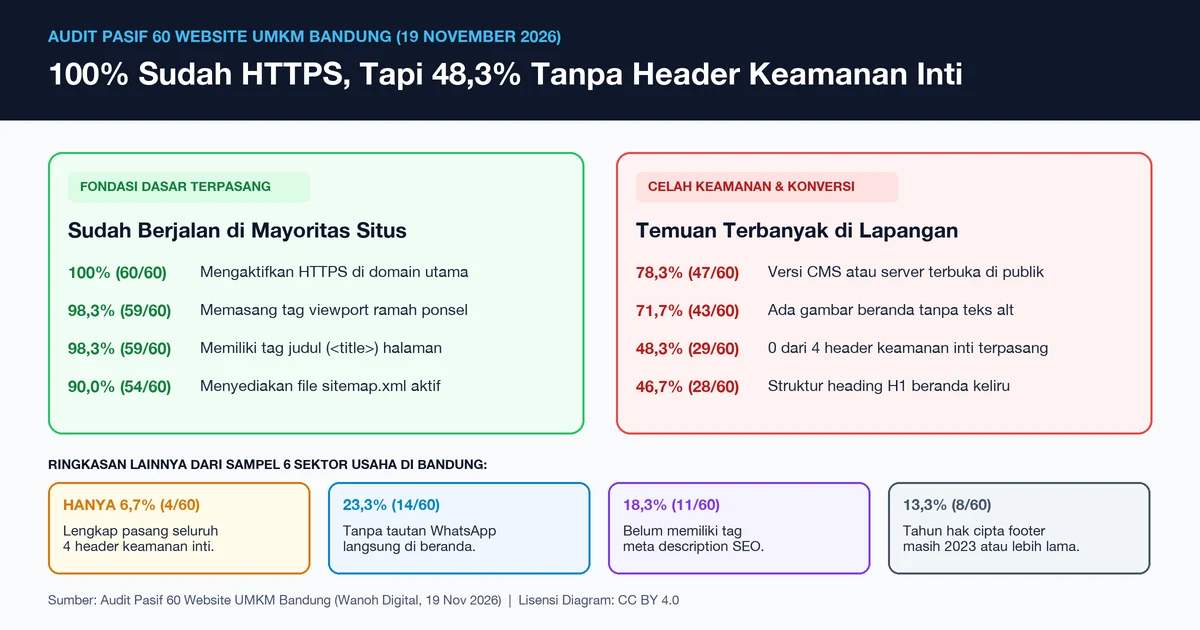
60Bandung SME websites as of the19 November 2026cutoff proves that every sampled site already serves traffic overHTTPS, yet nearly half (48.3%) lack any of the four core browser security headers [1, 10]. In addition,78.3%still expose their content management system version in public markup,46.7%have flawed primary<h1>heading structures, and23.3%omit a direct WhatsApp link on the homepage [5, 10]. Technical benchmarks in this report reference the Open Worldwide Application Security Project (OWASP) Secure Headers Project, Mozilla Developer Network (MDN) documentation, Google Search guidelines, and the officialPHPrelease lifecycle [1, 8]. This study is intended for small and medium business owners in Bandung and West Java who run an active domain and send prospective buyers to their site. One key limitation applies: samples were chosen purposively across six business sectors, and local speed timings were excluded because the auditing network showed high baseline latency, leaving Google's field metrics as the valid speed benchmark [9].
Many small business owners assume basic website security is finished once the Hypertext Transfer Protocol Secure (HTTPS) padlock appears in the browser bar. Our audit data shows 100% of the 60 sampled sites actively use HTTPS, yet nearly half (48.3%) send none of the browser protection headers such as Strict-Transport-Security (HSTS) or Content-Security-Policy (CSP) [1, 2]. Encryption via HTTPS protects data in transit, while security headers stop browsers from running injected malicious scripts or embedding your business page inside deceptive frames [3, 4].
A second misconception is believing a homepage that looks tidy on a phone screen is automatically clear to Google Search and ready to convert visitors into chats. Across the same 60 sites, 98.3% include a mobile-friendly viewport tag, yet our field findings show 71.7% contain images missing alternative text, 18.3% lack a search meta description, and 23.3% have no direct WhatsApp link on the front page. Without a clear search snippet and an instant chat button on the opening screen, prospects who click through from search results often leave before starting a conversation [6].
Table of Contents
- What is the actual state of Bandung SME websites across the 60 audited sites?
- Why do 48.3% of HTTPS-enabled SME websites still lack security headers?
- How many local websites are losing search clicks and WhatsApp inquiries?
- What are the passive audit methodology and sample limitations of this report?
- What steps can business owners check themselves in 15 minutes?
- Brief technical notes for your website maintainer
- Frequently Asked Questions (FAQ)
- References
What is the actual state of Bandung SME websites across the 60 audited sites?
Out of 66 candidate Bandung SME websites tested on 19 November 2026, 60 active sites completed the full passive audit across six sectors; most look polished on the surface, yet leave technical gaps in security headers and search-readable structure.
Based on our field notes, the six business categories represented in the 60 completed sites cover other local services such as workshops, laundries, air-conditioning repair, logistics, florists, courses, and event organizers (14 sites or 23.3%); renovation, construction, and furniture (13 sites or 21.7%); garment printing and apparel manufacturing (10 sites or 16.7%); culinary and catering (8 sites or 13.3%); rentals and travel (8 sites or 13.3%); and clinics and healthcare (7 sites or 11.7%). Meanwhile, 6 of the 66 initial candidates were excluded due to connection failures, request timeouts, or empty Hypertext Markup Language (HTML) responses on initial fetch.

Source: Photo by Bench Accounting via Wikimedia Commons / Unsplash, https://commons.wikimedia.org/wiki/File:Man_at_a_laptop_in_an_office_%28Unsplash%29.jpg. License: CC0 1.0.
On baseline technical hygiene measurable without executing browser scripts, most active domains already have the essentials in place. All 60 sites serve pages over HTTPS, only 1 site (1.7%) had a Transport Layer Security (TLS) certificate with fewer than 30 days remaining (and none under 14 days), 98.3% include both a page <title> and viewport tag, and 90.0% provide a sitemap.xml file [5].
Issues pile up in deeper configurations that owners rarely inspect at project handover. How search engines discover, crawl, and interpret those HTML files is explained concisely in this official Google video [5, 7]:
Why do 48.3% of HTTPS-enabled SME websites still lack security headers?
Exactly 29 of the 60 audited sites (48.3%) had none of the four core browser security headers (HSTS, CSP, X-Frame-Options, and X-Content-Type-Options), and only 4 sites (6.7%) implemented all four, because most run default server and Content Management System (CMS) settings without additional hardening [1, 10].
When a browser opens a web address, the server sends not only text and images, but also short instructions called Hypertext Transfer Protocol (HTTP) headers that govern security behavior on the visitor's screen [1]. The chart below shows the adoption gap across five HTTP protection headers among the 60 Bandung business sites on 19 November 2026.
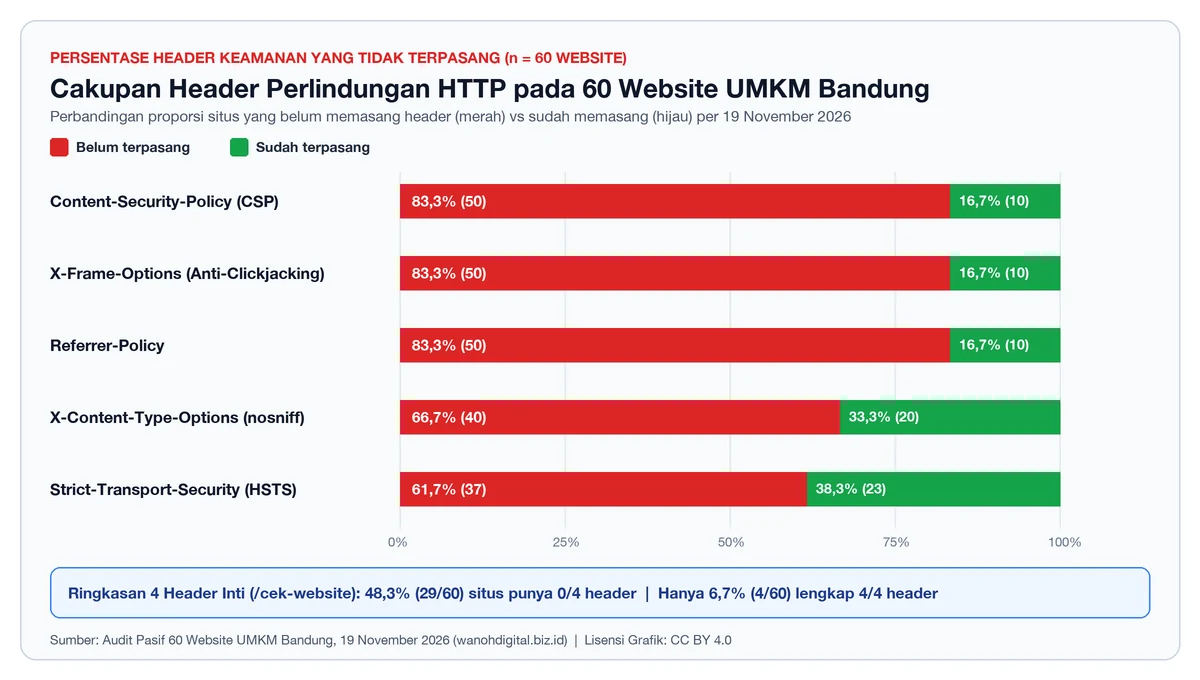
Source: Wanoh Digital (compiled from the 60 Bandung sites passive audit dataset, 19 November 2026). License: CC BY 4.0.
To help business owners distinguish which protections are active and which are missing, this table summarizes every passive security parameter and what it defends against:
| Passive Security Parameter | Missing / Flagged | Configured | Direct Impact on Business & Visitors |
|---|---|---|---|
Primary domain HTTPS protocol | 0.0% (0/60) | 100% (60/60) | Encrypts form submissions and browsing traffic in transit |
TLS certificate validity >= 30 days | 1.7% (1/60) | 98.3% (59/60) | Prevents browser security warnings caused by expired certificates |
Exposed generator tag or X-Powered-By | 78.3% (47/60) exposed | 21.7% (13/60) hidden | Hides CMS and server version details from automated vulnerability scanners |
Strict-Transport-Security (HSTS) | 61.7% (37/60) | 38.3% (23/60) | Instructs browsers to use encrypted connections only without downgrade risk [2] |
X-Content-Type-Options: nosniff | 66.7% (40/60) | 33.3% (20/60) | Stops browsers from guessing and executing image or text files as scripts [1] |
Content-Security-Policy (CSP) | 83.3% (50/60) | 16.7% (10/60) | Restricts script sources so injected third-party code cannot execute freely [3] |
X-Frame-Options / frame-ancestors | 83.3% (50/60) | 16.7% (10/60) | Blocks your site from being embedded inside deceptive frames (clickjacking) [4] |
Referrer-Policy | 83.3% (50/60) | 16.7% (10/60) | Limits page origin details sent when visitors click outbound links [1] |
Beyond missing headers, our field audit found that 78.3% (47 of 60 sites) still expose a CMS generator meta tag or X-Powered-By header in public output. Leaving software versions visible while PHP 8.2 security support officially ends on 31 December 2026 lets automated scanners filter thousands of outdated sites in seconds to target them with spam link injections or hidden ad redirects [8]. Business owners should make sure routine upkeep covers CMS engine and server patching, not just swapping promotional banners or copy.
How many local websites are losing search clicks and WhatsApp inquiries?
Nearly half of the sampled sites (46.7%) have improper primary <h1> heading structure and 23.3% omit a direct WhatsApp (WA) link on the front page, weakening both topic clarity for search engines and ease of inquiry for mobile buyers [5, 6].
For Google Search, Google Search Central documentation states that using more than one <h1> element on a page does not trigger an automatic ranking penalty because modern crawlers understand semantic hierarchy [5]. Even so, 30.0% (18/60) of Bandung sites had no <h1> tag at all and 16.7% (10/60) used multiple <h1> tags, blurring topic signals for screen readers, lightweight crawlers, and Artificial Intelligence (AI) summarizers [5]. On top of that, 18.3% (11/60) lack a meta description tag, which controls the search result snippet that convinces prospects to click [6].
| Search & Conversion Indicator | Findings Across 60 Sites | Impact on Discovery & Prospective Buyers | Fix Priority |
|---|---|---|---|
Homepage images missing alt text (at least 1) | 71.7% (43/60) | Product photos are harder for image search and screen readers to interpret [5] | Add short descriptions to key product photos |
Majority of images (>= 50%) missing alt text | 38.3% (23/60) | Weakens visual context signals across catalog pages | Fill in alt text starting with core service pages |
Flawed homepage <h1> structure (0 or > 1) | 46.7% (28/60) | Core service and target city are unclear to skimmers and AI readers [5] | Use one clear <h1> naming main service and city |
Missing meta description tag | 18.3% (11/60) | Search snippets pull random page fragments, lowering click-through rate [6] | Write a benefit-focused 120-150 character summary |
Missing robots.txt file | 13.3% (8/60) | Crawler instructions are missing at the domain root | Provide a basic robots.txt allowing search bots |
Missing sitemap.xml file | 10.0% (6/60) | New service pages or articles take longer for search engines to find [5] | Enable an automatic sitemap and submit to Search Console |
No direct WhatsApp link on homepage | 23.3% (14/60) | Mobile visitors have to copy phone numbers manually before messaging | Place a wa.me button with a clear prefilled greeting |
| No direct contact channel in initial HTML | 8.3% (5/60) | Crawlers and some visitors find no WA, phone, email, or contact form | Render main contact links directly in static homepage HTML |
Outdated footer copyright year (<= 2023) | 13.3% (8/60) | Visitors may assume the business is no longer operating | Update footer year during annual content checks |
Non-HTTPS internal links remain (http) | 6.7% (4/60) | Adds unnecessary redirect hops when navigating between pages | Switch all menu and internal button links to HTTPS |
As an illustrative scenario of overlooked conversion leakage, imagine a local renovation contractor spending Rp 1,500,000 a month on search ads at an average cost-per-click of Rp 2,500 to drive 600 homepage visits. In that illustrative scenario, if lacking a WhatsApp button on the opening screen causes 25% of mobile visitors to bounce rather than hunt for a phone number on a separate contact page, 150 clicks worth Rp 375,000 disappear every month before a single sales chat starts.
This click-to-chat leakage matches what we cover in our guide on auditing a homepage when ads get clicks but few WhatsApp inquiries. To keep your budget from going toward preventable cleanup later, compare monthly website maintenance rates and check code ownership and web agency contract terms before hiring a new maintainer.
What are the passive audit methodology and sample limitations of this report?
The audit ran on a uniform cutoff date of 19 November 2026 using a single passive HTTP GET request to each homepage (1.5 MB read cap, 15-second timeout), passive TLS certificate inspection, and checks for robots.txt and sitemap.xml without executing JavaScript, logging into admin dashboards, or running intrusive vulnerability scans [10].
To keep this report honest and prevent overstating conclusions, three methodological boundaries must be read alongside the figures:
- Purposive sample of independent domains, not a random population survey: the
60sites come from Bandung local businesses operating their own domains (.com,.id,.co.id, or.biz) across six sectors, so results do not represent SMEs selling exclusively on social media or marketplaces. All company names and domains remain confidential and appear only in aggregate. - Initial HTML inspection like a lightweight crawler: sites that inject contact numbers or
<h1>tags only via client-side scripts after load were recorded based on their initial HTML, reflecting how many non-browser crawlers and fast parsers behave. - Exclusion of local response speed timings: a control test against a Content Delivery Network (CDN) edge node from the auditing machine showed Time to First Byte (TTFB) above
1,400milliseconds due to local connection conditions during data collection, so local speed numbers were intentionally omitted to avoid bias. Accurate load performance relies on Chrome User Experience Report (CrUX) field metrics under Core Web Vitals thresholds (LCP <= 2.5s,INP <= 200ms, andCLS <= 0.1) [9].
For journalists, researchers, or community leads looking to cite the figures or download CC BY 4.0 charts with ready-to-copy attribution, full summary tables are available on the Bandung 2026 SME Website Health Research dataset page [11].
What steps can business owners check themselves in 15 minutes?
Business owners can inspect seven core elements of their company website using only a phone browser and one free passive scan without opening server access or sharing admin passwords [10].
Copy and tick the checklist below to separate light content fixes your admin can handle in a day from server configuration tasks to pass to your developer:
7-Point SME Website Self-Audit Checklist
Check off the items you have already verified below, or click Copy Checklist to send it to your team or web developer.
If you want to inspect your four security headers, Search Engine Optimization (SEO) tags, viewport setup, and signs of injected spam text right now without asking a developer first, run an instant free scan with Wanoh Digital's Free Website Check (including an optional one-page manual summary via WhatsApp, capped at 10 sites per week). If you want an initial chat or ongoing care such as Temani Website (Rp 400,000/month or Rp 4,000,000/year) after reviewing your report, see how our free consultation works on How Wanoh Digital Works or message WhatsApp +62 851 8323 1708.
Brief technical notes for your website maintainer
When your internal technical staff or web vendor resolves the missing security headers and exposed server versions flagged above, apply this baseline HTTP header block and passive verification command [1, 2]:
# Example baseline security headers on Nginx (test CSP carefully first so third-party assets are not blocked)
add_header Strict-Transport-Security "max-age=31536000; includeSubDomains" always;
add_header X-Content-Type-Options "nosniff" always;
add_header X-Frame-Options "SAMEORIGIN" always;
add_header Referrer-Policy "strict-origin-when-cross-origin" always;

# Hide Nginx version and disable PHP X-Powered-By in php.ini (expose_php = Off)
server_tokens off;
After reloading the configuration, test response headers from a terminal with curl to confirm every protection header is sent and X-Powered-By is absent without breaking page rendering:
curl -sI https://example.com/ | grep -iE "strict-transport|content-security|x-frame|x-content-type|referrer-policy|x-powered-by"Frequently Asked Questions (FAQ)
Does a website that already uses HTTPS still need additional security headers?
Yes, it does [1, 2]. HTTPS protects traffic in transit between the server and visitor, whereas security headers such as HSTS, X-Content-Type-Options, X-Frame-Options, and CSP instruct the browser not to downgrade to unencrypted connections, block fake frame embedding, and restrict which external scripts are allowed to run [3, 4].
How many Bandung SME websites have no security headers configured at all?
In our passive field audit of 60 active business websites in Bandung as of 19 November 2026, 48.3% (29 of 60 sites) had none of the four core security headers (HSTS, CSP, X-Frame-Options, and X-Content-Type-Options: nosniff). Only 6.7% (4 of 60 sites) implemented all four core headers [1, 10].
Why should CMS generator tags and PHP versions be hidden from public view?
Hiding generator meta tags and X-Powered-By headers does not patch vulnerabilities on its own, but it stops automated scanners from easily fingerprinting your site's software version [8]. With PHP 8.2 security support ending on 31 December 2026, sites advertising older versions quickly land on automated bot target lists [8].
Does having more than one H1 tag immediately hurt Google rankings?
Not automatically [5]. Google Search Central documentation notes that Google can process multiple <h1> elements without penalty as long as the page structure remains sensible [5]. Still, keeping one primary <h1> at the top of the homepage remains good practice for topic clarity among visitors, screen readers, and AI summarizers [5].
How can I check my business website's security header score without handing over admin logins?
You can use a passive checker that accepts a public Uniform Resource Locator (URL) and inspects only HTTP response headers and initial homepage HTML without asking for admin panel or server passwords [10]. That check immediately reveals HTTPS status, the four core headers, title and meta description tags, viewport settings, and signs of suspicious injected text [10].
References
Verified Sources & References (11 Sources)Show References
- Open Worldwide Application Security Project (OWASP). "OWASP Secure Headers Project." OWASP Foundation, 01 November 2026. https://owasp.org/projects/secure-headers-project (accessed 20 November 2026).
- MDN Web Docs Contributors. "Strict-Transport-Security Header." Mozilla Developer Network, 10 October 2026. https://developer.mozilla.org/en-US/docs/Web/HTTP/Reference/Headers/Strict-Transport-Security (accessed 20 November 2026).
- MDN Web Docs Contributors. "Content-Security-Policy Header." Mozilla Developer Network, 10 October 2026. https://developer.mozilla.org/en-US/docs/Web/HTTP/Reference/Headers/Content-Security-Policy (accessed 20 November 2026).
- MDN Web Docs Contributors. "X-Frame-Options Header." Mozilla Developer Network, 10 October 2026. https://developer.mozilla.org/en-US/docs/Web/HTTP/Reference/Headers/X-Frame-Options (accessed 20 November 2026).
- Google Search Central. "Search Engine Optimization (SEO) Starter Guide." Google for Developers, 15 October 2026. https://developers.google.com/search/docs/fundamentals/seo-starter-guide?hl=id (accessed 20 November 2026) (in Indonesian).
- Google Search Central. "Control Your Snippets in Search Results." Google for Developers, 15 October 2026. https://developers.google.com/search/docs/appearance/snippet?hl=id (accessed 20 November 2026) (in Indonesian).
- Google (Official YouTube Channel). "How Google Search Works (in 5 minutes)." YouTube, 10 January 2020. https://www.youtube.com/watch?v=0eKVizvYSUQ (accessed 20 November 2026).
- PHP Development Team. "PHP: Supported Versions." The PHP Group, 19 November 2026. https://www.php.net/supported-versions.php (accessed 20 November 2026).
- Walton, Philip, et al. "Web Vitals." Google web.dev, 14 May 2026. https://web.dev/articles/vitals (accessed 20 November 2026).
- Wanoh Digital. "Free Website Check: Passive Security, Speed & SEO Parameters." Wanoh Digital, 19 November 2026. https://wanohdigital.biz.id/en/cek-website (accessed 20 November 2026).
- Wanoh Digital. "Bandung 2026 60 SME Website Health Research (CC BY 4.0 Public Dataset)." Wanoh Digital, 21 November 2026. https://wanohdigital.biz.id/en/riset-umkm-bandung-2026 (accessed 21 November 2026).