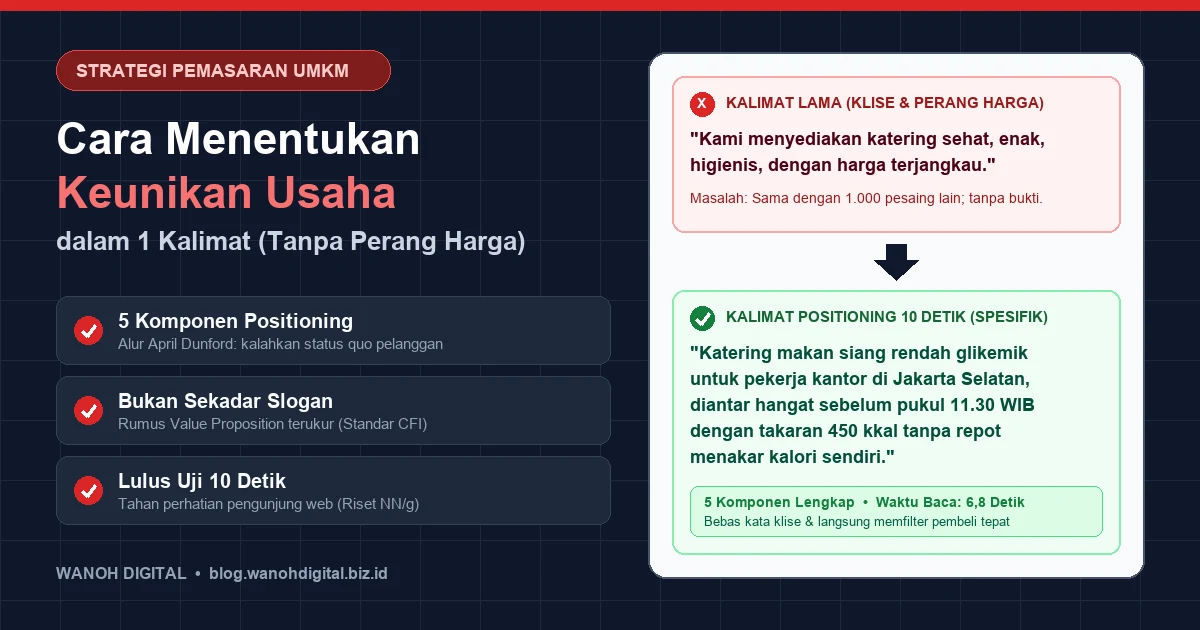
Summary Defining your business uniqueness (positioning) in a single sentence keeps your business out of price wars against similar competitors [1, 5]. Based on April Dunford's five-component framework, the Corporate Finance Institute (CFI) value proposition guide, and Nielsen Norman Group (NN/g) 10-second page-visit research, uniqueness cannot be invented from vague slogans like "top quality at friendly prices". Instead, you build it sequentially by mapping customers' old habits, your differentiating attributes, measurable value, best-fit buyer segments, and the right market category [1, 2, 3].
Finding a sharp way to define business uniqueness is one of the most urgent tasks for micro, small, and medium enterprises (SMEs) in crowded local markets. Based on Ministry of Cooperatives and SMEs data published by Indonesia's Directorate General of Taxes (DJP), there are 64.2 million SME units in Indonesia contributing 61.07% of Gross Domestic Product (GDP), or Rp 8.573,89 trillion, while employing 117 million workers (97% of the national workforce) [4]. When tens of thousands of sellers in the same city offer similar food, clothing, or services, buyers who cannot tell quality apart naturally pick the cheapest shop.
Many business owners answer "What makes your business unique?" with the same three cliches repeated by every competitor: "Quality ingredients, friendly service, and affordable prices." This guide explains why generic claims fail to win buyers, how to uncover your real edge through April Dunford's five components and Small Business Administration (SBA) competitive analysis, and how to condense it into one clear sentence that passes the first 10 seconds of customer attention [1, 2, 3, 5].
Article Contents
- Why do "good quality and affordable price" claims make your business look identical?
- What is the difference between positioning, value proposition, and a slogan?
- How do you define business uniqueness through 5 sequential components?
- What is the one-sentence uniqueness formula and examples for SMEs?
- How do you test and place your positioning sentence across digital channels?
- Common Questions About SME Positioning and Uniqueness
- References
Why do "good quality and affordable price" claims make your business look identical?
Abstract claims like "top quality at friendly prices" fail to differentiate your business because every competitor can write the same promise with zero proof a buyer can check before paying [2]. According to user-behavior research from Nielsen Norman Group, web visitors often leave a page within 10 to 20 seconds unless they see a clear value proposition in the first 10 seconds [3]. Without specific differentiation, lowest price becomes the customer's only yardstick [5].
The SBA guide on market research and competitive analysis notes that market research helps you find who your customers are, while competitive analysis makes your business unique so you build a lasting competitive advantage that drives revenue [5]. Likewise, the SBA lean business planning guide stresses choosing a clear strategic direction: either cutting cost or maximizing value (reducing cost or maximizing value) [7]. When your business fails to communicate its unique value, discounting becomes the only lever left, shrinking gross margin and breaking the rules of calculating selling price and Cost of Goods Sold (COGS) without selling at a loss [5, 7].
Why must your uniqueness fit into one sentence that reads cleanly at a glance? In empirical page-dwell research published by Nielsen Norman Group citing the Weibull distribution analysis by Chao Liu, Ryen W. White, and Susan Dumais at the Association for Computing Machinery (ACM) Special Interest Group on Information Retrieval (SIGIR), three strict digital buyer habits stood out [3]:
- 99% of web pages show a negative aging effect: Visitors arrive skeptical after seeing too many wordy pages, so their chance of closing a tab is highest in the opening seconds [3].
- Visitors read only about a quarter (25%) of the text: Average visits last under a minute, and hurried readers scan only roughly 25% of the words on screen [3].
- Harsh judgment in the first 10 seconds: Visitors decide whether a business is worth reading or worth leaving within the first 10 seconds; once a page survives seconds 10 through 30, people are much more willing to stay two minutes or longer [3].
That explains why the top line of a business website, social bio, or storefront banner cannot waste space on pleasantries like "Welcome to our store where we serve with all our heart." Per the Corporate Finance Institute definition of Value Proposition, customer value is the difference between the benefits and costs they experience [2]. Within the first 10 seconds, your sentence needs to show what concrete benefit buyers get and how your offer beats other options [2, 3].
What is the difference between positioning, value proposition, and a slogan?
Positioning is the strategic choice defining how your product stands out at delivering something a specific group of customers cares deeply about [1]. A value proposition or Unique Selling Proposition (USP) is a short statement summarizing how product benefits are delivered, experienced, and distinguished from rivals [2, 7]. Meanwhile, a slogan or tagline is merely a short ad phrase that CFI warns should never be confused with a value proposition because slogans rarely explain concrete product benefits [1, 2].
Many SME owners rack their brains for rhyming TV-style jingles before setting their basic positioning. Positioning strategist April Dunford, in A Quickstart Guide to Positioning, compares positioning to the opening scene of a movie: it tells the audience where the story takes place, who the main character is, and what mood to expect [1]. Once context is set properly, buyers quickly infer who you compete against, what features you offer, who the product serves, and what price range makes sense [1].
To keep from mixing up the three when writing marketing copy, compare their roles in the table below:
| Comparison Point | Positioning (Context Setting) | Value Proposition / Uniqueness Sentence | Brand Slogan / Tagline |
|---|---|---|---|
| Definition & Main Job | Sets the market category context, the old alternative replaced, and the buyer segment where your business wins [1]. | A brief promise (1 to 2 sentences) summarizing tangible and intangible benefits plus what sets the offer apart for target buyers without extra explanation [2, 7]. | A short phrase or emotional motto used for brand recall once the business is already recognized [1, 2]. |
| Question Answered | "What product category is this, who is it for, and what old habit does it replace?" [1, 6] | "Why should I buy from your business now instead of other options?" [2, 7] | "What mood or spirit does this brand represent?" [2] |
| Common SME Mistake (Illustrative Scenario) | Assuming the target market is "everyone who likes eating cake" [7]. | Writing "Delicious quality bread at friendly prices for families." | Putting "Five-Star Taste, Street-Cart Price" at the very top of the website without explaining the product. |
| Strong SME Example (Illustrative Scenario) | Positioning the shop as "Whole-wheat sandwich bread with zero added sugar for diabetic buyers in Surabaya." | "Low-glycemic whole-wheat bread with zero cane sugar, baked fresh every morning and delivered before 07:00 WIB." | "Worry-Free Healthy Breakfast." (Used only beside the logo, never as a replacement for explaining the offer) [2]. |
As Corporate Finance Institute emphasizes, a value proposition should never be confused with a slogan or catchphrase because slogans rarely communicate functional benefits clearly to first-time buyers [2]. For a growing SME, what belongs on the first line of your profile bio and homepage is one business uniqueness sentence combining positioning context and your value proposition [1, 2, 3].
How do you define business uniqueness through 5 sequential components?
A proven way to define business uniqueness starts not by guessing catchy lines in a meeting, but by mapping five interdependent components in order: identifying customers' competitive alternatives, isolating your differentiating attributes, translating those attributes into real customer value, narrowing down the best-fit buyer segment, and picking a market category that makes your advantage obvious [1, 6].
Across years of repositioning products from near-shutdown to tens of millions of US dollars in growth, April Dunford observed that traditional fill-in-the-blank "Positioning Statement" templates can backfire when filled straight away [1]. Why? Because fill-in-the-blank templates assume you already know the right answer for each slot, even though one product can fit different market categories and different customer segments [1].
Grounded in Jobs To Be Done thinking and SBA competitive analysis guidelines, work from the customer's viewpoint through these five sequential steps [1, 5, 6]:
1. Map Competitive Alternatives, Especially the Status Quo
Step one is not listing every similar shop online, but answering one key question: "If your business did not exist today, what would customers do to solve this problem?" [1, 6].
In Positioning and Competition, April Dunford explains that the primary competitor you have to beat is often not another business like yours, but the status quo (customers' existing habit) [6]. In B2B software deals, 20% to 30% of opportunities are lost not to rival vendors, but to "no decision", such as sticking with manual spreadsheets, paper notes, or asking an intern [1, 6].
The exact same pattern plays out for SMEs. In an illustrative home-style healthy catering business, your main alternative is rarely another diet caterer; it is office workers buying fried snacks or Padang rice downstairs, or bringing instant noodles because it is cheap and easy. Also avoid chasing phantom competitors, businesses in other cities that look similar on paper yet never appear on your buyers' shortlist [1, 6].
2. Isolate Differentiated Capabilities
Once you know customers' current habits plus the one or two direct rivals they actually compare you against, ask: "What capabilities, ingredients, technical processes, or service mechanics do we have that the alternatives in step one lack?" [1, 5].
Drawing from SBA guidance and SME operations, differentiating attributes do not require new inventions; they can come from [1, 5]:
- Ingredient specs or production process: As illustrative examples, weighed calorie portions per meal, wrinkle-resistant cotton weave, or drying shoes inside a temperature-controlled UV chamber.
- Delivery model and turnaround speed: As illustrative examples, guaranteed arrival before office lunch break, free pickup and drop-off, or 72-hour rush uniform production.
- Warranty structure and ordering convenience: As illustrative examples, a 30-day free repair guarantee on loose stitching, or daily meal pauses in one tap.
3. Translate Into Value and Proof for Customers
Customers do not buy technical specs; they buy what those specs improve in their daily life or work [1, 2]. Take each unique attribute from step two and ask the blunt question: "So what for customers?" [1].
As an illustrative scenario, "using a 38-degree-Celsius shoe-drying cabinet" is a technical attribute (step 2); the real customer value (step 3) is "your work shoes dry completely in 6 hours without the glue peeling under harsh midday sun." To back that value claim with real proof, gather authentic quotes from happy buyers using our guide on how to ask for Google Maps customer reviews without sounding pushy.
4. Narrow Down Best-Fit Target Customers
Not every buyer cares about the specific edge you built [1]. SBA business planning guidance explicitly states that "Your business won't be for everybody", so you must name your target segment specifically [7]. Step four identifies the traits of buyers who feel the urgency most acutely, decide fastest, and gladly pay a fair price [1, 5, 7].
As an illustrative scenario, someone with ten pairs of casual sneakers rarely needs a 6-hour express shoe wash; a commuter or field worker with just one main pair of work shoes needs it urgently after getting caught in the rain. The sharper you define this target group by location, job, or specific situation per SBA market research principles, the better your ads and messaging land [1, 5, 7].
5. Pick a Market Category That Makes Your Advantage Obvious
Only in the final step do you select the market category where you frame your product so its unique value jumps out to the target buyers from step four [1].
April Dunford warns of a major trap when picking a category: many founders assume they need to invent a clever new category label buyers have never heard of, yet 90% of tech companies that went public over a five-year span positioned themselves inside existing market categories rather than creating new ones from scratch [1]. Use a product category buyers already search for, then narrow the niche: turning "Database" into "Embedded Database for Mobile Devices" [1], or narrowing "Catering" into "Low-Glycemic Lunch Catering for Office Workers".
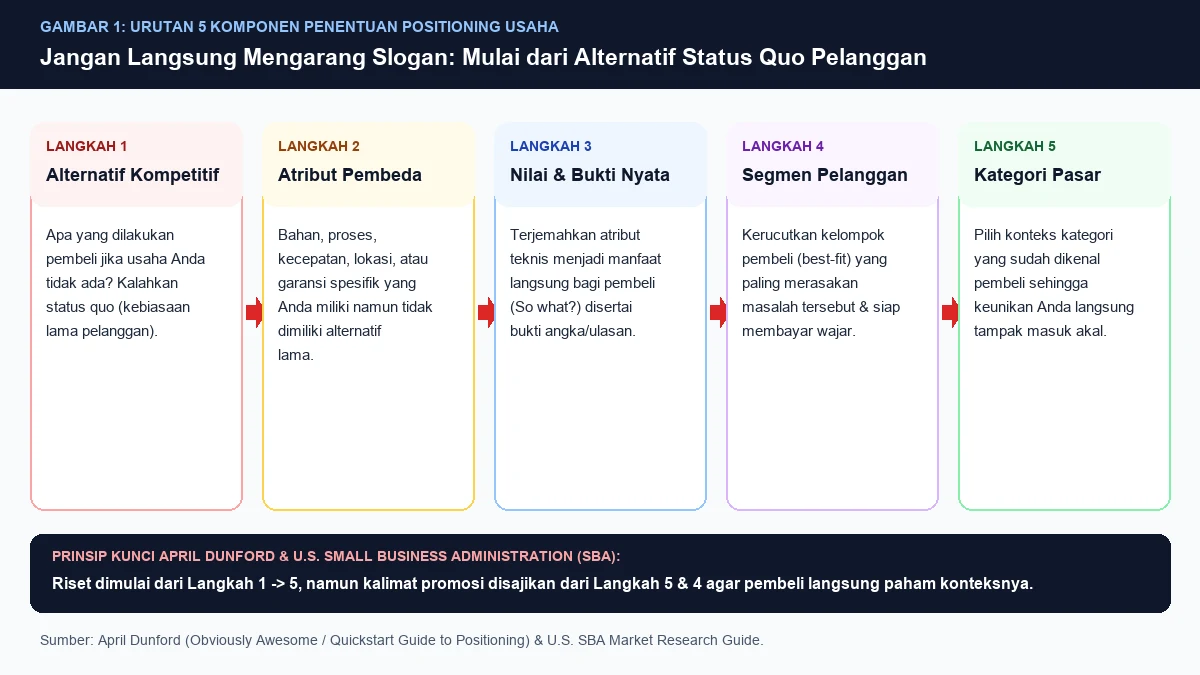
Source: Harry Agustiana, Wanoh Digital, /assets/img/blog/menentukan-keunikan-usaha-positioning/figure-1.webp. License: CC BY 4.0.
What is the one-sentence uniqueness formula and examples for SMEs?
Once all five components are mapped in sequence, combine them into one sentence using this pattern: [Business Name] is a [5. Specific Market Category] for [4. Target Customer Segment] to [3. Core Value/Benefit] via [2. Differentiating Attribute & Proof], without [1. Pain of the Status Quo Alternative] [1, 2]. This sentence packs product context, target buyer, and measurable promise so it passes the 10-second comprehension check [2, 3].
Notice that although you research from component 1 (Alternatives) toward component 5 (Market Category), when presenting to buyers you flip the order to open with Market Category and Customer Segment so the reader's brain gets an immediate anchor from second one [1, 3]. Use these two templates depending on placement:
- Formula 1 (External Sentence for Website Hero, Brochures, & Company Profiles):
[Business Name]is a[5. Specific Market Category]for[4. Target Customer Segment]so they can[3. Core Benefit]through[2. Unique Attribute & Numeric Proof], without[1. Drawback of the Old Way / Status Quo].
- Formula 2 (Short Version for Social Media Bios & Google Maps):
[5. Specific Market Category]for[4. Target Customer Segment]with[2. Unique Attribute & Numeric Proof]so you[3. Core Benefit].
To see the difference in practice, compare the before-and-after sentences across four illustrative SME sectors below:
| SME Sector (Illustrative Scenario) | Old Generic Line (Invites Price Wars) | 10-Second Positioning Line (Built from 5 Components) | Why the New Line Works Better |
|---|---|---|---|
| 1. Food / Daily Catering | "Healthy, delicious, hygienic catering at affordable prices in Jakarta." | "Dapur Sehat Senayan is a low-glycemic lunch caterer for South Jakarta office workers managing blood sugar, served warm before 11:30 WIB at 450 kcal per meal without counting calories yourself." | Names the specific category, area, verifiable delivery time (11:30 WIB), 450 kcal portion, and beats the status quo of self-tracking [1, 2]. |
| 2. Local Service / Shoe Laundry | "The top shoe cleaning service in town, clean like new." | "LangkahKilat is an express shoe wash and sterilization service for Bandung commuters that dries work shoes in 6 hours inside a 38-degree UV cabinet, without risking peeled glue from sun-drying." | Drops abstract claims, supplies 6-hour and 38-degree figures, and answers the glue-damage worry [2, 6]. |
| 3. Retail & Apparel / Workwear | "Premium women's shirts in stylish and comfortable designs." | "KarsaWastra is a nursing-friendly work shirt line for working mothers to stay neat all day without ironing, featuring a 22 cm hidden zipper and wrinkle-resistant woven cotton." | Speaks straight to the best-fit segment (working mothers) with two functional payoffs (no-iron + 22 cm nursing access) [1, 2, 7]. |
| 4. B2B Service / Uniform Maker | "Fast, cheap, high-quality office shirts and jackets." | "GardaKonveksi makes field work uniforms for logistics and construction firms in Greater Jakarta with a guaranteed 14-business-day delivery schedule and free replacement for torn seams within 30 days." | Shifts competition from unit price to 14-day schedule certainty that Business-to-Business (B2B) procurement teams care about [1, 5]. |
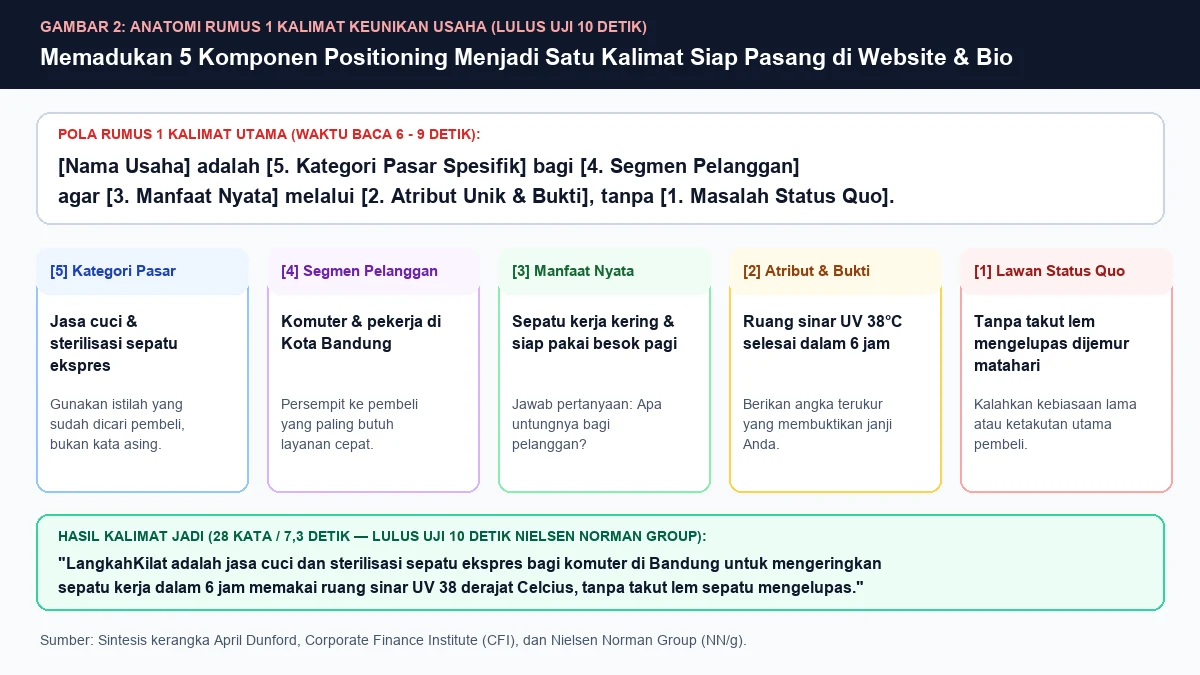
Source: Harry Agustiana, Wanoh Digital, /assets/img/blog/menentukan-keunikan-usaha-positioning/figure-2.webp. License: CC BY 4.0.
Use the interactive tool below to assemble your own positioning sentence, test whether its read time stays under 10 seconds [3], and catch cliches that need concrete proof:
SME Positioning Sentence Builder & Score Tester (10-Second Check)
Fill in April Dunford's 5 positioning components below to assemble your uniqueness sentence, check the 10-second reading limit, and catch cliche phrases.
How do you test and place your positioning sentence across digital channels?
Once assembled, your uniqueness sentence must pass three checks: under-10-second reading speed, stripping adjectives without proof, and live validation with five of your most loyal customers [1, 2, 3]. Once verified, display it prominently above the fold on your business website homepage, social media bios, Google Maps profile, and WhatsApp greeting message [2, 3].
Corporate Finance Institute points out an execution rule business owners often miss: even if you craft a sharp value proposition, if that sentence is not clearly visible across marketing materials such as your website, the effect of the proposition will be zero [2]. Place your uniqueness sentence consistently across these four touchpoints:
- Above the Fold (Hero Section) of Your Business Website
- Google Business Profile Description & Social Bios
- WhatsApp Business Automated Greeting (Greeting Message)
- One-Line Script for Cashiers & Sales Admins
Because website visitors decide whether to stay or bounce within the first 10 seconds and read only about 25% of page copy [3], make your positioning line the main headline or subheadline right above the WhatsApp button. If you are still deciding whether your business needs a dedicated web page to highlight this edge instead of relying solely on fast-buried social feeds, read our guide on when a business needs its own website and when social media is enough.
Put the short version (Formula 2 from the simulator above) in the first 150 characters of your Instagram bio, TikTok bio, and Google Maps summary so local buyers grasp your specialty and service area right away [2, 5].
Many prospects message your store WhatsApp only to ask "Price list please." Reply with your one-sentence uniqueness and guarantee proof before dropping the price table, so buyers understand the value behind your price first [2, 7].
Train every staff member to say the same uniqueness sentence whenever customers ask what makes your product different, keeping the in-store pitch aligned with what appears on your website [1, 2].
Before publishing your new line, walk through this Standard Operating Procedure (SOP) positioning audit checklist:
Checklist: 5-Component Audit & 10-Second Positioning Sentence Test
Check off the items you have verified below, or click Copy Checklist to send them to your team or website vendor.
If you have nailed a sharp uniqueness sentence yet your existing web page or digital catalog fails to communicate that edge within the first 10 seconds of a visit [3], inspect your current site via Free 24-Hour Website Check, see how Wanoh Digital builds business websites, or browse company profile and catalog websites we have delivered.
Common Questions About SME Positioning and Uniqueness
Can an SME have more than one positioning sentence if it sells many products?
At the overall store or brand level, you need one umbrella positioning sentence explaining the core reason customers shop with you [1, 2, 7]. However, if you run multiple product lines serving distinct buyer groups, Corporate Finance Institute explains that each product line can carry its own supporting value proposition on its dedicated product page as long as it never contradicts the store's main positioning [1, 2].
What if I sell identical commodity goods like water gallons, LPG canisters, or building supplies?
When the physical item itself is 100% identical to competitors, SBA and April Dunford stress building competitive advantage and differentiation from the buying experience and service mechanics that beat the shop next door's status quo [5, 6, 7]. As an illustrative scenario, a water-and-gas distributor can position itself as "Water gallon and LPG delivery for Griya Asri households with guaranteed 30-minute arrival and free dispenser hookup including second-floor carry-up."
How often should a business positioning sentence be changed or updated?
Unlike monthly promo banners, positioning is a long-term strategic anchor that should not be rewritten every week or customers will get confused [1, 2]. You only revisit positioning when a structural shift happens in your market: when a new competitive alternative changes buyer habits, when you ship a major new capability, or once you dominate an initial niche and expand into a broader category [1, 5].
References
Verified Sources & References (7 Sources)Show References
- Dunford, April. "A Quickstart Guide to Positioning." April Dunford, 15 March 2021. https://www.aprildunford.com/post/a-quickstart-guide-to-positioning (accessed 09 November 2026).
- Corporate Finance Institute. "Value Proposition: Definition, Importance, How to Create." Corporate Finance Institute, 30 June 2020. https://corporatefinanceinstitute.com/resources/management/value-proposition/ (accessed 09 November 2026).
- Nielsen, Jakob. "How Long Do Users Stay on Web Pages?" Nielsen Norman Group, 11 September 2011. https://www.nngroup.com/articles/how-long-do-users-stay-on-web-pages/ (accessed 09 November 2026).
- Coordinating Ministry for Economic Affairs of the Republic of Indonesia. "UMKM Menjadi Pilar Penting dalam Perekonomian Indonesia." Kemenko Perekonomian RI Press Release, 5 May 2021. https://ekon.go.id/publikasi/detail/2969/umkm-menjadi-pilar-penting-dalam-perekonomian-indonesia (accessed 23 November 2026) (in Indonesian).
- U.S. Small Business Administration. "Market Research and Competitive Analysis." U.S. Small Business Administration, 24 March 2026. https://legacy.sba.gov/business-guide/plan-your-business/market-research-competitive-analysis (accessed 09 November 2026).
- Dunford, April. "Positioning and Competition." April Dunford, 28 December 2020. https://www.aprildunford.com/post/positioning-and-competition (accessed 09 November 2026).
- U.S. Small Business Administration. "Plan Your Business: Write Your Business Plan (Lean Startup Format)." U.S. Small Business Administration, 28 August 2026. https://www.sba.gov/counseling/plan-your-business/ (accessed 09 November 2026).