Summary As a rule of thumb, custom web app development costs in Indonesia run between Rp 3,500,000 and Rp 10,000,000 for a simple single internal module, Rp 10,000,000 to Rp 35,000,000 for a multi-role system with payment or messaging integration, and above Rp 35,000,000 for cross-department operations. Evaluating this budget becomes pressing ahead of year-end 2026 bookkeeping under the Directorate General of Taxes (DJP) electronic Coretax administration, alongside per-user subscription hikes in commercial Software as a Service (SaaS) suites such as Microsoft 365 taking effect from 01 July 2026 [1, 7]. The threshold for switching systems refers to the 10-year data-processing record retention mandate in Minister of Finance Regulation (PMK) No. 81 of 2024, access logging rules under the Personal Data Protection Law (UU PDP) No. 27 of 2022, and spreadsheet error audits [1, 2]. This guide is written for Small and Medium Enterprise (SME) owners, agent savings coordinators, and distribution teams struggling to reconcile figures across admins and branches. One boundary remains firm: if only one or two people enter data under uniform calculation rules, free Google Forms and Google Sheets remain far cheaper without building a new system [5, 11].
Many business owners assume that once order volume picks up, they must immediately commission a custom web application worth tens of millions of rupiah just to look professional. Forcing a large build while recording workflows are still uniform only adds monthly server rental and upkeep costs to tasks that free online forms can handle cleanly [11].
The opposite misconception affects businesses that believe sticking with a single shared spreadsheet in a WhatsApp group or buying a cheap app without receiving the source code carries no hidden cost. A 35.5-year literature review by Pak-Lok Poon and colleagues in 2024 documented that defects in operational spreadsheets recur frequently and distort business decisions [3]. Consistent with that finding, Raymond R. Panko's compilation of seven field audits recorded errors in 24% of 367 inspected workbooks, rising to 91% across 54 workbooks in post-1997 audit studies, while closed-source apps leave a business stranded whenever it needs to change maintainers [4, 11].
Table of Contents
- What are typical web app development costs in Indonesia and what goes into them?
- When are free spreadsheets still enough, and what are the clear signs it is time to switch to a web app?
- How do 24-month costs compare across manual spreadsheets, SaaS subscriptions, and a custom web app?
- What source code ownership and technology clauses must you require before paying a deposit?
- What does a realistic 4 to 6 week timeline look like for building one core web app module?
- When is a free consultation enough, and when should you hire custom web app development?
- Brief technical notes for your IT lead or vendor
- Frequently Asked Questions (FAQ)
- References
What are typical web app development costs in Indonesia and what goes into them?
As a practical benchmark in Indonesia, custom web app development ranges from Rp 3,500,000 to Rp 10,000,000 for a simple internal module with a single admin role, rises to Rp 10,000,000 to Rp 35,000,000 for a multi-role system with agent approvals or payment gateway integration, and reaches Rp 35,000,000 to over Rp 100,000,000 for multi-department systems.
Those figures reflect four areas of real engineering work beyond screen layouts. The largest share usually goes toward translating business rules and approval flows into the database, followed by isolating role permissions so branch data never leaks across teams, connecting third-party services like WhatsApp notifications or invoice settlement, and configuring the server with scheduled backups [10].
Under a transparent contract structure like Wanoh Digital's, building a Sistem Kerja (Working System) starts with free workflow mapping before agreeing on a written per-module quote, an ongoing development rate of Rp 175,000 per hour, and an optional Temani Sistem (System Care) retainer starting at Rp 1,000,000 per month that includes 24-hour server alerts to Telegram and a 3-hour monthly change quota [11].
To avoid spending budget on unused features, compare the scope limits and cost implications of these four system paths:
| System Path | Upfront & Monthly Cost Range | Scope & Safe Operating Limits | Code Ownership, Tax Rules & Status |
|---|---|---|---|
| Google Form + Google Sheets | Rp 0 upfront; Rp 0 basic account subscription (rule of thumb: 1 to 2 data-entry users) | Holds up to 20 million cells or 100 MB uploads; fits single-ledger tracking [5] | Data sits in your Google account; lacks strict row-level audit logs required under Article 31 of UU PDP [2] |
| Per-User SaaS App | Starts around USD 7 to USD 14 per seat on office plans from 01 July 2026 [7], or local per-seat rental fees | Good for standard flows (generic accounting, basic retail POS); rigid for custom commission rules | System code stays with the vendor; transaction archives must be exported regularly for 10-year retention [1] |
| 1 Custom Web App Module | Practical range Rp 3,500,000 to Rp 35,000,000 one-off; server & upkeep Rp 300,000 to Rp 1,000,000/month | Targets one bottleneck (agent deposits, workshop queues, branch orders) with separate login roles [10] | Fully business-owned: domain, server, database, and unencrypted source code handed over [11] |
| Multi-Module Sistem Kerja / Mini ERP | Practical range Rp 35,000,000 to Rp 100,000,000+ in phases; managed care from Rp 1,000,000/month [11] | Connects inventory, branch billing, tiered approvals, and permanent cross-team audit logs | Fully business-owned: chosen only once the first core module proves daily adoption [11] |
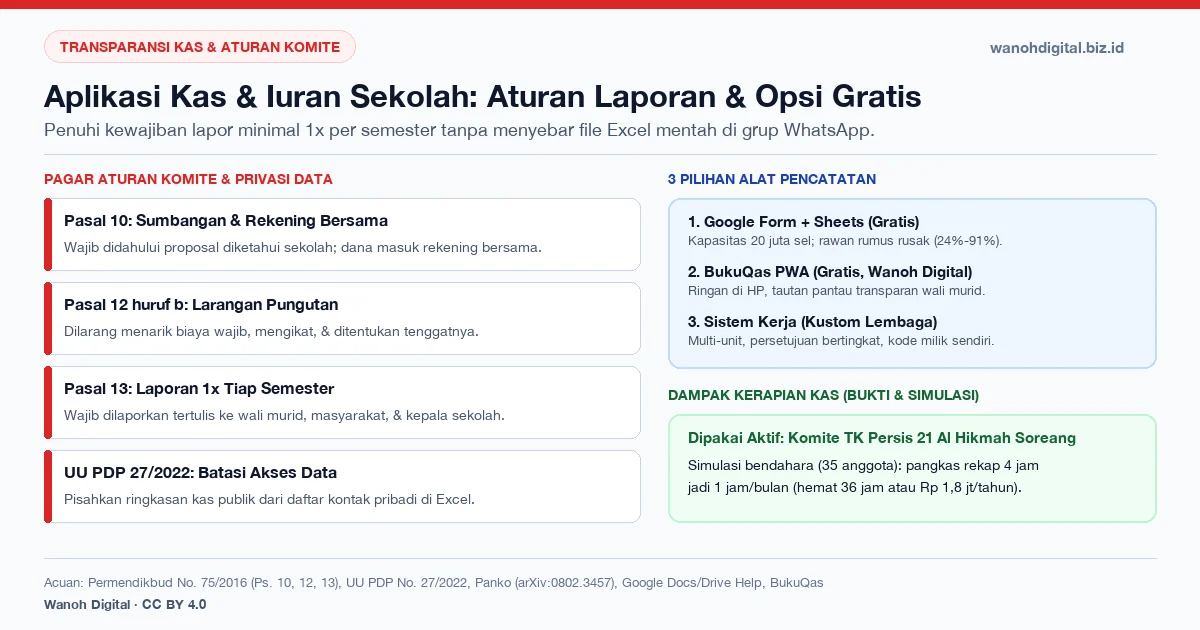
If your business or organization bookkeeping is currently handled by a single treasurer with a uniform cash flow, start by cleaning up the spreadsheet structure using our guide on how to create a transparent organization cash report. You can also compare how a standard profile site differs from a functional application in our breakdown of website costs from year one to annual upkeep.
When are free spreadsheets still enough, and what are the clear signs it is time to switch to a web app?
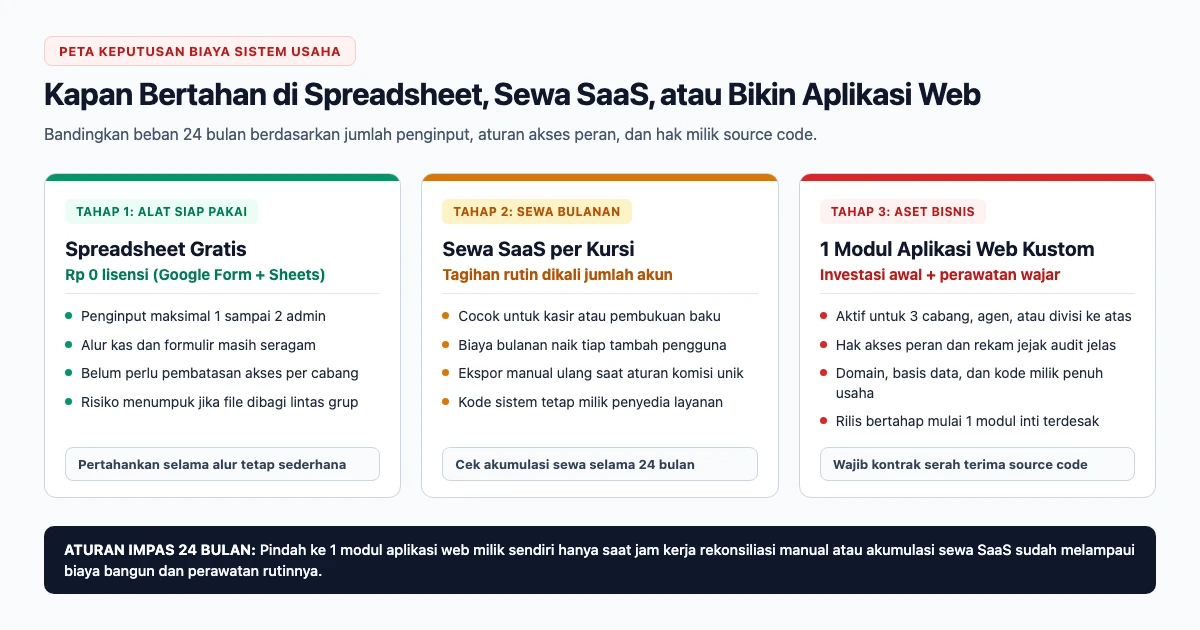
As a practical rule, free spreadsheets remain sufficient as long as no more than 2 people enter data along a single workflow without needing branch-by-branch read restrictions. A business only needs to move to a web app when two of the following five operational and legal triggers appear week after week.

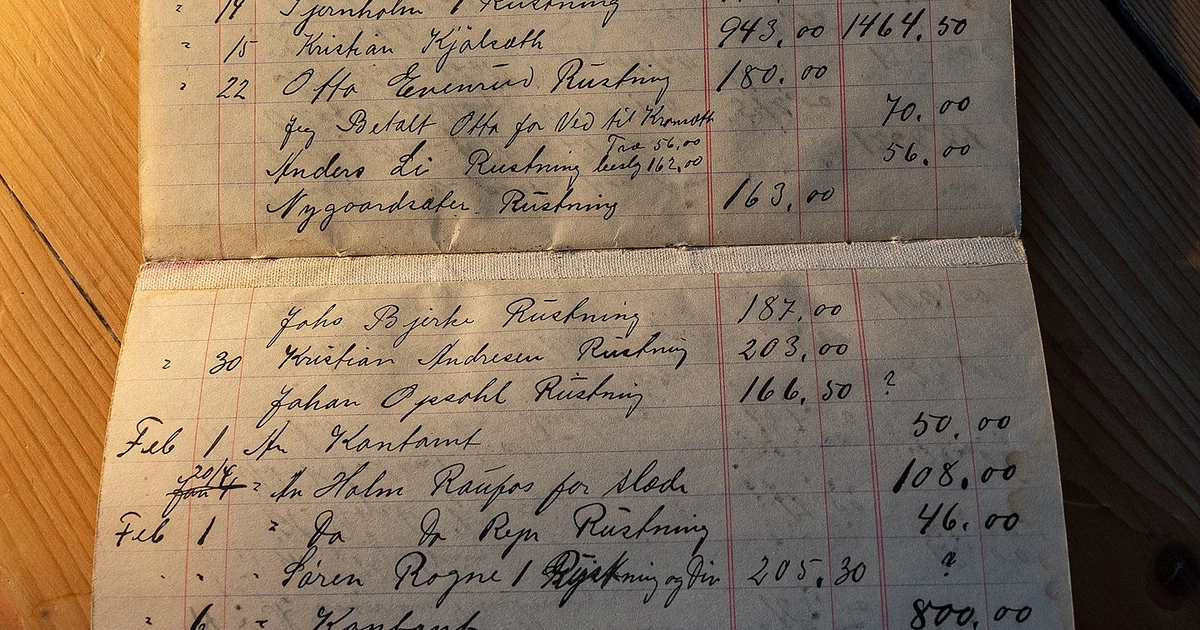
Source: Photo by Bench Accounting via Wikimedia Commons / Unsplash, https://commons.wikimedia.org/wiki/File:Ships_out_today_%28Unsplash%29.jpg. License: CC0 1.0.
Five concrete thresholds separate "just tidy up the spreadsheet" from "time to move to a web app":
- Formulas Break When Multiple Admins Edit Together: Google Sheets supports up to
20 millioncells (100 MB), while desktop Microsoft Excel handles up to1,048,576rows and16,384columns (XFD) with a32,767-character limit per cell, heavily tied to device Random Access Memory (RAM) [5, 6]. Raw file capacity rarely fails first; browser lag and overwritten formulas appear long before limits are hit. Panko's review recorded an average Cell Error Rate of1%to2%in live business spreadsheets, only kept in check through cell-by-cell auditing [4]. - One Shared Link Exposed Without Access Control: In the Open Worldwide Application Security Project (OWASP) Top 10:2025 web risk ranking, Broken Access Control sits at rank 1 [10]. Sharing a single receivables or customer sheet link so branch admins can type updates exposes all phone numbers and commission payouts to people who should only see their own entries [10].
- Mandatory Personal Data Processing Logs Under UU PDP: Law No. 27 of 2022 on Personal Data Protection requires data controllers to record all personal data processing activities under
Article 31and enforce technical safeguards against unauthorized access underArticle 35[2]. Free shared spreadsheets do not provide a tamper-resistant audit trail locking down who downloaded or altered a customer's phone number. - Year-End Tax Reconciliation and 10-Year Retention Under Coretax:
Article 460 paragraphs (1)and(2)of Minister of Finance Regulation (PMK) No. 81 of 2024 affirm that bookkeeping may be kept electronically and that all books, ledgers, and underlying data-processing records must be stored in Indonesia for10 years[1]. Hunting through WhatsApp chat history for daily transfer receipts right before tax filing multiplies reconciliation discrepancies. - Admins Spend Hours Daily Copying and Pasting: When operations staff spend every afternoon copying rows from incoming chat messages into multiple tabs just to tally ending balances or partner commissions, hidden payroll waste is already running even though spreadsheet licenses cost zero rupiah.
Watch this official guide from the Directorate General of Taxes (DJP) to see how structured the electronic financial statements are when filing a Corporate Annual Tax Return (SPT Tahunan Badan) in the Coretax portal:
While weighing whether to commission an application, organize your customer contacts and order threads first using our guide on managing an SME customer database across WhatsApp and email.
How do 24-month costs compare across manual spreadsheets, SaaS subscriptions, and a custom web app?
System costs should always be compared over at least a 24-month window as a rule of thumb, because per-user subscription fees look modest on month one yet compound every time field staff join. A custom web app carries a higher upfront build cost, but adding branch accounts on your own server adds zero per-seat fees.
Commercial platform price hikes are also a real second-year cash risk. In Microsoft 365's official commercial pricing update effective 01 July 2026 upon renewal, Business Basic list pricing increases from USD 6 to USD 7 per user per month and Business Standard rises from USD 12.50 to USD 14 per user per month [7]. Similar per-seat pricing applies across most rented accounting and Customer Relationship Management (CRM) tools.
To see the break-even math objectively, review this illustrative scenario over 24 months for an agent savings or distribution business with 12 active users (2 head-office admins and 10 collection agents):
- Path A (Stay on Free Spreadsheets): Software rental is zero, but in this illustrative scenario admins spend an average of
12 hoursa month reconciling bank transfers, WhatsApp chats, and commission formulas atRp 50,000per hour (Rp 600,000/month orRp 14,400,000over24months). Adding an assumedRp 350,000/month in manual error corrections or missed bonuses (Rp 8,400,000over24months) puts Path A's hidden cost atRp 22,800,000. - Path B (Rent Per-User SaaS Software): In this illustrative scenario, the business rents off-the-shelf software at
Rp 150,000per user per month for12active accounts (Rp 1,800,000/month orRp 43,200,000over24months). Because generic SaaS rarely supports local tiered commission rules, admins still spend4 hoursper month re-exporting data to spreadsheets atRp 200,000/month (Rp 4,800,000over24months), bringing Path B's total toRp 48,000,000with zero code ownership. - Path C (Build 1 Core Custom Web App Module): The business builds one focused module (partner registration, deposit entry, balance and commission calculation) for
Rp 15,000,000upfront in this illustrative scenario, with Virtual Private Server (VPS), domain, and basic backups aroundRp 350,000/month (Rp 8,400,000over24months). Total24-month spending comes toRp 23,400,000, savingRp 24,600,000versus per-seat SaaS with break-even reached around month 10. Even if the owner adds active care such as Temani Sistem atRp 1,000,000/month (Rp 24,000,000over24months) [11], theRp 39,000,000total still savesRp 9,000,000compared to Path B while leaving the company with a system it owns outright.
Use the open calculator below to swap in your own headcount, hourly pay rates, and real vendor quotes:
24-Month Cost Comparison Calculator: Spreadsheet vs SaaS vs Custom Web App
Enter your own operational numbers to compare 24-month total costs across staying on manual spreadsheets, renting per-user SaaS tools, and building one custom web app module you own.
Path A - Stay on Spreadsheets (24 months): Rp 22,800,000 (reconciliation Rp 14,400,000 + error fixes Rp 8,400,000)
Path B - Rent SaaS for 12 users (24 months): Rp 48,000,000 (subscriptions Rp 43,200,000 + rework Rp 4,800,000)
Path C - 1 Self-Owned Custom Web Module (24 months): Rp 23,400,000 (upfront Rp 15,000,000 + server/care Rp 8,400,000)
24-month comparison: Path C saves Rp 24,600,000 vs SaaS (break-even around month 10)
Contract & ownership checks ticked: 0 of 7 items
What source code ownership and technology clauses must you require before paying a deposit?
Before paying a deposit for web app development, make sure written terms place the domain, server access, database, and full source code inside a repository owned by your business so you are never locked into a single vendor [11]. Technical terms should also require an active Long-Term Support (LTS) framework that still receives security patches, rather than an aging release that forces a costly rewrite months after launch [8, 9].
Technically, the two safest web app ecosystems in Indonesia for future developer handoffs are Laravel (PHP) and Node.js. According to Laravel's official support schedule, security fixes for Laravel 11 ended on 12 March 2026, Laravel 12 is supported until 24 February 2027, and Laravel 13 (released 17 March 2026 on PHP 8.3 through 8.5) receives security patches until 17 March 2028 [8]. On the Node.js side, the official release working group notes that Node.js 20 reached end of life on 30 April 2026, Node.js 22 stays supported until 30 April 2027, Node.js 24 until 30 April 2028, and Node.js 26 entered Active LTS on 28 October 2026 through 30 April 2029 [9].
Keep the checklist below as a mandatory attachment before signing any work order or project proposal:
7-Point Web App Contract & Handover Checklist
Check off the items you have already verified below, or click Copy Checklist to send it to your team or web developer.
To budget for ongoing monthly upkeep once your application is handed over, see our breakdown of monthly website and system maintenance costs.
What does a realistic 4 to 6 week timeline look like for building one core web app module?
As a practical benchmark, building a healthy single core web module takes 4 to 6 weeks of staged work so owners do not burn budget on side features before daily recording runs smoothly. Scoping the build to one critical bottleneck keeps timelines tight and minimizes pushback from field staff transitioning off paper or spreadsheets.
A realistic six-week sequence breaks down into four measurable phases:
- Week 1 (
5workdays): Real Workflow Mapping & Off-the-Shelf Fit Check. The developer listens to field friction, inspects existing spreadsheets, and confirms honestly whether Google Forms and Google Sheets solve the issue or a dedicated web module is justified [11]. - Weeks 2 to 4 (
10to15workdays): Core Module & Access Control Build. Engineers implement the database schema, validated entry screens, and OWASP-aligned role separation so agents see only their own records while head-office admins view full summaries [10]. - Week 5 (
5workdays): User Acceptance Testing (UAT) with Live Numbers. Admin staff test entry flows, transaction reversals, and report exports using real operational figures before retiring old records. - Week 6 (
5workdays): Parallel Launch, Code Handover & Short Training. For the first three to five days the new system runs alongside old records to verify zero discrepancies, closing with source code repository transfer, server credentials, and a concise admin guide.
When is a free consultation enough, and when should you hire custom web app development?
A free initial consultation is the smarter move whenever you are unsure whether a problem stems from recording discipline or software limits, as shown in two real cases documented in Wanoh Digital's portfolio [11].
In the Training Institute case, administrators initially reached out on WhatsApp because student monthly payment records were scattered; after mapping the process during the Sarankan (Advise) step, a free Google Form connected straight to Google Sheets solved the issue without building a paid app [11]. By contrast, for PaketLebaranKu (paketlebaranku.id), tracking participant deposits and agent commissions across books and spreadsheets required a custom Progressive Web App (PWA), which went on to process over 500 deposits in its first month with automated Telegram alerts [11].
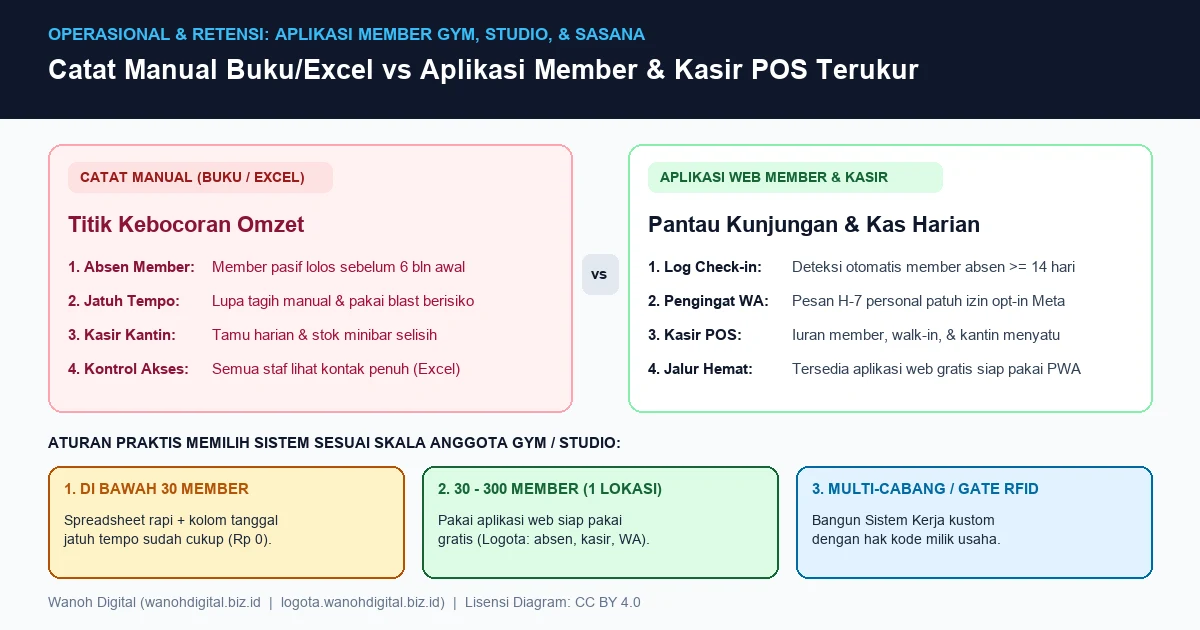
Beyond spreadsheets, membership businesses and community treasurers can also try our free ready-to-use web apps such as Logota (used in daily operations at Rose Gym) and BukuQas (actively used by Komite Orang Tua TK Persis 21 Al Hikmah Soreang) before commissioning custom software [11].
If you want to test whether your current workflow warrants a custom system or can be cleaned up with a free spreadsheet setup, review Wanoh Digital's Web App Development Service and see documented builds on our portfolio page. You can also walk us through your cash or branch workflow in a free Dengar (Listen) session via WhatsApp at +62 851 8323 1708 [11].
Brief technical notes for your IT lead or vendor
Once you appoint an internal developer or external vendor to build a business web app, share these two verification checks so the system meets electronic bookkeeping and security standards from day one:
- Append-Only Audit Trail Table: To support financial traceability and personal data processing logs under
Article 31of UU PDP andArticle 460of PMK No. 81 of 2024 [1, 2], ensure the Structured Query Language (SQL) database logs who changed what without overwriting history:
CREATE TABLE audit_logs (
  id BIGINT GENERATED ALWAYS AS IDENTITY PRIMARY KEY,
  actor_user_id BIGINT NOT NULL,
  actor_role VARCHAR(40) NOT NULL,
  action VARCHAR(32) NOT NULL,
  entity_name VARCHAR(64) NOT NULL,
  entity_id VARCHAR(64) NOT NULL,
  before_state JSONB,
  after_state JSONB,
  ip_address VARCHAR(45),
  created_at TIMESTAMP WITH TIME ZONE NOT NULL DEFAULT NOW()
);

CREATE INDEX idx_audit_entity ON audit_logs (entity_name, entity_id, created_at);- Pre-Launch Runtime & Package Security Checks: Confirm the application is not built on framework or runtime branches past official security support in 2026 [8, 9]:
# For Laravel apps (confirm Laravel >= 12/13 and PHP >= 8.3)
php -v
php artisan --version
composer audit

# For Node.js apps (use active LTS branches: v22, v24, or v26; avoid EOL v20)
node -v
npm audit --omit=dev
Frequently Asked Questions (FAQ)
Do small businesses with modest revenue already need a custom web application?
Not always. When data entry is still handled by one or two people using a uniform recording format and there is no need to restrict access per agent or branch, a free combination of Google Forms and Google Sheets is far more economical than building a web app that requires upfront development fees and monthly server maintenance [5, 11].
Why do web app development quotes vary widely from a few million to tens of millions of rupiah?
Price differences depend on the number of user roles and permission rules, the complexity of business calculations (such as tiered commissions or multi-warehouse stock), whether payment gateways or messaging notifications are integrated, and the vendor's commitment to handing over clean source code along with usage documentation [10, 11].
Who owns the source code and database once a custom web app is paid in full?
In a fair software contract for business owners, the domain registered under the company name, server and database credentials, and the complete source code repository belong entirely to the business that funded the build so future updates are never locked to a single vendor [11].
What monthly expenses should be budgeted after a web app goes live?
Beyond initial development, business owners need to budget for recurring server or hosting rental, annual domain renewal, and routine maintenance so security patches, off-server backup checks, and uptime monitoring stay consistent every month [11].
References
Verified Sources & References (12 Sources)Show References
- Ministry of Finance of the Republic of Indonesia. "Minister of Finance Regulation No. 81 of 2024 on Tax Provisions for Core Tax Administration System Implementation." Audit Board Legal Documentation and Information Network (JDIH BPK), 18 October 2024. https://peraturan.bpk.go.id/Details/306614/pmk-no-81-tahun-2024 (accessed 16 November 2026) (in Indonesian).
- Republic of Indonesia. "Law No. 27 of 2022 on Personal Data Protection." Audit Board Legal Documentation and Information Network (JDIH BPK), 17 October 2022. https://peraturan.bpk.go.id/Details/229798/uu-no-27-tahun-2022 (accessed 16 November 2026) (in Indonesian).
- Pak-Lok Poon, Man Fai Lau, Yuen Tak Yu, and Sau-Fun Tang. "Spreadsheet quality assurance: a literature review." Frontiers of Computer Science 18(2), CityUHK Scholars, 15 April 2024. https://scholars.cityu.edu.hk/en/publications/spreadsheet-quality-assurance-a-literature-review/ (accessed 16 November 2026).
- Raymond R. Panko. "Thinking Is Bad: Implications of Human Error Research for Spreadsheet Research and Practice." arXiv preprint 0802.3457, 23 February 2008. https://arxiv.org/abs/0802.3457 (accessed 16 November 2026).
- Google Drive Help. "Files you can store in Google Drive." Google Support, 01 November 2026. https://support.google.com/drive/answer/37603?hl=en (accessed 16 November 2026).
- Microsoft Support. "Excel specifications and limits." Microsoft Support, 01 November 2026. https://support.microsoft.com/en-us/excel/excel-specifications-and-limits (accessed 16 November 2026).
- Nicole Herskowitz. "Advancing Microsoft 365: New capabilities and pricing update." Microsoft 365 Blog, 04 December 2025. https://www.microsoft.com/en-us/copilot/blog/2025/12/04/advancing-microsoft-365-new-capabilities-and-pricing-update/ (accessed 16 November 2026).
- Laravel Official Documentation. "Release Notes - Support Policy." Laravel 13.x Documentation, 17 March 2026. https://laravel.com/framework/docs/13.x/releases (accessed 16 November 2026).
- Node.js Release Working Group. "Node.js Releases." Node.js Foundation, 28 October 2026. https://nodejs.org/en/about/previous-releases (accessed 16 November 2026).
- Open Worldwide Application Security Project (OWASP). "A01:2025 Broken Access Control." OWASP Top 10:2025, 24 September 2026. https://top10.owasp.org/2025/A01_2025-Broken_Access_Control/ (accessed 16 November 2026).
- Wanoh Digital. "Web App & Business System Development Services." Wanoh Digital, 16 November 2026. https://wanohdigital.biz.id/en/jasa-aplikasi-web (accessed 16 November 2026).
- Directorate General of Taxes (Official YouTube Channel). "TUTORIAL CORETAX RESMI: Panduan SPT Tahunan Wajib Pajak Badan - Sektor Manufaktur." YouTube, 02 September 2025. https://www.youtube.com/watch?v=UOM-fcSgwUU (accessed 16 November 2026) (in Indonesian).