
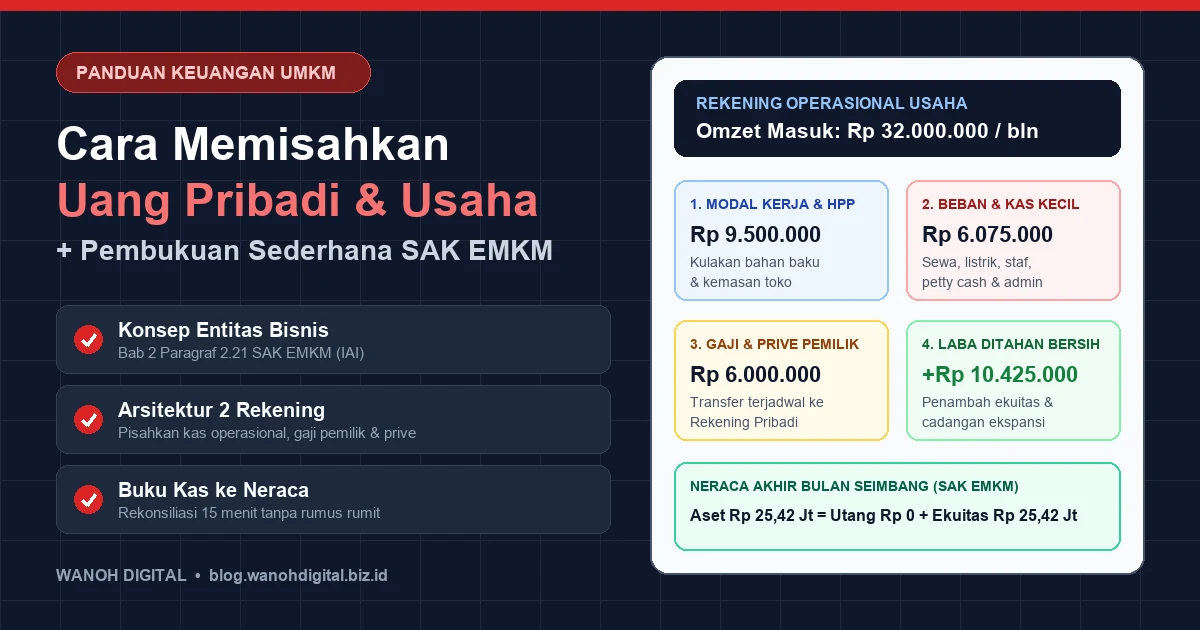
Summary Separating personal and business money requires applying the Business Entity Concept under Chapter 2 Paragraph 2.21 of the Financial Accounting Standards (SAK) for Micro, Small, and Medium Entities (EMKM) issued by the Indonesian Institute of Accountants (IAI) [1]. Start by separating your operating bank account from your household account, setting a fixed owner-manager salary schedule, logging non-salary withdrawals or taken inventory in an owner drawing account (prive) so Cost of Goods Sold (COGS) does not bloat, and keeping a categorized cash book reconciled every month-end [2, 3, 4].
Knowing how to separate personal and business money is the first rescue step for micro, small, and medium enterprise (SME) owners whose stores stay busy with buyers yet always run short on cash when it is time to restock. Based on Ministry of Cooperatives and SMEs data cited by the Directorate General of Taxes (DJP), Indonesia has 64.2 million SME units contributing 61.07% of Gross Domestic Product (GDP), or Rp 8.573,89 trillion, and employing 117 million workers (97% of the national workforce) [9]. Yet many micro businesses still mix grocery money and till cash inside a single wallet or bank account.
When sales proceeds go straight toward home electricity bills, kids' snacks, or personal vehicle installments without separate records, you can no longer tell whether your business makes a profit or eats its own working capital. This guide explains the account-separation setup, owner salary vs. prive rules, and daily bookkeeping examples anchored in IAI standards, DJP tax rules, and official small-business guidance from the Small Business Administration (SBA) and Internal Revenue Service (IRS) [1, 2, 3, 5].
Article Contents
- Why must personal and business money stay separate even if you own both?
- How do you separate personal and business money in 5 practical steps?
- What is the difference between owner salary and prive (drawing account) in SME finance?
- Do SMEs need full double-entry bookkeeping or simple cash recording?
- What do simple bookkeeping and monthly cash reconciliation look like for SMEs?
- When should SMEs move from manual notes to an integrated digital system?
- Common Questions About Business Money Separation and SME Bookkeeping
- References
Why must personal and business money stay separate even if you own both?
Mixing personal and business money creates a false cash balance illusion that tricks owners into spending restock capital as free profit. Under Chapter 2 Paragraph 2.21 of SAK EMKM issued by IAI, every business must apply the business entity concept, keeping business transactions separate from owner transactions [1]. Beyond preventing cash-flow failure, separate accounts protect personal assets in incorporated firms and prevent Income Tax (PPh) miscalculations [2, 3, 7].
Many first-time founders figure that because they own the business and run it from home, opening a second account only adds bank fees. In accounting, however, your business is an "entity" distinct from you as an individual. In SAK EMKM Chapter 2 Paragraph 2.21 page 18, IAI states that a business entity, whether a sole proprietorship, an unincorporated firm, or a legal corporation, must be clearly separable from its owner, and business transactions must be separated from the owner's personal transactions [1].
Alongside accounting standards, official SBA guidance on opening a business bank account details four structural benefits of keeping business banking separate from day one [2]:
- Legal Protection (Protection): Keeping business funds separate from personal funds supports limited personal liability protection so household assets stay shielded if a corporate entity faces a commercial dispute [2].
- Professionalism (Professionalism): Customers pay into an account in the business name, and you can delegate daily payment checks to cashiers without exposing your family's personal savings balance [2].
- Financing Readiness (Preparedness): Clean business bank records unlock working-capital credit lines or equipment financing from banks [2].
- Purchasing Power & Credit History (Purchasing Power): Clean business account statements build a measurable business credit history when negotiating supplier payment terms [2].
From an Indonesian tax standpoint, commingling accounts carries real fiscal risk. Under Government Regulation (PP) Number 20 of 2026, effective 22 April 2026 amending PP Number 55 of 2022, Individual Taxpayers (WP OP) running SMEs get a 0% PPh exemption on the first Rp 500 million of annual turnover and a 0.5% Final PPh rate above that up to Rp 4.8 billion per year with no time limit while eligible [7]. PP 20/2026 also broadens the aggregation rule combining turnover across husband, wife, and all Sole Proprietorship LLCs (Perseroan Perorangan) they establish when calculating that Rp 4.8 billion cap [7].
If you mix business and personal accounts, family savings pools, transfers from relatives, or personal loan disbursements land on the exact same statement as customer sales. Tax recordkeeping guidance in IRS Publication 583 warns that business records must identify source of receipts to separate business income from nonbusiness receipts and taxable revenue from nontaxable funds [3]. Without separate accounts and clear labels, you risk paying tax on your own personal money mistaken for sales turnover.
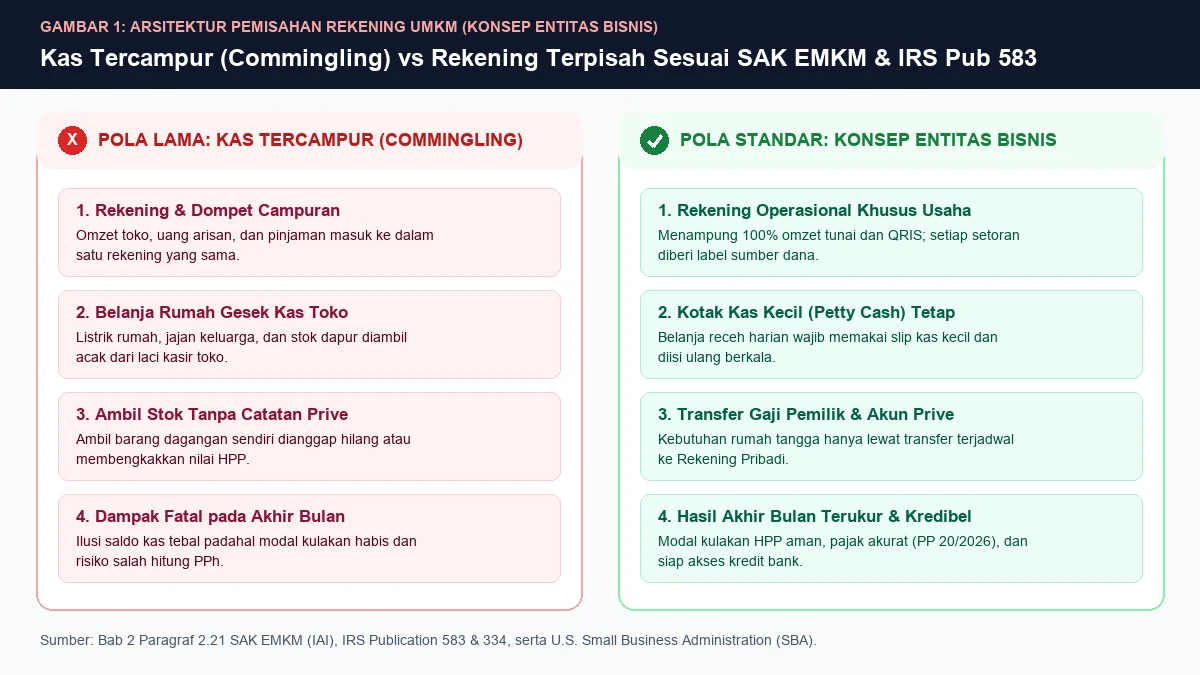
Source: Harry Agustiana, Wanoh Digital, /assets/img/blog/memisahkan-uang-pribadi-dan-uang-usaha/figure-1.webp. License: CC BY 4.0.
How do you separate personal and business money in 5 practical steps?
Separating personal and business money takes five consecutive steps: opening a dedicated operating bank account, labeling the source of every incoming deposit, banning personal spending straight from the business till, setting up a fixed-cap petty cash fund, and scheduling owner salary transfers only after setting aside restock capital [2, 3]. With this routine, your monthly bank statement doubles as the backbone of an accurate cash book [3].
You do not need to wait until your business becomes a Limited Liability Company (PT) or Limited Partnership (CV) to start separating money. If you operate as a sole proprietor, dedicating a second bank account 100% to business transactions is enough to stop cash leaks. Here are five operational steps adapted from the business checkbook workflow in IRS Publication 583 [3]:
- Open a Dedicated Operating Account & Separate QRIS Settlement
- Label the Source of Every Deposit (Identify Source of Receipts)
- Enforce a Zero Personal Swipe Rule
- Create a Fixed-Cap Petty Cash Fund
- Ring-Fence COGS Capital and Tax Reserves Before Taking Profits
Assign one dedicated bank account to hold all customer receipts and pay business bills [2, 3]. Make sure Quick Response Code Indonesian Standard (QRIS) settlements, customer bank transfers, and marketplace payouts land directly in this operating account rather than your household savings account.
Not every rupiah entering your business account is sales revenue. Following IRS Publication 583, mark the source of every deposit on transfer slips or in your cash book: Sales Revenue, Owner Capital Injection, or Third-Party Loan [3]. Clear labels stop your own bridge capital from being counted as taxable revenue.
Use the business bank account and cash drawer exclusively for business expenses [3]. Never pay household groceries, school tuition, or family dinners with the business debit card or till cash. Whenever you need cash from the business for personal living, make one formal transfer from the business account to your personal account and log it as owner salary or owner drawing (prive) [3].
For small daily cash expenses like courier parking, water gallon refills, or receipt copies, avoid grabbing bills randomly from daily sales. Use a fixed-balance petty cash fund as demonstrated in IRS Publication 583 [3]. In an illustrative scenario, you keep a Rp 500.000 petty cash cap in a locked box; every time staff spends Rp 25.000 on packing tape, the receipt and petty cash slip go into the box so remaining cash plus receipts always equals Rp 500.000, and you top the box back up to Rp 500.000 weekly or monthly.
Money coming into the business account must fund inventory turnover first before paying the owner. Set aside your restock capital using our guide on how to calculate selling price and COGS without losing money, cover fixed store bills, and reserve taxes before transferring owner pay to your household account.
What is the difference between owner salary and prive (drawing account) in SME finance?
Owner salary is fixed compensation paid because you actively work in daily operations, recorded as an operating expense on the income statement. By contrast, prive (drawing account) is taking cash or inventory beyond salary for personal use, which reduces business equity [4]. Per IRS Publication 334, personal withdrawals must be excluded from COGS and business expenses [4].
After separating accounts, the biggest question SME owners face is how to pay themselves for daily living. Many owners withdraw cash whenever their personal wallet runs empty and book it as a "business expense" to make profits look smaller, or skip recording it altogether. To keep books clean, separate the three cash flows from business to owner:
| Comparison Parameter | Manager Salary (Active Owner) | Prive (Drawing Account) | Profit Share / Retained Earnings Dividend |
|---|---|---|---|
| Operational Definition | Pay for hands-on labor when the owner cooks, serves buyers, manages stock, or runs marketing. | Cash withdrawals or store goods taken by the owner for personal or family use outside regular pay [4]. | Periodic distribution of net profit to the owner as capital provider after working-capital reserves are met. |
| Financial Statement Line | Recorded as Owner-Manager Salary Expense on the Income Statement (reduces operating net profit). | Recorded in the Prive / Owner Drawings account reducing Equity on the Balance Sheet (not a business expense) [1, 4]. | Reduces Retained Earnings / Equity on the Balance Sheet after period close [1]. |
| Schedule & Pattern | Fixed monthly date (in an illustrative scenario, every 25th or 1st of the month). | Ad hoc, capped strictly so it never drains working capital. | Quarterly, semiannual, or annual when business cash is in surplus. |
| When Taking Store Goods | Not applicable (paid via transfer to personal bank account). | Cost of goods taken must be subtracted from Purchases/COGS and charged to Prive [4]. | Not applicable (calculated from realized net cash profit). |
Pay close attention to the bottom row of that table, because that is where food stalls, grocery shops, and apparel sellers lose track of margins. When you pull rice, coffee beans, or shirts from store stock for your household, their cost is neither a business expense nor COGS of goods sold.
In IRS Publication 334 Chapter 6 (Line 36: Purchases Less Cost of Items Withdrawn for Personal Use), the rule states that when an owner withdraws merchandise for personal or family use, the owner must subtract the cost of those items from total purchases by crediting purchases and charging the amount to the drawing account (withdrawals account / prive) [4]. Leaving personal withdrawals inside purchases artificially inflates COGS and makes your store's gross profit look lower than reality [4].
What is a healthy owner salary for a young business? As a rule of thumb, set monthly manager pay to match basic household living costs or local store-manager wages in your city (in an illustrative scenario, Rp 4.000.000 to Rp 6.000.000 per month for a small shop turning over Rp 35.000.000 monthly). As a rule of thumb, hold off on raising personal lifestyle draws until business operating cash holds at least three months of fixed store costs.
Do SMEs need full double-entry bookkeeping or simple cash recording?
Not every SME has to run complex double-entry accounting from day one. Under Article 14 of the Income Tax Law in conjunction with the Tax Regulation Harmonization Law, Individual SME Taxpayers with gross annual turnover below Rp 4.8 billion are allowed to keep simple cash records instead of full double-entry books [5]. Still, to track net worth and qualify for bank loans, preparing the three minimum SAK EMKM statements is strongly recommended [6].
To keep accounting jargon from getting in your way, compare single-entry recording and double-entry bookkeeping as laid out in IRS Publication 583 and DJP tax rules [3, 5]:
- Single-Entry Bookkeeping
- Double-Entry Bookkeeping
Per IRS Publication 583, single-entry is the simplest approach focused on profit and loss, tracking cash inflows and outflows through two core records: a daily summary of cash receipts and monthly summaries of cash receipts and disbursements [3]. In Indonesia, under Law Number 7 of 2021 on Harmonization of Tax Regulations, individual business owners below Rp 4.8 billion annual turnover only need this gross-receipts recording, whether using the 0.5% Final PPh rate or calculating tax via Net Income Calculation Norms (NPPN) provided they notify DJP within the first 3 months of the tax year on their Annual Tax Return (SPT) [5].
Double-entry bookkeeping uses journals and ledgers recording every transaction on two sides (debit on the left, credit on the right) for built-in self-balancing verification [3]. It tracks not only revenue and expenses, but also assets, liabilities, and equity continuously [3]. In Indonesia, full bookkeeping is mandatory for taxpayers with Rp 4.8 billion or more in annual turnover, individual taxpayers who do not elect NPPN, and corporate entities like CVs or PTs [5, 7].
Even if tax rules let your micro business record turnover only, tracking cash in alone leaves you blind to stock on hand, unpaid customer receivables, and supplier bills owed. That is why IAI published a streamlined standard tailored for SMEs: SAK EMKM.
Under SAK EMKM Chapter 3 Paragraph 3.9 page 20, minimum SME financial statements skip complex cash-flow statements and require just 3 core components [6]:
- Statement of Financial Position (Balance Sheet) at Period End: Shows assets (cash, receivables, inventory, fixed assets), liabilities (payables, bank loans), and equity (owner capital plus retained earnings minus prive) at close [1, 6].
- Income Statement for the Period: Shows total revenue minus business expenses (including COGS, operating costs, and taxes) to reveal monthly or annual net profit or loss [1, 6].
- Notes to Financial Statements (CaLK): States compliance with SAK EMKM, summarizes accounting policies, and lists key breakdowns (such as receivables balances or loan schedules) [6].
When preparing these three statements, SAK EMKM Chapter 2 Paragraphs 2.16 and 2.19 page 17 establish historical cost (actual cash paid or received at transaction time) as the measurement basis and the accrual basis for recognizing items [8]. Better yet, you can run a Categorized Daily Cash Book (single-entry with categories) each day, then spend fifteen minutes at month-end adding remaining stock, receivables, and payables to produce SAK EMKM-compliant reports [3, 6].
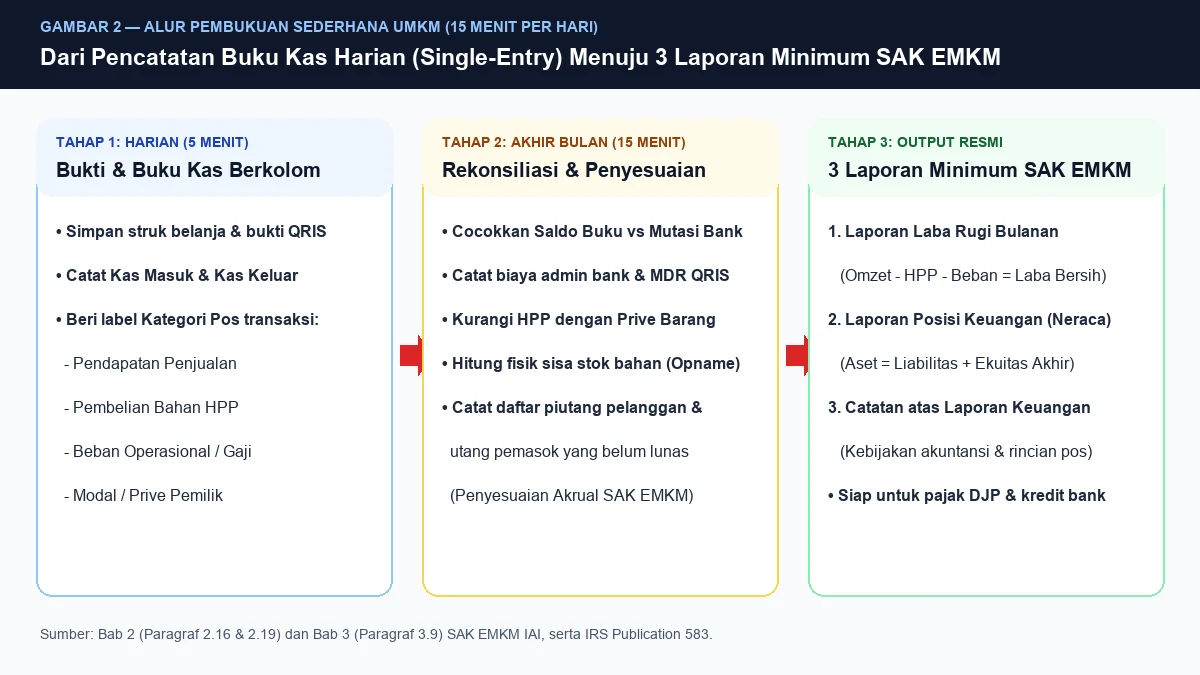
Source: Harry Agustiana, Wanoh Digital, /assets/img/blog/memisahkan-uang-pribadi-dan-uang-usaha/figure-2.webp. License: CC BY 4.0.
What do simple bookkeeping and monthly cash reconciliation look like for SMEs?
Simple SME bookkeeping works with three linked tables: a Categorized Cash In and Out Book, a Monthly Income Statement and Balance Sheet Summary, and a Bank Reconciliation Sheet [3, 6]. At every month-end, you match your cash book's ending balance against your bank statement, accounting for bank admin fees, Merchant Discount Rate (MDR) deductions, and deposits still awaiting settlement [3].
To see how this works in real numbers, walk through an illustrative November scenario for "Kedai Kopi & Roastery Senja" (a sole proprietorship owned by Raka). In this illustrative scenario, at the start of the month Raka opens a dedicated business bank account, deposits Rp 15.000.000 in initial working capital, and sets aside a Rp 500.000 petty cash box.
1. Sample Categorized Cash In and Out Book (Illustrative Scenario)
Instead of listing cash inflows and outflows in one ungrouped column, Raka adds a Category column modeled on the check disbursements journal in IRS Publication 583 [3]. That single column saves hours of sorting receipts at month-end:
| Date | Transaction Description & Receipt (Illustrative Scenario) | Category | Cash In (Rp) | Cash Out (Rp) | Book Bank & Cash Balance (Rp) |
|---|---|---|---|---|---|
| 01 Nov | Raka's initial capital deposit into the business account | Owner Capital (Equity) | 15.000.000 | 0 | 15.000.000 |
| 02 Nov | Purchase of green coffee beans, fresh milk, & packaging cups | COGS Materials Purchase | 0 | 11.500.000 | 3.500.000 |
| 10 Nov | Weeks 1-2 sales summary (Cash & QRIS settlements) | Sales Revenue | 14.200.000 | 0 | 17.700.000 |
| 15 Nov | Monthly shop rent, electricity, internet, & water bills | Fixed Operating Expense | 0 | 3.200.000 | 14.500.000 |
| 20 Nov | 5 kg ground coffee taken by Raka for a family event (at cost) | Goods Prive (COGS Adjustment) | 0 | 0 (Non-cash Adj. Rp 300.000) | 14.500.000 |
| 25 Nov | Weeks 3-4 sales summary (Cash & QRIS settlements) | Sales Revenue | 17.800.000 | 0 | 32.300.000 |
| 26 Nov | Part-time barista wages & owner-manager salary (Raka) | Salary Expense (Rp 2.500.000 + Rp 4.500.000) | 0 | 7.000.000 | 25.300.000 |
| 28 Nov | Extra personal transfer to Raka for urgent household needs | Cash Prive (Equity Reduction) | 0 | 1.200.000 | 24.100.000 |
| 30 Nov | Petty cash replenishment (parking, water gallons, dish soap) | Operating Expense (Petty Cash) | 0 | 350.000 | 23.750.000 |
| 30 Nov | Monthly bank admin fee & account charges | Bank Admin Expense | 0 | 25.000 | 23.725.000 |
Look closely at the 20 November entry in this illustrative scenario: when Raka takes 5 kg of ground coffee worth Rp 300.000 at cost for a family event, zero cash leaves the bank, yet per IRS Publication 334 Chapter 6 that Rp 300.000 must be subtracted from COGS material purchases (bringing customer-bound purchases to Rp 11.200.000) and added to Raka's total Prive of Rp 1.500.000 (Rp 1.200.000 cash plus Rp 300.000 goods) [4].
2. Monthly Income Statement & Balance Sheet Summary (Illustrative Scenario)
On the evening of 30 November in this illustrative scenario, Raka counts remaining inventory and finds Rp 1.700.000 of unused coffee beans and cups, with zero unpaid supplier bills. Because Raka's cumulative annual turnover remains below Rp 500 million, under PP 20/2026 his Final PPh for the month is Rp 0 [7]. From the cash book above, Raka puts together a clean SAK EMKM financial summary [6]:
- November COGS Calculation (Illustrative Scenario): Beginning Inventory Rp 0 plus Net Purchases Rp 11.200.000 (after subtracting Goods Prive of Rp 300.000) minus Ending Inventory Rp 1.700.000 yields net COGS of Rp 9.500.000 [4, 6].
- November Income Statement (Illustrative Scenario):
- Total Sales Revenue in the illustrative scenario: Rp 32.000.000 (Rp 14.200.000 plus Rp 17.800.000).
- Less Materials & Packaging COGS in the illustrative scenario: Rp 9.500.000.
- Gross Profit in the illustrative scenario: Rp 22.500.000 (70.31% gross margin).
- Less Operating Expenses in the illustrative scenario: Rent & Utilities (Rp 3.200.000) plus Barista & Owner-Manager Salaries (Rp 7.000.000) plus Petty Cash (Rp 350.000) plus Bank Admin (Rp 25.000) totals Rp 10.575.000.
- November Net Business Profit in the illustrative scenario: Rp 11.925.000.
- Statement of Financial Position (Balance Sheet) as of 30 November (Illustrative Scenario):
- Total Assets in the illustrative scenario: Cash & Bank Balance (Rp 23.725.000) plus Ending Raw-Material Inventory (Rp 1.700.000) equals Rp 25.425.000.
- Total Liabilities (Debt) in the illustrative scenario: Rp 0.
- Total Equity (Net Worth) in the illustrative scenario: Initial Capital (Rp 15.000.000) plus Net Profit (Rp 11.925.000) minus Total Cash & Goods Prive (Rp 1.500.000) equals Rp 25.425.000 (Balanced: Assets = Liabilities + Equity) [1, 6].
Notice how clear Raka's financial picture becomes once personal and business funds are separated: even though the bank holds Rp 23.725.000 in cash, Raka knows exactly that monthly net profit was Rp 11.925.000 while the rest is working capital needed for next month's cycle.
3. Monthly Bank Reconciliation Formula
The last step every month-end is matching your cash book balance against your bank statement (reconciling the checking account) per IRS Publication 583 [3]. Differences between your books and the bank statement usually stem from three items: automatic bank fees or QRIS MDR deductions, late-month sales awaiting settlement the next day, or data-entry typos in the cash book [3]. Use this reconciliation formula:
$Ending Cash Book Balance = Bank Statement Balance + Unsettled Deposits - Unrecorded Bank/MDR Fees$
Test your own business cash allocation, safe owner salary and prive limits, and bank reconciliation check using the interactive simulator below:
Business Cash Allocation, Owner Salary & Monthly Reconciliation Simulator
Separate COGS working capital, manager salary, and prive (cash or goods) and test whether your cash book matches your bank statement.
1. Monthly Inflows, COGS & Business Expenses
2. Owner Pay (Salary vs Prive) & Bank Reconciliation
4. Ready-to-Copy Account Separation & Monthly Reconciliation Checklist
Run through this Standard Operating Procedure (SOP) checklist at every month-end closing:
Checklist: Cash Separation Discipline & Month-End Reconciliation
Check off the items you have verified below, or click Copy Checklist to send them to your team or website vendor.
When should SMEs move from manual notes to an integrated digital system?
SMEs should upgrade from paper notebooks or manual spreadsheets to digital systems once daily volume passes twenty to thirty receipts, involves rotating cashiers, or takes orders across multiple online channels. Connecting order catalogs with payment tracking lowers cash discrepancies while building bankable financial records [2, 3].
Early on at five to ten transactions a day, updating a categorized cash book in Google Sheets every evening before closing is plenty [3]. As orders and SKUs grow, manual tracking hits three breaking points:
- Missed Orders During Peak Hours: Cashiers forget to log chat orders while serving walk-in buyers, leaving physical cash short compared with used stock.
- Untracked Customer Receivables: In catering, garment production, or shuttle services using deposits (down payment), paper notes easily miss remaining final-payment reminders.
- Out-of-Sync Price Lists and COGS: When supplier costs climb and you raise shelf prices, staff still quote old prices in chat threads, eroding gross margin.
Once your business reaches this stage, organizing digital operations becomes just as critical as organizing bank accounts. An official website displaying live pricing, structured order forms, and business-named payment instructions builds the professionalism SBA highlights [2].
Before committing to multiple POS subscriptions or building your own site, check how tech costs fit healthy fixed-overhead budgets in our SME website cost breakdown. If you want help designing a product catalog site, deposit-and-agent tracking workflow, or clean company profile without bloated monthly fees, review how Wanoh Digital works and see client web apps and websites on our portfolio page. For community dues books or simple daily membership and cashier ledgers with no subscription fees, you can also try our free web apps BukuQas and Logota.
Common Questions About Business Money Separation and SME Bookkeeping
What if sales are slow and business cash cannot cover the owner's salary this month?
Do not force a full salary transfer that drains next month's COGS restock capital. Record the unpaid portion of manager pay as Salary Payable to Owner under business liabilities to settle once cash returns to surplus, or pair a smaller base pay with quarterly net-profit sharing. That keeps your income statement reflecting true labor cost without starving raw-material turnover.
How do you record personal cash used in an emergency to cover business supply purchases?
Whenever you must cover stock or store bills with personal money in an emergency, save the receipt and never leave the transaction unrecorded [3]. You have two clean bookkeeping options: either run a reimbursement transferring the exact receipt amount from the business account to your personal account and logging it as material purchases or operating expense, or, if you do not plan to pay yourself back, book it under Equity as Additional Owner Paid-In Capital [1, 3].
Do I need a corporate bank account, or can I use a second bank account in my own name?
For a new sole proprietorship, opening a second personal savings account dedicated 100% to business transactions is enough to apply the business entity concept and stop fund commingling [1, 3]. However, once you register a legal entity such as a Perseroan Perorangan or PT for limited liability protection and tax treatment under PP Number 20 of 2026, you must open an official corporate bank account under that entity's legal name [2, 7].
References
Verified Sources & References (9 Sources)Show References
- Indonesian Institute of Accountants (IAI). "Standar Akuntansi Keuangan Entitas Mikro, Kecil, dan Menengah (SAK EMKM): Bab 2 Konsep dan Prinsip Pervasif (Paragraf 2.20-2.21)." Ikatan Akuntan Indonesia, 01 January 2018. https://www.iaiglobal.or.id/v03/files/file_sak/emkm/files/basic-html/page18.html (accessed 09 November 2026) (in Indonesian).
- U.S. Small Business Administration. "Launch Your Business: Open a Business Bank Account." U.S. Small Business Administration, 28 August 2026. https://www.sba.gov/counseling/launch-your-business/ (accessed 09 November 2026).
- Internal Revenue Service. "Publication 583 (12/2024), Starting a Business and Keeping Records." U.S. Department of the Treasury, 15 December 2024. https://www.irs.gov/publications/p583 (accessed 09 November 2026).
- Internal Revenue Service. "Publication 334 (2025), Tax Guide for Small Business: Chapter 6 How To Figure Cost of Goods Sold." U.S. Department of the Treasury, 15 January 2026. https://www.irs.gov/publications/p334 (accessed 09 November 2026).
- Government of the Republic of Indonesia. "Undang-Undang (UU) Nomor 7 Tahun 2021 tentang Harmonisasi Peraturan Perpajakan." Peraturan.go.id (JDIH Kemenkumham RI), 29 October 2021. https://peraturan.go.id/id/uu-no-7-tahun-2021 (accessed 23 November 2026) (in Indonesian).
- Indonesian Institute of Accountants (IAI). "Standar Akuntansi Keuangan Entitas Mikro, Kecil, dan Menengah (SAK EMKM): Bab 3 Penyajian Laporan Keuangan (Paragraf 3.9)." Ikatan Akuntan Indonesia, 01 January 2018. https://www.iaiglobal.or.id/v03/files/file_sak/emkm/files/basic-html/page20.html (accessed 09 November 2026) (in Indonesian).
- Government of the Republic of Indonesia. "Peraturan Pemerintah (PP) Nomor 20 Tahun 2026 tentang Perubahan atas Peraturan Pemerintah Nomor 55 Tahun 2022 tentang Penyesuaian Pengaturan di Bidang Pajak Penghasilan." Peraturan.go.id (JDIH Kemenkumham RI), 22 April 2026. https://peraturan.go.id/id/pp-no-20-tahun-2026 (accessed 23 November 2026) (in Indonesian).
- Indonesian Institute of Accountants (IAI). "Standar Akuntansi Keuangan Entitas Mikro, Kecil, dan Menengah (SAK EMKM): Bab 2 Konsep dan Prinsip Pervasif (Paragraf 2.16 dan 2.19)." Ikatan Akuntan Indonesia, 01 January 2018. https://www.iaiglobal.or.id/v03/files/file_sak/emkm/files/basic-html/page17.html (accessed 09 November 2026) (in Indonesian).
- Coordinating Ministry for Economic Affairs of the Republic of Indonesia. "UMKM Menjadi Pilar Penting dalam Perekonomian Indonesia." Kemenko Perekonomian RI Press Release, 5 May 2021. https://ekon.go.id/publikasi/detail/2969/umkm-menjadi-pilar-penting-dalam-perekonomian-indonesia (accessed 23 November 2026) (in Indonesian).